
TPO single-ply · Houston
TPO Roofing in Houston, TX
White, reflective, heat-welded and by a distance the most common commercial roof going onto Houston buildings. Which is fine, as long as somebody specifies it properly and welds it properly, and those are two separate failure modes.
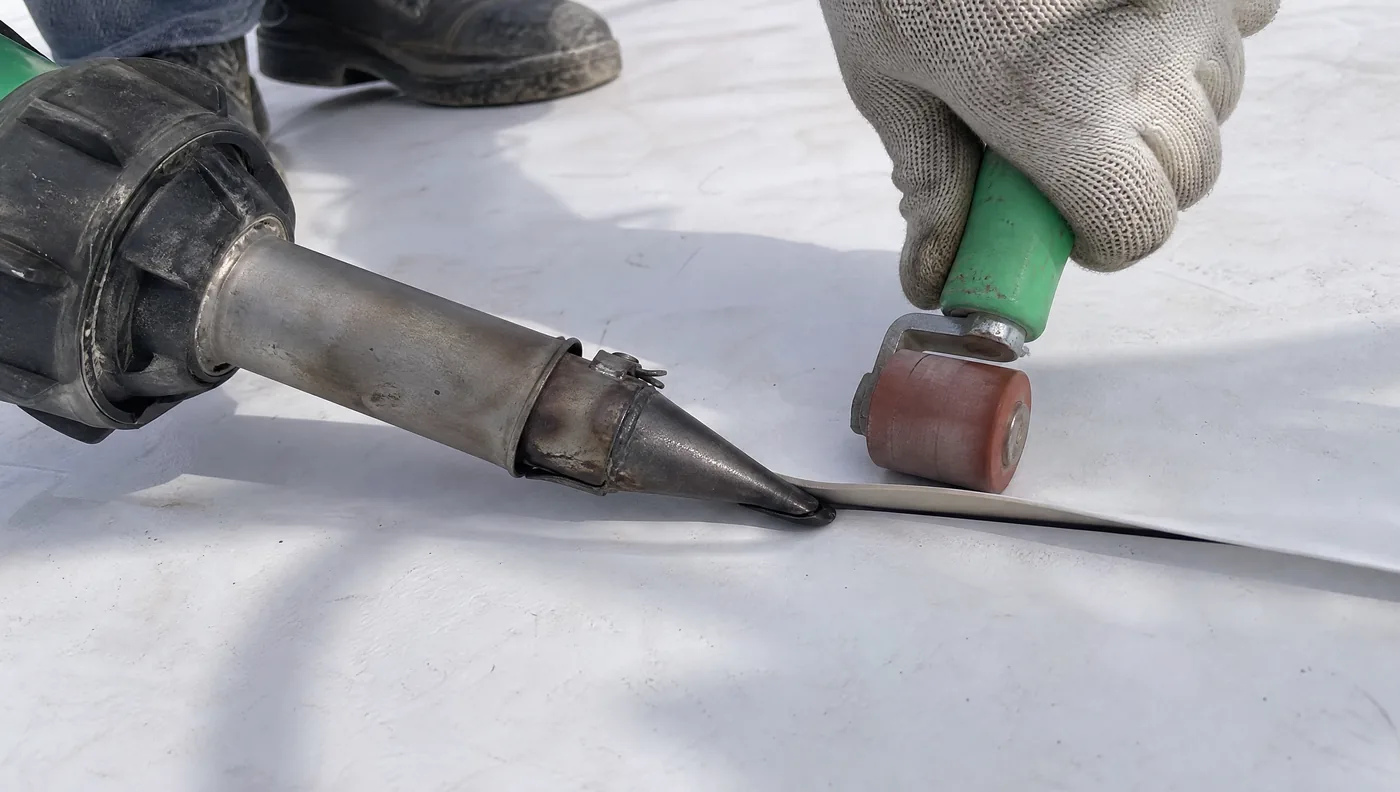
TPO roofing costs $6.50 to $12.00 per square foot installed in Houston depending on membrane thickness and what is underneath it. TPO is a thermoplastic single-ply membrane whose seams are fused with hot air rather than glued, which makes a correctly welded seam as strong as the sheet itself.
In a cooling-dominated climate like this one the reflectivity is not a marketing point, it is money. A white membrane over correctly specified polyiso measurably reduces the heat load coming into the building through the roof, every summer, for the life of the roof.
Thickness
45, 60 or 80 mil, and why it matters more than the brand
Specify 60 mil as a minimum and 80 mil on any roof with rooftop equipment. This is the single most consequential line in a TPO specification and it is the one most often quietly reduced to win a bid.
A mil is a thousandth of an inch. The difference between 45 and 60 mil is not just thickness, it is the thickness of the coating above the reinforcing scrim, which is what actually resists weathering and punctures. Run 45 mil on a roof that HVAC technicians walk twice a month and you will be repairing punctures at year six.
- 45 milBudget specification. Reasonable on a clean roof with almost no penetrations and no foot traffic. We rarely specify it.
- 60 milThe Houston default and what we quote unless there is a reason not to. Warranty terms of 20 years are standard at this thickness.
- 80 milRoofs with condensers, exhaust fans, kitchen equipment, service walkways or regular access. Also worth it on any roof you intend to hold for 25 years or more.
- Fleece-backBacked with polyester fleece for adhered applications and for installing over an uneven existing substrate on a recover.
- ReinforcementThe polyester scrim inside the sheet. It is what hail fractures, and it is why hail damage on TPO is invisible.
Ask every bidder for the mil thickness in writing. If two TPO bids are within a few percent of each other and one is 45 mil, that is where the difference went.
Welding
Welding, and the only quality check that matters
TPO seams are fused with hot air at roughly 900 to 1,100 degrees Fahrenheit, either with a hand welder on details or an automatic welder running the field seams. Get the temperature, the speed and the pressure right and the seam is stronger than the membrane. Get any one of them wrong and you have a cold weld, which looks identical and is not a seam at all.
The check is a blunt probe run along every finished seam by hand. If the probe finds a gap, the seam gets re-welded. It is slow, it is unglamorous, and it is completely non-negotiable, because a cold weld will not show itself for a year or two and by then the water has been in the insulation the whole time.
Things that make welding harder and get skipped when a crew is behind: dirty membrane at the lap, which has to be cleaned first, cold or damp conditions, weld temperature not being reset when the weather changes through the day, and welding right up to the end of the shift when everybody wants to go home. We run test welds at the start of every day and every time conditions change, and we keep the coupons.
Talk to a roofer
Get a TPO specification with the mil thickness written on it
We will walk the roof and write a scope that states thickness, insulation R-value, attachment and warranty term. Hold your other bidders to the same sheet and the comparison becomes obvious.
Call (281) 720-3785- A roofer picks up, not a call centre
- Line-item written scope before anything is torn off
- Progress billing tied to milestones, never 85% up front
TPO pricing
What TPO roofing costs in Houston by thickness
Installed, including tear-off, disposal, code-required insulation, cover board, edge metal and a registered manufacturer warranty. This is the range we bid from before we have walked the building.
| Specification | Installed cost | Typical warranty | Where it belongs |
|---|---|---|---|
| 45 mil, mechanically attached | $6.00 – $8.00 | 10 – 15 yrs | clean roofs, no traffic, short holds |
| 60 mil, mechanically attached | $6.50 – $9.50 | 20 yrs | the Houston default for warehouse and retail |
| 60 mil, fully adhered | $8.00 – $11.00 | 20 yrs | high wind exposure, better uplift performance |
| 80 mil, mechanically attached | $7.50 – $11.00 | 25 – 30 yrs | rooftop equipment and regular foot traffic |
| 80 mil, fully adhered | $9.00 – $12.00 | 30 yrs | long-hold assets, exposed sites, coastal-adjacent |
| Fleece-back recover over existing | $5.50 – $8.50 | 15 – 20 yrs | sound dry existing roof, one recover only |
| TPO repair, per seam run | $350 – $900 | – | cheaper per repair when several are done in one visit |
Ranges collected from Houston commercial quotes and supply pricing in July and August 2026. Fully adhered costs more than mechanically attached because of the adhesive and the labour, and it earns it back in wind uplift performance, which is a reasonable thing to pay for on the Gulf coast.
What goes wrong
How TPO roofs actually fail in Houston
Four ways, in rough order of frequency on the buildings we get called to.
- Seam failure from a cold weld. Installation defect, shows up in years two to five, usually in runs rather than singly because it is the same operator having the same bad afternoon.
- Punctures from foot traffic and dropped tools. Especially around rooftop units. The fix is walkway pad on every service route, which costs very little at install and is nearly always omitted.
- Hail bruising. The impact fractures the scrim without breaking the surface. It passes a visual inspection and fails eighteen months later. Documenting this correctly after a storm is what determines whether it is a claim or your problem.
- Wind uplift at the perimeter and corners. Uplift pressures at a roof corner are several times what they are in the field, which is why fastening patterns are denser there. Skimp on the corner enhancement and that is where it peels.
Read the wind exclusion in your TPO warranty
Nearly every single-ply manufacturer warranty excludes damage from wind above a stated speed, commonly somewhere between 55 and 72 mph depending on the product and the attachment. Beryl put a 84 mph gust through Houston Hobby on July 8, 2024. In a market that sees those numbers, the exclusion is not theoretical, and the practical consequence is that a manufacturer can point at a wind event as the cause of a failure that was really a workmanship problem. Ask for the wind speed on the warranty in writing, and specify an enhanced-wind system if the building justifies it.
Manufacturers
Which TPO we install and why we are not religious about it
We are certified with GAF for EverGuard, with Carlisle SynTec, with Johns Manville and with Versico, and we install Duro-Last where a prefabricated system suits the roof. Any of them will make a good roof. The formulations have converged over the last decade and the differences between the major manufacturers matter far less than three other things: the thickness specified, the quality of the welding, and whether the details were done properly.
Where the brand does matter is the warranty. A manufacturer will only issue a full system warranty when the whole assembly, insulation and cover board and membrane and fasteners, is theirs and the installer is certified for it. Mixing a cheaper insulation under a premium membrane saves a few cents a foot and can cost you the warranty entirely.
All TPO membranes we install meet ASTM D6878, which is the standard that actually defines what TPO is. If a quote does not reference it, ask what is in the roll.
Buildings we cover
TPO installation, repair and recover across the Houston metro:
Commercial roofing in Bellaire, Stafford commercial roofing, commercial roofers in Pasadena, Channelview, TX, Commercial roofing in Humble, Deer Park commercial roofing, commercial roofers in Katy, Sugar Land, TX, Commercial roofing in Cypress, Spring commercial roofing, commercial roofers in La Porte, Baytown, TX, Commercial roofing in Tomball, and The Woodlands commercial roofing and every submarket we work.
Related work
Straight answers
TPO questions we get constantly
How long does a TPO roof last in Houston?
A 60 mil TPO roof correctly installed in Houston lasts 20 to 25 years, and 80 mil pushes that to 25 to 30. Heat and UV are the limiting factors here rather than freeze cycling, and this climate is harder on a membrane than most of the country. What shortens it dramatically is foot traffic without walkway pads, ponding water, and hail.
Can TPO be installed over my existing roof?
Often yes, if the existing roof is dry, sound and is the only system up there. A fleece-back TPO recover over an existing membrane or built-up roof is faster, cheaper and avoids the disposal cost entirely. The building code permits one recover, not two, so we core-cut first to see how many systems are actually on the deck. It is genuinely common to find more than the owner believes.
Is TPO better than modified bitumen?
For most Houston commercial buildings, yes, and it is not close on reflectivity. For a roof with heavy foot traffic, a building you want a redundant two-ply system on, or an owner who values being able to have any roofer patch it with a torch and a bucket, modified bitumen has a real argument. TPO is a single layer relying on many linear feet of welded seam. Mod bit is two plies with no seam integrity dependency of the same kind. Here is the mod bit case in full, and the seven systems side by side.
Can I repair TPO myself?
No, and this is a genuine practical downside of the material. TPO seams are heat welded, which needs a welder, a temperature setting appropriate to the day and somebody who knows how to probe the result. Peel-and-stick patch tape from a supply house holds for a season and then lets go, and it contaminates the area so the eventual proper repair costs more. If your maintenance team wants to be able to fix things themselves, that is a legitimate argument for modified bitumen instead, and you should weigh it at specification rather than discover it later.
Talk to a roofer
Want a number on this roof?
Call and describe the building. If it needs a survey we will come and walk it, and there is no charge for that whether or not you use us.
Call (281) 720-3785- A roofer picks up, not a call centre
- Line-item written scope before anything is torn off
- Progress billing tied to milestones, never 85% up front