
Built-up roofing · Houston
Built-Up Roofing (BUR) in Houston, TX
If your building went up between about 1960 and 1995 and has rock on the roof, this is what you have. The good news is that a great many of them are still perfectly serviceable. The bad news is what it costs to take one off.
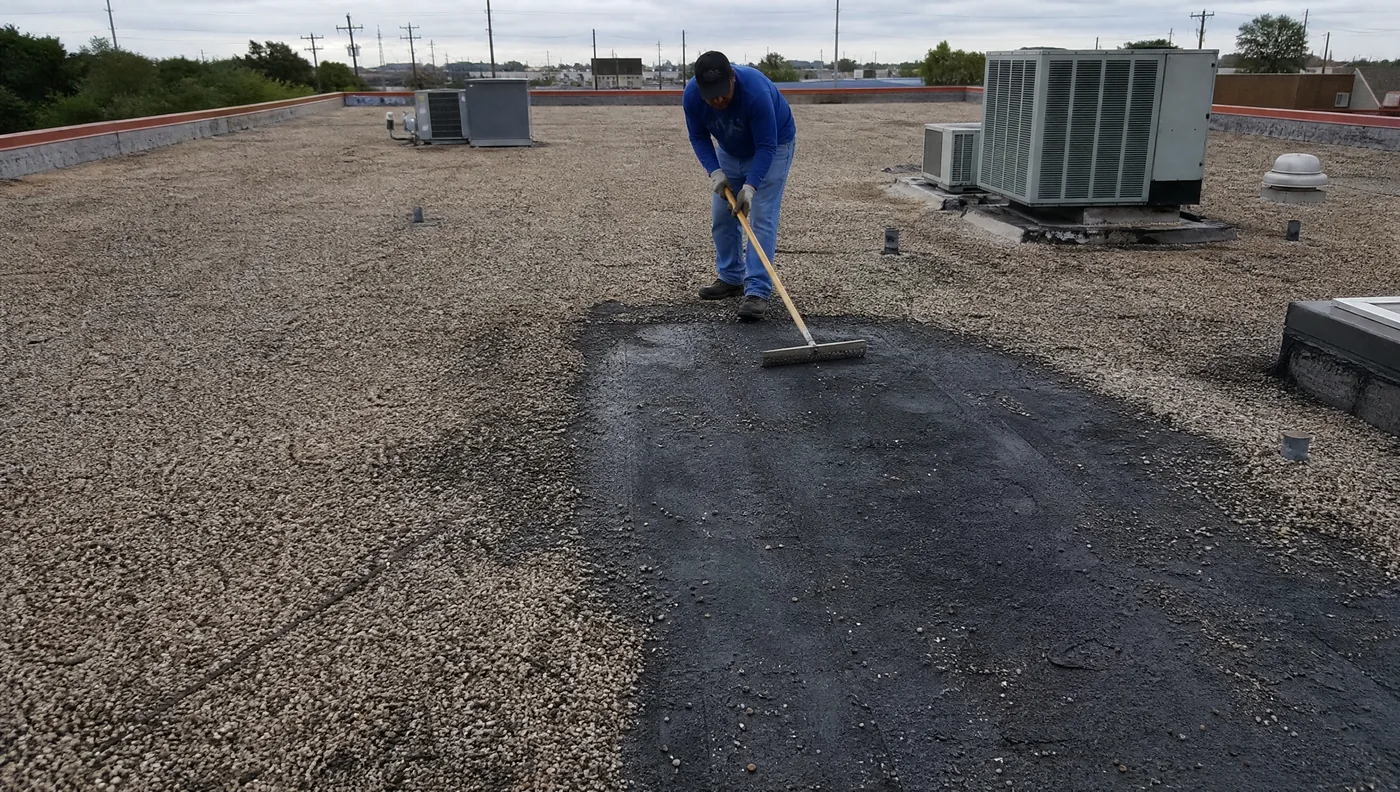
Built-up roofing is the original flat roof: alternating layers of bitumen and reinforcing felt, three or four plies deep, surfaced with gravel or a cap sheet. It costs $8.50 to $13.50 per square foot installed in Houston, lasts 20 to 30 years, and is the heaviest and most redundant assembly available.
We repair BUR, we recover it, and we tear it off. What we do not do is pretend a sound gravel roof needs replacing because single-ply is easier for us to install.
What is up there
Working out what you actually have
A core cut, and there is no substitute for it. A two-inch plug taken through the whole assembly tells you the number of plies, the surfacing, the insulation type and thickness, whether that insulation is wet, and what the deck is. Ten minutes, patched properly afterwards, and it settles arguments that otherwise run for months.
What we find on Houston BUR roofs, in rough order of frequency:
- Three or four plies of felt in asphalt, gravel surfaced, over perlite or fibreboard insulation, on a steel or concrete deck. The classic.
- A mod bit cap sheet already installed over the original BUR at some point in the nineties, meaning you already have two systems and no recover left under the code.
- Coal tar pitch rather than asphalt on older and dead-flat roofs. This matters: coal tar has different repair materials, different hazards, and a genuinely different disposal question.
- Wet perlite or fibreboard that has been holding water for years. Perlite in particular turns to porridge and stops being insulation or a substrate.
Until somebody has cut a core, anyone quoting you a BUR job is guessing, and the guesses that go wrong all go wrong in the same direction.
Repair and recover
Repairing and recovering a gravel roof
Repairing BUR is straightforward and the materials are available anywhere. Spud the gravel back from the repair area, cut out the failed section, build the plies back with hot or cold-applied bitumen and felt, and re-surface. A competent roofer can do it and the repair lasts.
The commonly missed step is the gravel. It has to be removed from the work area and properly re-embedded afterwards, and a repair that leaves bare bitumen exposed will oxidise and fail there in a couple of seasons. If you have had repairs done and you can see black patches from the ground, that is what happened.
Recovering a gravel roof means putting a new system over the top, and the gravel is the obstacle. Loose aggregate has to be removed or the surface spudded flat, which on a large roof is a serious operation with real disposal weight attached. Once it is flat, a new layer of polyiso and a single-ply membrane over the top is a genuinely good outcome: you get a code-compliant insulation upgrade, a warrantable new roof, and you never touch the deck.
The other real option on a sound BUR roof is a restoration coating, which avoids the gravel question entirely on a smooth-surfaced or cap-sheeted roof and is a fraction of the price. Coatings, and when they are the wrong answer.
Talk to a roofer
Have a gravel roof and three bids that disagree?
Let us cut a core. Half the disagreement between BUR bids is that the bidders are each assuming a different assembly, and ten minutes with a core cutter settles it.
Call (281) 720-3785- A roofer picks up, not a call centre
- Line-item written scope before anything is torn off
- Progress billing tied to milestones, never 85% up front
BUR pricing
Built-up roofing cost in Houston, including the disposal
The disposal line is shown separately because it is the number that differs most between a BUR job and everything else, and because a bid that buries it is a bid you cannot compare.
| Work | Installed cost | Service life | Notes |
|---|---|---|---|
| New 4-ply BUR, gravel surfaced | $9.50 – $13.50 | 20 – 30 yrs | heaviest assembly, maximum redundancy |
| New 3-ply BUR, cap sheet | $8.50 – $11.50 | 18 – 25 yrs | lighter, coatable surface |
| Recover with single-ply over BUR | $7.00 – $10.50 | 20 – 25 yrs | gravel removal or spudding priced separately |
| Silicone coating over smooth BUR | $2.25 – $4.75 | 10 – 15 yrs | sound and dry substrate only |
| BUR patch repair, per detail | $350 – $950 | – | includes spudding and re-embedding aggregate |
| Gravel removal / spudding | $0.85 – $2.10 / sq ft | – | the line most often left off a recover bid |
| Tear-off and disposal, 4-ply gravel | $1.60 – $3.40 / sq ft | – | charged by weight, roughly 500-600 lb per 100 sq ft |
| Tear-off and disposal, single-ply | $0.60 – $1.30 / sq ft | – | shown for comparison |
Ranges collected from Houston commercial quotes and disposal pricing in July and August 2026. Tear-off and disposal figures are per square foot of roof area, not per ton, and assume normal ground access for skips. Restricted access sites, crane removal or night work push the top of the range.
The tear-off problem
Why tearing one off costs what it costs
Weight and disposal. This is the one line on a BUR bid that surprises people and it is entirely legitimate.
A four-ply gravel built-up roof weighs on the order of 500 to 600 pounds per hundred square feet with the aggregate on it. On a 30,000 square foot building that is well over seventy tons of material that has to come off the roof, go into skips and go to landfill, and Houston disposal is charged by weight. Compare that with a single-ply tear-off, which is a fraction of the tonnage.
So a BUR tear-off carries roughly double the removal labour and several times the disposal cost of a single-ply tear-off. Any bid that does not itemise the disposal is hiding either a large number or an intention to do something else with the material.
Ask whether it is asphalt or coal tar before anybody starts
Coal tar pitch roofs, common on older dead-flat commercial buildings, carry handling and exposure considerations that asphalt does not, and the disposal classification can be different. A core cut identifies it immediately. It is not a reason to panic and it is a reason to know before the crew is on the roof rather than after.
New BUR
Would you install a new built-up roof today?
Occasionally, and usually as a modified bitumen hybrid rather than a traditional four-ply.
New BUR still makes sense on buildings that want maximum redundancy and are not weight-constrained, on institutional and government work where the specification calls for it, and on roofs with very heavy traffic. Johns Manville and GAF both still make complete BUR systems and they are good ones.
Against that: it is slower to install, it needs a kettle or a large cold-adhesive operation on site, the odour is a genuine issue on an occupied building, it is the heaviest assembly you can specify, and modern SBS modified bitumen delivers most of the redundancy benefit at less weight and less disruption. Which is why most of what used to be specified as BUR now gets specified as a two-ply modified system.
Buildings we cover
Built-up roof repair, recover and tear-off across the Houston metro:
Commercial roofing in Bellaire, Stafford commercial roofing, commercial roofers in Pasadena, Channelview, TX, Commercial roofing in Humble, Deer Park commercial roofing, commercial roofers in Katy, Sugar Land, TX, Commercial roofing in Cypress, Spring commercial roofing, commercial roofers in La Porte, Baytown, TX, Commercial roofing in Tomball, and The Woodlands commercial roofing and every submarket we work.
Related work
Straight answers
Questions we get on this specifically
There is rock all over my roof. Is that a problem?
No, that is the roof working as designed. The aggregate protects the bitumen from UV and provides fire resistance, and a BUR roof without it degrades quickly. What is a problem is gravel in the gutters and at the base of downspouts in quantity, which means it is migrating off the field, and bare black patches visible from the ground, which means the surfacing is gone where it is needed most.
How do I know how many plies I have?
Core cut. There is no way to tell from the surface and no way to tell from the original drawings, because what got built is frequently not what was drawn and something has usually been added since. We take cores as part of any survey where a replacement is on the table, and we patch them properly on the way out.
Can a BUR roof be repaired in the rain?
Not properly. Hot asphalt and wet substrate do not mix, and cold-applied repairs need a dry surface to bond. An emergency dry-in over a BUR roof is done with self-adhered or mechanically fastened temporary materials, and the permanent repair waits for dry weather. Anybody mopping hot asphalt onto a wet built-up roof is creating the blister you will call about in two years.
My BUR roof has blisters. Do they need cutting out?
Not all of them. A blister that is intact, not growing and not in a traffic path can reasonably be left alone and monitored, and cutting into it creates a repair where there was not a leak. A blister that has split, is in a walkway, or is growing between inspections gets cut out, dried and rebuilt. Marking and photographing them at each maintenance visit is how you tell which sort you have, which is one more argument for a documented maintenance programme.
Talk to a roofer
Want a number on this roof?
Call and describe the building. If it needs a survey we will come and walk it, and there is no charge for that whether or not you use us.
Call (281) 720-3785- A roofer picks up, not a call centre
- Line-item written scope before anything is torn off
- Progress billing tied to milestones, never 85% up front