
Commercial roof repair · Houston
Commercial Roof Repair in Houston, TX
The stain on the ceiling tile is almost never underneath the leak. On a low-slope roof water travels sideways along the deck flutes and comes down wherever it finds a hole, which can be fifty feet from where it got in.
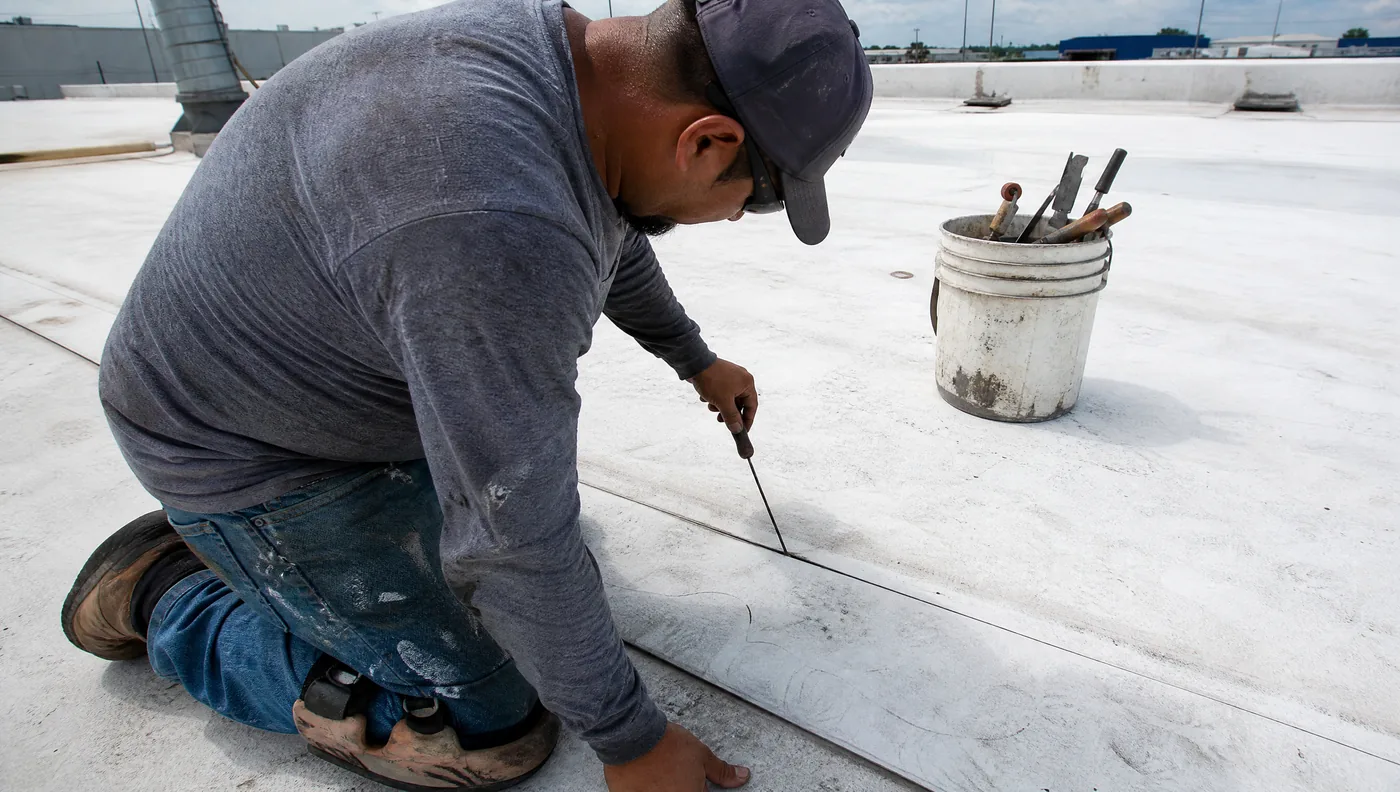
Commercial roof repair in Houston starts with locating the actual point of entry, not with patching the nearest suspicious thing. We repair TPO, PVC, EPDM, modified bitumen, built-up and metal roofs on commercial and industrial buildings across Harris, Fort Bend, Montgomery and Chambers County, and a repair call gets a written finding with photographs whether or not you go ahead with the work.
Most of what we get called to is one of six things, and after fifteen years you can usually guess which from the description on the phone.
The six usual suspects
Where commercial roofs actually leak
Almost never through the middle of the field. Membrane in the open field of a roof is the part doing the least work and failing the least often. The failures cluster at details, and it is nearly always one of these.
Lap seams that were never properly welded
A hot-air weld on TPO or PVC is either made or it is not, and the way you find out is with a blunt probe run along the seam. A cold weld looks identical to a good one from six feet away and opens under a screwdriver. On a roof installed by a crew that was rushing, you find the same failure every twenty feet along the same run.
Curb and penetration flashings
Every HVAC unit, exhaust fan, vent, conduit stand and skylight is a hole in your roof with a collar around it. The collar is where it leaks. Split corners on curb flashings, pitch pans that have dried out and shrunk away from the post, and boot flashings that have cracked at the base account for a very large share of everything we fix.
Fasteners backing out
On a mechanically attached membrane, the plates and screws sit under the sheet. When a screw backs out of a deteriorating deck it tents the membrane above it, and eventually the plate wears through. You can see this from a distance as a field of small bumps.
Ponding water at the low points
Water sitting more than 48 hours does three things: it grows biological matter that holds moisture against the sheet, it puts weight on a deflected deck which makes the pond deeper, and it finds every marginal seam it sits on top of.
Edge metal and coping
Wind gets under a loose coping cap or a failed drip edge and peels from there. The ANSI/SPRI ES-1 standard exists because edge failure is one of the most common ways a commercial roof comes apart in a wind event, and it is the detail most often value engineered out of a bid.
Something a different trade did
The most common single cause on a building under ten years old. A satellite dish lag-bolted through the membrane, a new gas line laid straight on the sheet, a condenser swapped and the old curb left open. If you have had any rooftop work done recently, tell us, because that is where we will look first.
How we find it
How we find a leak we cannot see
Four techniques, escalating in cost, and we use the cheapest one that will answer the question.
- Walk and probe. Free with the survey. A methodical pass with a probe over every seam and detail in the area upslope of the interior symptom. This finds it maybe half the time.
- Water testing. Flood a suspect detail in a controlled way with somebody inside watching. Slow, tedious, extremely conclusive when it works.
- Infrared survey. Flown or walked after sundown. Wet insulation holds the day's heat and glows against the dry field. This does not find the hole, it finds the wet area, which tells you how big your actual problem is. Budget $500 to $1,000. More on moisture surveys here.
- Core cuts. A two inch plug taken through the assembly and patched. It is the only way to know for certain what is under the membrane, how many layers you have and whether the insulation is saturated. We take cores on any building where we are about to price a replacement.
Owners sometimes flinch at paying for diagnosis. The arithmetic is simple: a survey that costs $500 and saves you from replacing forty thousand square feet you did not need to replace is the highest-return money on the whole project.
Talk to a roofer
Water coming in right now?
Call and describe what you are seeing and where. If it is active we will get somebody out today, and the first job is stopping water entering the building, not writing you a quotation.
Call (281) 720-3785- A roofer picks up, not a call centre
- Line-item written scope before anything is torn off
- Progress billing tied to milestones, never 85% up front
Repair pricing
What commercial roof repairs cost in Houston
Repair work is priced by the detail, not by the square foot, because a single failed curb flashing takes the same crew half a day whether it sits on a 6,000 foot roof or a 60,000 foot one. These are the ranges we quote from before we have seen the building.
| Repair | Typical range | Crew time | Notes |
|---|---|---|---|
| Service call and diagnosis | no charge | 1 – 2 hrs | walk, probe and written finding with photographs |
| Single lap seam weld repair | $350 – $900 | 2 – 4 hrs | priced per run, cheaper if several are done in one visit |
| Curb or penetration re-flash | $450 – $1,400 | 3 – 6 hrs | per detail, depends on curb size and access |
| Pitch pan rebuild | $225 – $600 | 1 – 2 hrs | cut out, re-pack, re-pour with pourable sealer |
| Wet insulation cut-out and patch | $14 – $26 / sq ft | 1 – 3 days | membrane, ISO and cover board replaced to match |
| Drain re-sump and clamping ring | $900 – $2,600 | 1 day | tapered ISO sump, new ring, new lead or membrane flashing |
| Emergency dry-in and tarp | $800 – $3,500 | same day | stabilise only, permanent repair priced separately |
| Deck replacement, plywood | $100 / sheet | – | stated as a unit rate on every bid we write |
| Deck replacement, structural member | $35 / linear ft | – | stated as a unit rate on every bid we write |
Ranges collected from Houston-area commercial repair quotes and contractor discussion in July and August 2026. Deck unit rates are the figures we publish on our own bids so a rotten deck is a known number rather than an open-ended change order.
Repair or replace
When repair stops being the right answer
Repair a roof while the insulation under it is dry and the membrane still has flexibility left. Stop repairing it when neither is true.
The honest thresholds we work to:
- Under about 25% of the field wet. Cut out the wet, replace it, repair the details. Worth doing.
- 25% to 40% wet. A judgement call that depends on how long you intend to hold the building. If it is a five-year hold, repair. If it is a twenty-year hold, you are going to replace it eventually and every repair dollar in the meantime is spent twice.
- Over 40% wet, or a membrane that has gone chalky and brittle. Replace it. Patching a sheet that cracks when you fold it is not a repair, it is a deposit on the next call-out.
The other thing that ends the repair conversation is deck condition. If we core through and find corroded steel deck, or a gypsum deck that has taken water and gone soft, no membrane work fixes that. It is structural and it gets priced as structural.
What we will not do
Two things we will not do on a repair
We will not smear mastic over everything and call it done. Asphalt mastic on a TPO roof is a warranty violation and a temporary measure at best. It also makes the next repair harder, because the next roofer has to remove it before he can weld anything. Every building we take over that has been "maintained" by somebody's handyman has a black smear at every detail, and cleaning that off is billable time you are paying for twice.
We will not coat a roof to hide a leak. A coating over a wet substrate seals the water in. If the survey comes back wet across a meaningful share of the field, we will say so and we will not sell you the coating, which is a conversation we have had often enough that it is worth putting on the website. Here is when a coating genuinely is the right call.
Andre has a standing rule on the repair trucks: if you cannot explain to the owner in one sentence why the water was getting in, you have not found it yet, and you patch nothing until you have.
Buildings we cover
We repair commercial roofs across the Houston metro, from inner-loop retail strips to Ship Channel warehouses:
Commercial roofing in Bellaire, Stafford commercial roofing, commercial roofers in Pasadena, Channelview, TX, Commercial roofing in Humble, Deer Park commercial roofing, commercial roofers in Katy, Sugar Land, TX, Commercial roofing in Cypress, Spring commercial roofing, commercial roofers in La Porte, Baytown, TX, Commercial roofing in Tomball, and The Woodlands commercial roofing and every submarket we work.
Related work
Straight answers
Questions we get on this specifically
Can you repair a roof that is still under warranty?
Sometimes, but check first, because the wrong repair voids it. Most manufacturer warranties require repairs to be done by a contractor certified for that system, with matching materials, and often require the manufacturer to be notified. We hold certifications with GAF, Carlisle SynTec and Johns Manville, which covers most of what is on Houston roofs. Send us a photo of the warranty certificate or tell us who installed it and roughly when, and we will tell you whether we can touch it without costing you the coverage.
My HVAC contractor cut a new curb in and now it leaks. Whose problem is that?
Commercially it is between you and them, but practically it is now your roof. This is common enough that it has a price tag attached in the trade: uncoordinated tenant and equipment work is the leading cause of voided commercial roof warranties, and a widely discussed case in the industry put the cost of one uncoordinated rooftop installation at $85,000 in lost coverage. The fix is procedural rather than technical. Put a line in every rooftop contractor's scope requiring your roofer to flash any new penetration, and it stops happening.
Do you charge for the initial visit?
No.
How long does a repair last?
A correctly executed detail repair on a sound membrane should last as long as the rest of the roof does, which is the whole point of doing it properly rather than patching it. What does not last is a repair on a substrate that has failed: mastic on a brittle membrane buys months. We will tell you which of the two you are buying before you buy it, and if it is the second one we will price the replacement alongside so you can see both numbers.
Talk to a roofer
Want a number on this roof?
Call and describe the building. If it needs a survey we will come and walk it, and there is no charge for that whether or not you use us.
Call (281) 720-3785- A roofer picks up, not a call centre
- Line-item written scope before anything is torn off
- Progress billing tied to milestones, never 85% up front