
Industrial & heavy commercial · Houston
Industrial Roofing in Houston, TX
Roofing a live process facility is a different trade from roofing a retail centre. The membrane is the easy part. Getting a crew through the gate, keeping open flame off the site and working around a turnaround schedule is the job.
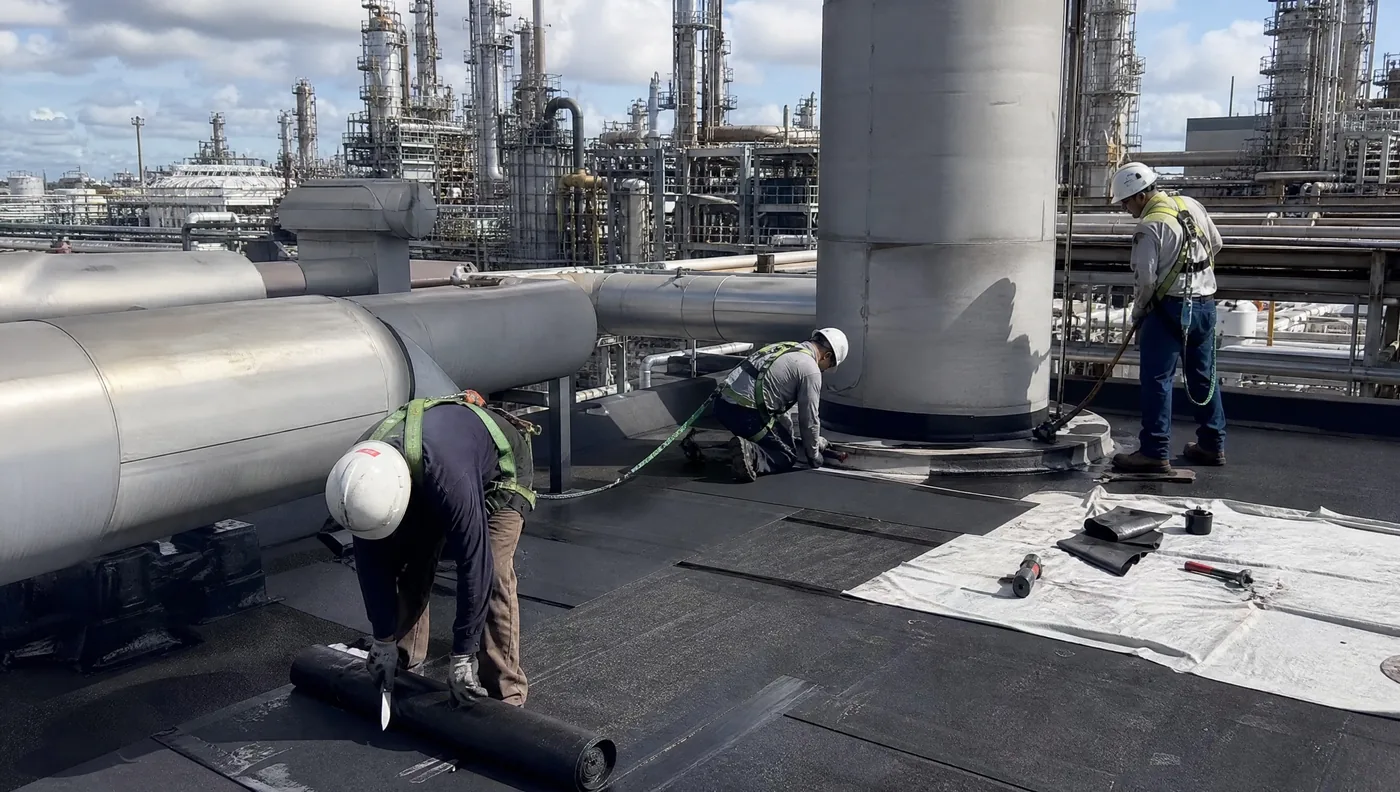
Industrial roofing in Houston covers plants, refineries, tank farms, distribution centres, manufacturing buildings and the office, lab and control buildings attached to them. We work across the Ship Channel corridor, the 290 and 249 industrial parks and the Grand Parkway distribution belt.
What makes it different from commercial work is almost never the roof. It is site access, safety compliance, hot work restrictions, contractor prequalification and scheduling against production, and a roofer who has not done it before will find that out the expensive way.
Site requirements
What working on an industrial site actually requires
Before a single roll of membrane arrives, most of this has to be in place, and on a major site it takes weeks rather than days.
- Contractor prequalification. ISNetworld, Avetta, Veriforce or the owner's own system. Safety statistics, insurance, written programmes, training records. Being registered and in good standing is a prerequisite for even bidding on a lot of Houston industrial work.
- Site-specific orientation for every crew member, renewed on a schedule, plus the site's own badge and access process.
- Hot work permits for anything producing flame, spark or sufficient heat, with a fire watch, gas testing where the area requires it, and a permit that is good for a defined window rather than a day.
- Escort requirements in operating areas, which materially affects productivity and belongs in the programme rather than in the excuses.
- Fall protection to OSHA 1926 Subpart M with a written plan, anchor points identified, and skylights and fragile surfaces addressed specifically. Industrial buildings are full of fragile rooflights that look like solid roof.
- Confined space, LOTO and line-break awareness where the roof work interacts with process equipment, vents or stacks.
- Crane and lift plans, often requiring approval days ahead and sometimes restricted to specific windows.
None of this is optional and none of it is quick. When an industrial roof bid comes in higher than a commercial one per square foot, a good deal of the difference is here rather than in the materials.
No-flame systems
Why almost everything we detail on a plant is flame-free
Most operating industrial sites in the Houston area either prohibit open flame outright or make it so procedurally expensive that it stops being worth it. That rules out torch-applied modified bitumen and hot asphalt kettles on a large share of the work we do.
What we specify instead:
- Mechanically attached single-ply. TPO or PVC, screws and plates, hot-air welded seams. Hot-air welding is not open flame and is generally acceptable where torching is not, though it still needs to be confirmed against the site's own rules rather than assumed.
- Self-adhered SBS modified bitumen. Cold applied, two-ply redundancy, no flame, no kettle, no odour.
- Cold adhesive systems where a fully adhered assembly is needed for wind uplift performance.
- Coatings and restoration, which are entirely cold-applied and are very often the right answer on a large plant roof anyway.
PVC deserves a specific mention on industrial work. Chemical and process exhaust degrades TPO and PVC resists it, which makes PVC the correct specification downwind of a great many things that plants vent. More on PVC here.
Talk to a roofer
Have a plant roof and a turnaround window?
Tell us the window and the site requirements. We would rather build the programme around your schedule at bid stage than discover the constraints in week two.
Call (281) 720-3785- Prequalified, with programmes and statistics on file
- Cold-applied systems as standard on live process sites
- Sectional handover, nothing left open overnight
Industrial pricing
What industrial roofing costs in Houston
Per square foot installed. The site access premium is shown separately because it is real, it varies enormously between sites, and it is the line that explains why an industrial bid looks high against a warehouse bid for the same membrane.
| Work | Installed cost | Service life | Notes |
|---|---|---|---|
| Mechanically attached TPO, 60 mil | $6.50 – $9.50 | 20 – 25 yrs | distribution and warehouse standard |
| Mechanically attached TPO, 80 mil | $7.50 – $11.00 | 25 – 30 yrs | plant roofs with equipment and traffic |
| PVC, 60 mil | $8.00 – $13.00 | 20 – 30 yrs | process and chemical exhaust exposure |
| Self-adhered SBS, 2-ply | $8.00 – $11.00 | 20 – 25 yrs | no-flame sites, redundancy required |
| Metal restoration coating | $3.50 – $6.50 | 15 – 20 yrs | the default answer on most large plant metal roofs |
| Single-ply retrofit over metal | $8.00 – $12.50 | 20 – 25 yrs | adds insulation, adds dead load, needs structural check |
| FM 1-90 enhanced attachment | +$0.60 – $1.80 | – | over standard attachment, often insurer-mandated |
| Site access & safety compliance premium | +5% – 20% | – | escorts, orientation, permits, restricted windows |
| Night or turnaround shift working | +15% – 35% | – | where the area cannot be released in production hours |
Ranges from Houston industrial quoting in July and August 2026. The access and shift premiums are the honest reason industrial work prices above commercial work for the same membrane, and a bid that does not carry them has either not read the site requirements or intends to raise them later as a change order.
Building types
The building types, and what each one needs
An industrial site is not one roof, it is usually six different roofs with different requirements and different budgets, and treating them as one line item is how capital plans go wrong.
- Warehouse and distributionLarge simple metal or single-ply roofs. Cheapest per foot, and wind uplift at the corners is the governing design issue.
- ManufacturingProcess exhaust, roof-mounted equipment, vibration, heat. PVC where the exhaust is aggressive.
- Process and refineryHot work prohibited, escorts, gas testing, tight turnaround windows. Everything cold-applied.
- Tank farm and utility buildingsSmall roofs, awkward access, high consequence if they leak onto controls.
- Office, lab and control roomsOccupied, noise and odour sensitive, conditioned. Reflectivity matters here.
- Canopies and truck docksConstant vehicle impact risk on the structure, drainage into traffic areas, frequently neglected.
Wind uplift is the specification driver across all of them. Large open-span buildings generate substantial uplift, corner and perimeter pressures are several times field pressures, and FM Approvals ratings such as 1-90 are frequently written into industrial specifications by the insurer rather than the owner. If your property insurer is FM Global, the roof specification is effectively theirs and it is worth getting their requirements before design rather than after.
Scheduling
Scheduling against production, not against the calendar
The single biggest difference from commercial work. On a retail centre you work around trading hours. On a plant you work around a production schedule that was set months ago and will not move for a roofing contractor.
What that means in practice:
- Turnaround windows. If a unit is coming down for maintenance, that is when roof work over it happens, and the window is fixed and short. Being ready to mobilise fully within it is the whole game.
- Shift working. Nights and weekends where the area cannot be released during production.
- Sectional handover. Areas released to us one at a time and handed back clean, tested and signed off before the next opens.
- Weather contingency that is genuinely planned. Nothing gets opened up that cannot be made watertight before the crew leaves, and on a live process building that rule is absolute rather than aspirational.
- Materials on site early. Polyiso lead times of four to six weeks will destroy a turnaround window if the ordering happens after the permit.
Tell us the constraint at bid stage. An industrial programme built around your turnaround costs more than one built around ours, and it is the only one that will actually happen.
Buildings we cover
Industrial roofing across the Houston metro, concentrated along the Ship Channel and the northwest industrial corridors:
Commercial roofing in Bellaire, Stafford commercial roofing, commercial roofers in Pasadena, Channelview, TX, Commercial roofing in Humble, Deer Park commercial roofing, commercial roofers in Katy, Sugar Land, TX, Commercial roofing in Cypress, Spring commercial roofing, commercial roofers in La Porte, Baytown, TX, Commercial roofing in Tomball, and The Woodlands commercial roofing and every submarket we work.
Related work
Straight answers
Questions we get on this specifically
Are you registered on ISNetworld or Avetta?
Yes, and we will supply our current grade and account details on request along with our EMR, our written safety programmes and our training matrix. If your site uses a system we are not yet registered on, registration takes a few weeks and we will start it before the bid rather than after the award, because the alternative is winning work we cannot mobilise on.
Can you work without any hot work at all?
Yes, and on most live process sites that is exactly what we do. Mechanically attached single-ply with hot-air welded seams, self-adhered SBS, cold adhesive systems and coatings between them cover essentially every industrial roofing requirement without a flame. Hot-air welding still needs confirming against your specific site rules rather than assumed to be acceptable, and where it is not, self-adhered SBS covers it.
Our insurer requires FM Approval. Can you meet that?
Yes. FM Approved assemblies are manufacturer-tested systems and the requirement affects attachment density, fastener type, insulation and cover board selection and edge detailing rather than being a separate product. It costs more per square foot, on the order of sixty cents to a dollar eighty over standard attachment for FM 1-90. Get your insurer's actual required rating in writing before we specify, because the difference between 1-60 and 1-90 is a real number and guessing high wastes money.
Can you roof over a live warehouse without shutting racking down?
Nearly always, yes. Mechanically attached roofing over occupied warehouse space creates noise and some vibration but no debris ingress if the deck is sound and sealed. Where the deck has open penetrations or the operation is sensitive, we install temporary protection underneath the work area section by section. What we will not do is tear off over live racking without containment, because a dropped fastener into an operation is somebody's afternoon at best.
Talk to a roofer
Want a number on this roof?
Call and describe the building. If it needs a survey we will come and walk it, and there is no charge for that whether or not you use us.
Call (281) 720-3785- A roofer picks up, not a call centre
- Line-item written scope before anything is torn off
- Progress billing tied to milestones, never 85% up front