
Coatings & restoration · Houston
Commercial Roof Coatings & Restoration in Houston
There is a widely held view in the roofing trade that coatings are a way to sell a cheap fix with a worthless warranty. It is a fair description of how coatings are often sold, and a poor description of what they can do when the roof under them is dry.
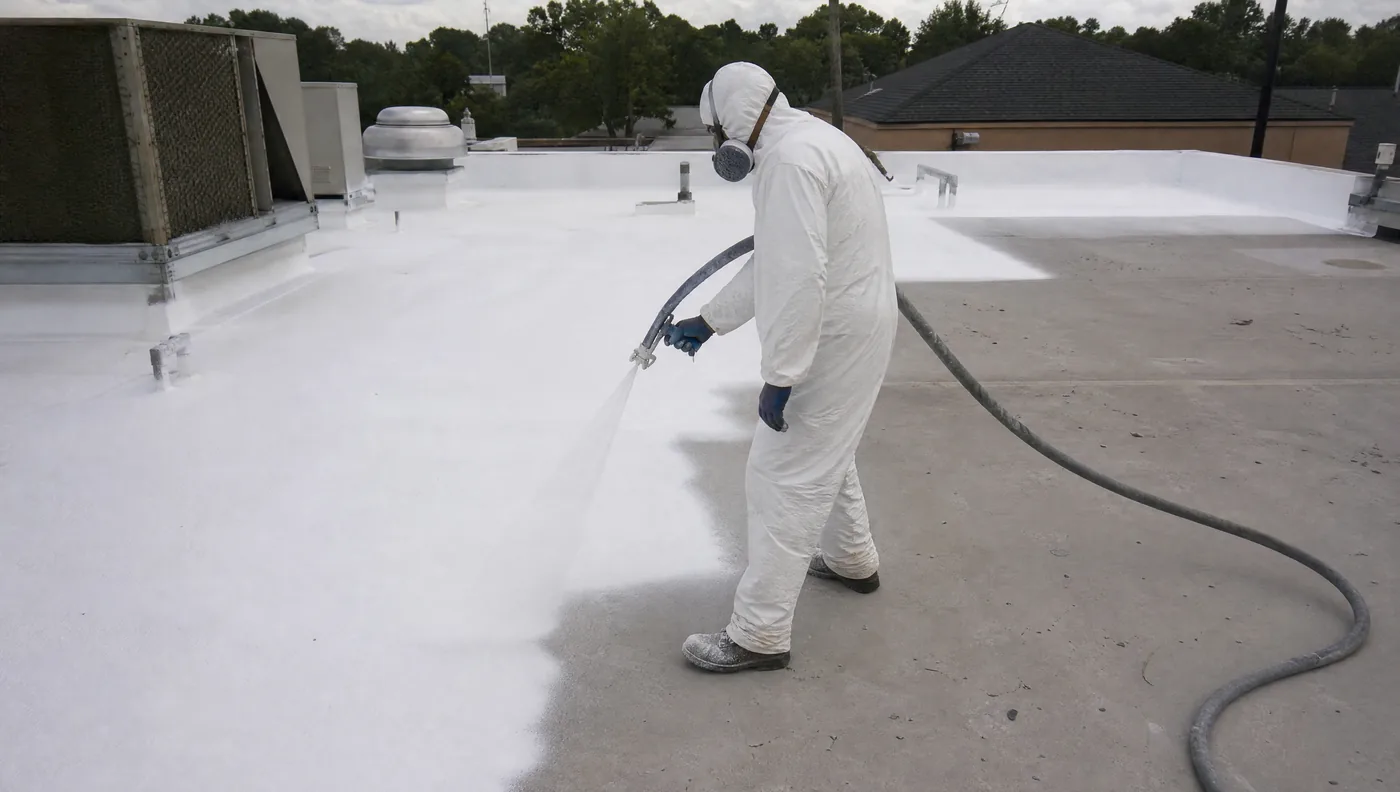
A commercial roof restoration coating costs $2.25 to $4.75 per square foot in Houston and extends a sound roof by ten to fifteen years, against $6.00 to $12.00 for a replacement. It is spray or roller applied over the existing roof, so there is no tear-off, no disposal, and almost no disruption to whoever is underneath.
It works on one condition and the condition is not negotiable: the roof under it has to be substantially dry. That is a factual question with a factual answer, and the answer costs $500 to $1,000 to obtain.
The moisture question
Why we scan before we quote a coating
Coating over wet insulation seals the water in permanently. The roof gets heavier, the insulation never dries and never recovers its R-value, and you have spent real money making the eventual tear-off worse and more expensive.
An infrared moisture survey is done after sundown. Wet insulation holds the day's heat longer than dry insulation and lights up against the cool field. It maps the wet areas as a plan, not as an opinion, and it costs $500 to $1,000 on a typical commercial building, or roughly two to ten cents a square foot on a large warehouse with a base charge for mobilisation.
Our thresholds, which we will apply to your building whether or not you like the answer:
- Under 10% of the field wet. Cut out and replace the wet areas, then coat. Straightforward.
- 10% to 25% wet. Still viable, and the cut-and-replace work starts to be a substantial part of the cost. We will show you both numbers.
- Over 25% wet. We will not quote a coating. You are replacing the roof, and coating it would be selling you something we know will not perform.
This is the entire reason coatings have a poor reputation. Sold onto a dry roof they are excellent value. Sold onto a wet one they are exactly the ripoff people describe, and the difference between the two is a scan.
Silicone or acrylic
Silicone or acrylic, and where foam fits
Silicone for anything that ponds, which in Houston is most roofs. Acrylic where the drainage is genuinely good and budget matters.
- SiliconeMoisture-cure, single component, unaffected by ponding water, excellent UV stability. $2.75 to $4.75 a square foot installed. The Houston default.
- AcrylicWater-based, cheaper, breathable, good reflectivity. $2.25 to $3.50. Not for ponding roofs. Needs re-coating sooner.
- PolyurethaneToughest against foot traffic and impact, more expensive, usually specified as a topcoat over foam or in traffic areas.
- SPF over the topSpray polyurethane foam adds insulation and builds slope, then takes a silicone topcoat. $5.50 to $9.00. Genuinely useful where you need R-value and drainage correction together.
- Mil thicknessThe number that decides the warranty. 20 mil dry is a short-term coating, 30 to 40 mil is a restoration system. Ask what the specified dry film thickness is.
The ponding question decides it more than anything else. Acrylic is water-based and re-emulsifies under standing water, which means a pond will eventually take the coating off. Silicone does not care about standing water at all, which is why it has become the default on low-slope commercial work in a city that gets this much rain.
Silicone's own weakness is that it holds dirt and gets slippery when wet, so walkway pads and a granule broadcast in traffic areas are worth specifying.
Talk to a roofer
Get the scan before you get the sales pitch
We will scan the roof and show you the thermal images. If it comes back dry, a coating is the best value on this whole website. If it comes back wet, we will tell you that instead.
Call (281) 720-3785- A roofer picks up, not a call centre
- Line-item written scope before anything is torn off
- Progress billing tied to milestones, never 85% up front
Coating pricing
What roof coatings cost in Houston, against replacing
The last two rows are what the coating is being compared against. On a dry, sound roof the arithmetic is not close.
| System | Installed cost | Service life | Suits |
|---|---|---|---|
| Acrylic, 20 mil | $2.25 – $3.00 | 8 – 12 yrs | well-drained roofs, budget-driven |
| Acrylic, 30 mil | $2.60 – $3.50 | 10 – 15 yrs | well-drained roofs, longer warranty |
| Silicone, 25 mil | $2.75 – $3.90 | 10 – 15 yrs | the Houston default |
| Silicone, 40 mil | $3.60 – $4.75 | 15 – 20 yrs | ponding roofs, longest coating warranties |
| Metal roof restoration system | $3.50 – $6.50 | 15 – 20 yrs | includes full fastener replacement |
| SPF foam plus silicone topcoat | $5.50 – $9.00 | 20 – 30 yrs | where R-value and slope both need correcting |
| Wet insulation cut-out before coating | $14 – $26 | – | priced per square foot of wet area only |
| New TPO replacement, for comparison | $6.50 – $9.50 | 20 – 25 yrs | the alternative |
| New PVC replacement, for comparison | $8.00 – $13.00 | 20 – 30 yrs | the alternative |
Ranges collected from Houston commercial quotes and coating supply pricing in July and August 2026. Coating prices assume a substantially dry substrate; the cut-out line is what wet areas add. Infrared survey to establish which of those applies runs $500 to $1,000.
The system
What a proper restoration actually involves
The coating itself is the last and quickest part. Most of the work and most of the value is underneath it.
- Infrared survey and core cuts. Map the wet, confirm the assembly.
- Cut out and replace wet insulation and failed membrane. Priced by the square foot, and this is the line that varies most between buildings.
- Power wash the entire roof and let it dry. On an asphalt roof this may need a primer as well. Skipping or rushing this is the leading cause of coating failure and it is invisible once the coating is on.
- Repair and reinforce every detail. Seams, laps, curbs, penetrations, drains and edges get polyester reinforcing fabric bedded in coating. Details are where roofs leak and a coating that has just been sprayed over a failing seam has fixed nothing.
- Base coat and top coat to the specified dry film thickness, usually in two passes in contrasting colours so coverage is visually verifiable.
- Inspection and warranty registration. Manufacturer restoration warranties of 10, 15 and 20 years exist and they are real, and they require the system to have been installed to specification with documented mil thickness.
If a coating quote does not describe steps 1, 3 and 4, it is a paint job.
Straight talk
Being straight about what coatings do not do
They do not add insulation. A coating is a fraction of a millimetre thick. If you need R-value, you need insulation, and that means a recover or an SPF system rather than a coating alone.
They do not fix drainage. A ponding roof that gets coated is a ponding roof with a coating on it. Silicone will survive it, but the ponding still holds weight and still grows things. Correcting slope needs tapered insulation. More on that here.
They do not fix a failed deck. Nothing applied on top of a roof addresses corroded steel deck underneath it.
They are not permanent. A restoration coating is a system with a service life, and it will need re-coating at the end of it. The good news is that re-coating a previously coated roof is straightforward and much cheaper than the first application, so the second cycle is genuinely inexpensive.
Used correctly, a coating is the highest-return money available on a commercial roof. Used to hide a wet roof, it is exactly what its critics say it is. We would rather tell you no and keep the relationship.
Buildings we cover
Roof coating and restoration across the Houston metro:
Commercial roofing in Bellaire, Stafford commercial roofing, commercial roofers in Pasadena, Channelview, TX, Commercial roofing in Humble, Deer Park commercial roofing, commercial roofers in Katy, Sugar Land, TX, Commercial roofing in Cypress, Spring commercial roofing, commercial roofers in La Porte, Baytown, TX, Commercial roofing in Tomball, and The Woodlands commercial roofing and every submarket we work.
Related work
Straight answers
Questions we get on this specifically
I have been told coatings are a scam. Are they?
Sold onto a wet roof, effectively yes, and that is a common enough practice that the reputation is earned. Sold onto a dry, structurally sound roof with proper preparation and detail reinforcement, a restoration coating is a legitimate, manufacturer-warranted system that will genuinely give you another decade or more for a third of the replacement cost. The variable is not the product, it is whether anybody established the moisture content before quoting. Ask any coating contractor what their moisture survey found. If they did not do one, you have your answer.
Will a coating stop my roof leaking?
Only if the leaks are through the surfacing and the details, which is often but not always. A coating system with proper detail reinforcement addresses seams, laps, curbs and penetrations, which is where most leaks come from. It does not address a failed deck, a structural movement crack or water entering somewhere other than the roof, which is more common than people expect, particularly through parapet walls and wall-to-roof junctions. We find the leak first and then decide what the roof needs.
Can I coat a TPO roof?
Yes, and it is a well-established way of extending a single-ply roof that is approaching the end of its warranty but is otherwise sound. The membrane needs proper cleaning and usually a primer, and any failed seams have to be repaired and reinforced first rather than coated over. It is a genuinely good use of a coating on a roof that is dry underneath, and it resets the clock for a fraction of what a replacement would cost.
How much does the roof really need to dry before you coat it?
Completely, at the surface, and the trapped moisture question is settled separately by the survey. Silicone is moisture-cure and can tolerate humidity, but no coating bonds properly to a wet or dirty surface, and a coating applied over morning dew will fail in sheets. In Houston humidity that means starting later in the day than crews would like, which is a scheduling cost rather than a technical problem. Anyone spraying at seven in the morning in August is not doing you a favour.
Talk to a roofer
Want a number on this roof?
Call and describe the building. If it needs a survey we will come and walk it, and there is no charge for that whether or not you use us.
Call (281) 720-3785- A roofer picks up, not a call centre
- Line-item written scope before anything is torn off
- Progress billing tied to milestones, never 85% up front