
Replacement & re-roofing · Houston
Commercial Roof Replacement in Houston, TX
There are two ways to put a new roof on a commercial building and they are not priced, permitted or code-assessed the same way. Knowing which one you are buying is most of the battle.
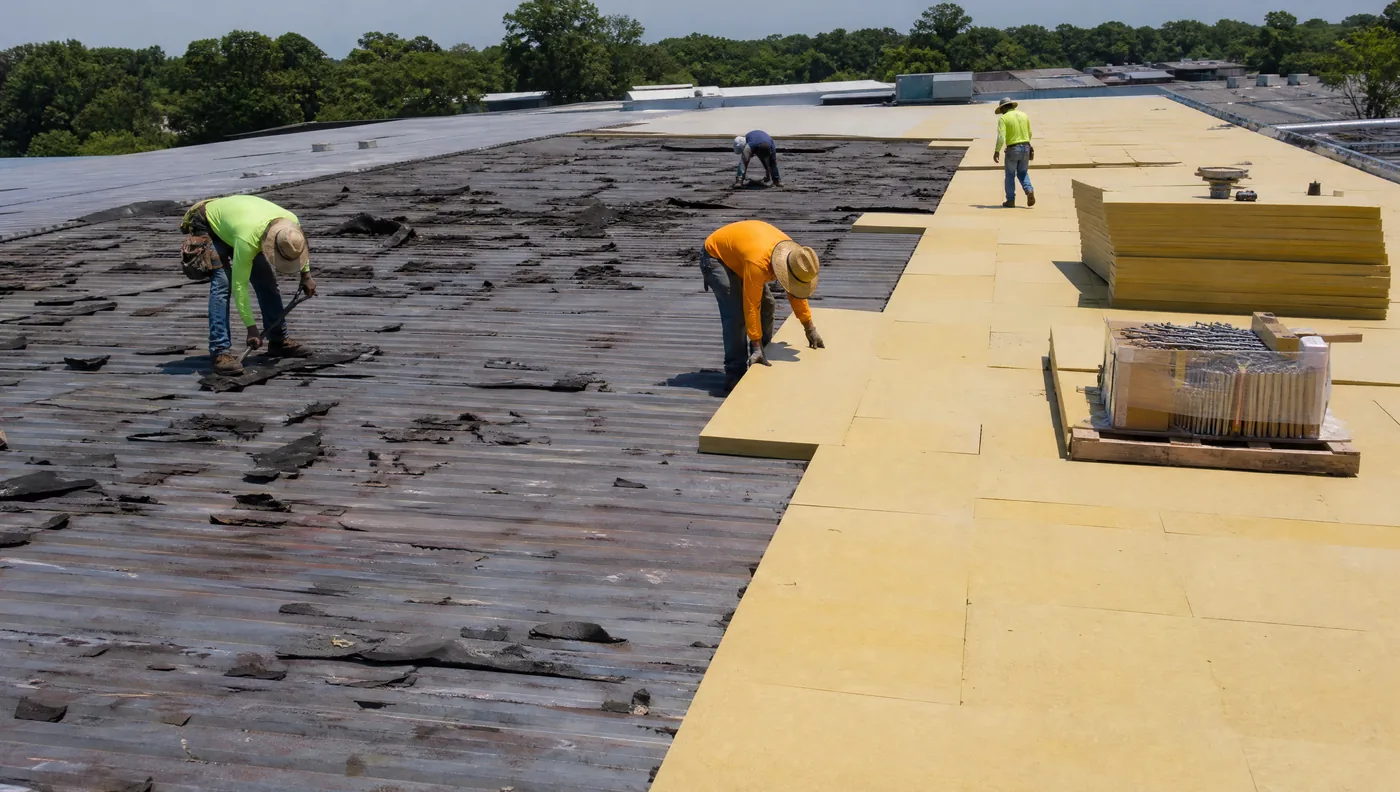
Commercial roof replacement in Houston costs between $6.00 and $12.00 per square foot installed, and takes anywhere from a week on a small retail building to two months on a large distribution centre. A replacement means tear-off to the deck, deck repair, new insulation to current code, cover board and a new membrane with a manufacturer warranty registered on it.
A recover, or overlay, is different: a new membrane installed over the existing roof without tearing it off. Cheaper, faster, less disruptive, and only available under specific conditions. Houston issues two different permit worksheets for the two jobs, CE-1076 for a re-roof and CE-1104 for an overlay, which is the clearest possible signal that the city treats them as different work.
Replace or recover
Should you tear off or recover?
Recover if the existing roof is dry and you have not already recovered once. Tear off if either of those is untrue.
The building code allows one recover over an existing roof. A second one is not permitted, which means a building already carrying two roof systems has no choice left. Core cuts tell us how many are up there, and it is genuinely common to find three on older Houston buildings put on by people who did not check.
Recover is also off the table if the existing insulation is wet, because you would be sealing saturated material permanently into the assembly, and if the deck needs substantial repair, because you cannot get at it without removing what is on top.
The dead-load question nobody asks
Every roof system you add puts weight on the structure. A four-ply built-up roof with gravel is a genuinely heavy assembly, and a building carrying two of them plus new insulation and a membrane may be at or over what the deck and joists were designed for. On any building where we find more than one existing system, we recommend a structural engineer signs off on the load before we recover rather than tear off. It is a small fee against a very bad outcome.
The code trigger
What the energy code does to a tear-off
A full replacement triggers the current energy code. A recover generally does not, and that difference is worth real money.
Houston adopted the 2021 International Codes, including the 2021 IECC under Ordinance No. 2023-907, effective January 1, 2024. Houston sits in climate zone 2A. When a roof assembly with insulation entirely above the deck is replaced, the code requires the new assembly to meet the current continuous insulation requirement, which is R-25, and it separately prohibits the replacement from reducing the assembly's R-value. In practice R-25 means about 4.4 inches of polyiso in two staggered layers.
If your building has been running an inch and a half of polyiso since the nineties, you are adding roughly two and a half inches of thickness to the roof. That is not just the cost of the boards. It changes:
- Edge metal and coping heights. New, taller, fabricated to suit.
- Drain sumps. The drains do not move up with the roof, so each one needs a tapered sump built around it or the roof ponds at every drain.
- Curb heights. Code wants eight inches of flashing height above the finished roof surface. Raise the roof and some curbs no longer have it, so they get extended, and that is mechanical work as well as roofing work.
- Door thresholds and equipment pads where a roof hatch or a penthouse door now sits too low.
None of this is exotic and all of it is normal on a Houston re-roof. What is not normal is a bid that fails to mention it. If two bids are within a few percent of each other and only one names an insulation thickness, they are not pricing the same job. Full detail in the permit and code guide.
Talk to a roofer
Get a specification you can actually compare
We will walk the roof, take cores, and write a scope that states the membrane thickness, the insulation R-value, the attachment method and the unit rates. Then take it and hold your other bidders to the same standard.
Call (281) 720-3785- A roofer picks up, not a call centre
- Line-item written scope before anything is torn off
- Progress billing tied to milestones, never 85% up front
Programme
How long a commercial roof replacement takes in Houston
Working days on the roof, excluding permit and material lead time. Weather is the wildcard: a Houston summer gives you productive mornings and afternoon thunderstorms, so we plan tear-off around the forecast rather than the calendar.
| Roof area | On-roof duration | Typical crew | Add for tapered / heavy tear-off |
|---|---|---|---|
| Under 5,000 sq ft | 3 – 5 days | 4 – 6 | +1 – 2 days |
| 5,000 – 15,000 sq ft | 1 – 2 weeks | 6 – 8 | +3 – 5 days |
| 15,000 – 40,000 sq ft | 2 – 4 weeks | 8 – 12 | +1 week |
| 40,000 – 100,000 sq ft | 4 – 8 weeks | 12 – 18 | +1 – 2 weeks |
| Over 100,000 sq ft | 2 – 4 months | 18+ | +2 – 4 weeks |
Add 10 business days of City of Houston plan review and four to six weeks of polyiso lead time before any of this starts. Tearing off a four-ply gravel built-up roof roughly doubles the removal time and the disposal cost against a single-ply tear-off.
The sequence
The sequence, start to finish
A 30,000 square foot single-ply replacement on an occupied building, which is the most common job we do, runs roughly like this.
- Survey, cores and moisture scan. Two to three days. We need to know what is up there before anybody prices anything.
- Specification and bid. System, thickness, R-value, attachment, edge detail, warranty term, unit rates, draw schedule. About a week.
- Permit. Application, worksheet CE-1076, plans where required, plan review. Allow 10 business days and do not let anybody tell you it happens overnight.
- Materials. Membrane and fasteners are usually quick. Polyiso runs on allocation periodically and tapered systems are made to order, so four to six weeks is normal and worth knowing before you set a date.
- Mobilisation. Crane or hoist set, ground protection down, dumpster placed, safety perimeter established, tenant notification out.
- Tear-off and install, in sections. The crew opens only what it can dry in before it leaves. Two to six weeks depending on size and weather.
- Sheet metal, terminations and details. Usually the longest part relative to its square footage and the part that decides whether the roof lasts.
- Inspection, warranty registration and close-out. City inspection, manufacturer inspection where the warranty requires it, as-built documentation and the closed permit handed to you.
Scheduling around you
Working over tenants, production and stock
Almost nothing we re-roof is empty. The building is trading, running shifts or storing somebody's inventory, and the roofing schedule has to bend around that rather than the other way round.
What that looks like in practice: sectioning the roof so no part of the building is ever open to weather at the end of a shift, working night or weekend hours over retail and restaurant tenants, coordinating with plant turnarounds so the noisy work lands in a window when the line is down anyway, and dust and debris containment over sensitive areas. On a food plant in the northwest last year we worked entirely at weekends for six weeks because the production schedule left us no other option, and that is a legitimate cost that belongs on the bid rather than as a surprise.
Tell us who is underneath and when they cannot be disturbed. It shapes the price and the programme, and it is far better dealt with in the bid than in week three.
Buildings we cover
Commercial re-roofing and replacement across the Houston metro:
Commercial roofing in Bellaire, Stafford commercial roofing, commercial roofers in Pasadena, Channelview, TX, Commercial roofing in Humble, Deer Park commercial roofing, commercial roofers in Katy, Sugar Land, TX, Commercial roofing in Cypress, Spring commercial roofing, commercial roofers in La Porte, Baytown, TX, Commercial roofing in Tomball, and The Woodlands commercial roofing and every submarket we work.
Related work
Straight answers
Questions we get on this specifically
Can I re-roof one section now and the rest next year?
Yes, and phasing across budget years is very common on large buildings. Two things to watch. Warranty coverage is issued per section rather than for the whole roof, so you end up with different expiry dates and a tie-in detail between old and new that has to be made properly. And the price per square foot goes up on the smaller phases because you are paying to mobilise more than once. Plan the phases along a natural break such as an expansion joint or a firewall rather than through the middle of a field.
Do I need a structural engineer?
Usually not, occasionally yes. You need one if we find more than one existing roof system and you want to recover rather than tear off, if the deck shows deflection or corrosion, if you are going from a lightweight membrane to a heavy assembly, or if rooftop equipment is being added at the same time. On a straightforward like-for-like single-ply replacement on a steel deck, no.
How disruptive is the tear-off, honestly?
Noisy, and that is the part people underestimate. Tear-off on a steel deck transmits straight into the space below and it is genuinely hard to work under. Odour is a factor with hot asphalt work, which is one of several reasons we specify self-adhered and mechanically attached systems on occupied buildings. Debris is manageable with containment. Nothing about it is dangerous to the people underneath if the sequencing is right, but if you have a call centre or a medical suite under that roof, schedule the tear-off at night and budget for it.
What warranty do I get?
A manufacturer system warranty, typically 15, 20 or 30 years depending on the system and thickness specified, plus our own workmanship warranty on top. The manufacturer warranty is the one worth having because it covers materials and, on full-system NDL coverage, labour to repair. Two conditions people miss: it requires documented maintenance, which is one reason we push maintenance programmes, and it is void if another trade penetrates the roof without your roofer flashing it. Read the wind-speed exclusion carefully too, because in a hurricane market that clause matters more here than almost anywhere.
Talk to a roofer
Want a number on this roof?
Call and describe the building. If it needs a survey we will come and walk it, and there is no charge for that whether or not you use us.
Call (281) 720-3785- A roofer picks up, not a call centre
- Line-item written scope before anything is torn off
- Progress billing tied to milestones, never 85% up front