
EPDM & PVC membrane · Houston
EPDM & PVC Roofing in Houston, TX
Two membranes that both get described as alternatives to TPO, which is unhelpful, because they solve completely different problems and one of them is the only correct answer for a building with a commercial kitchen on it.
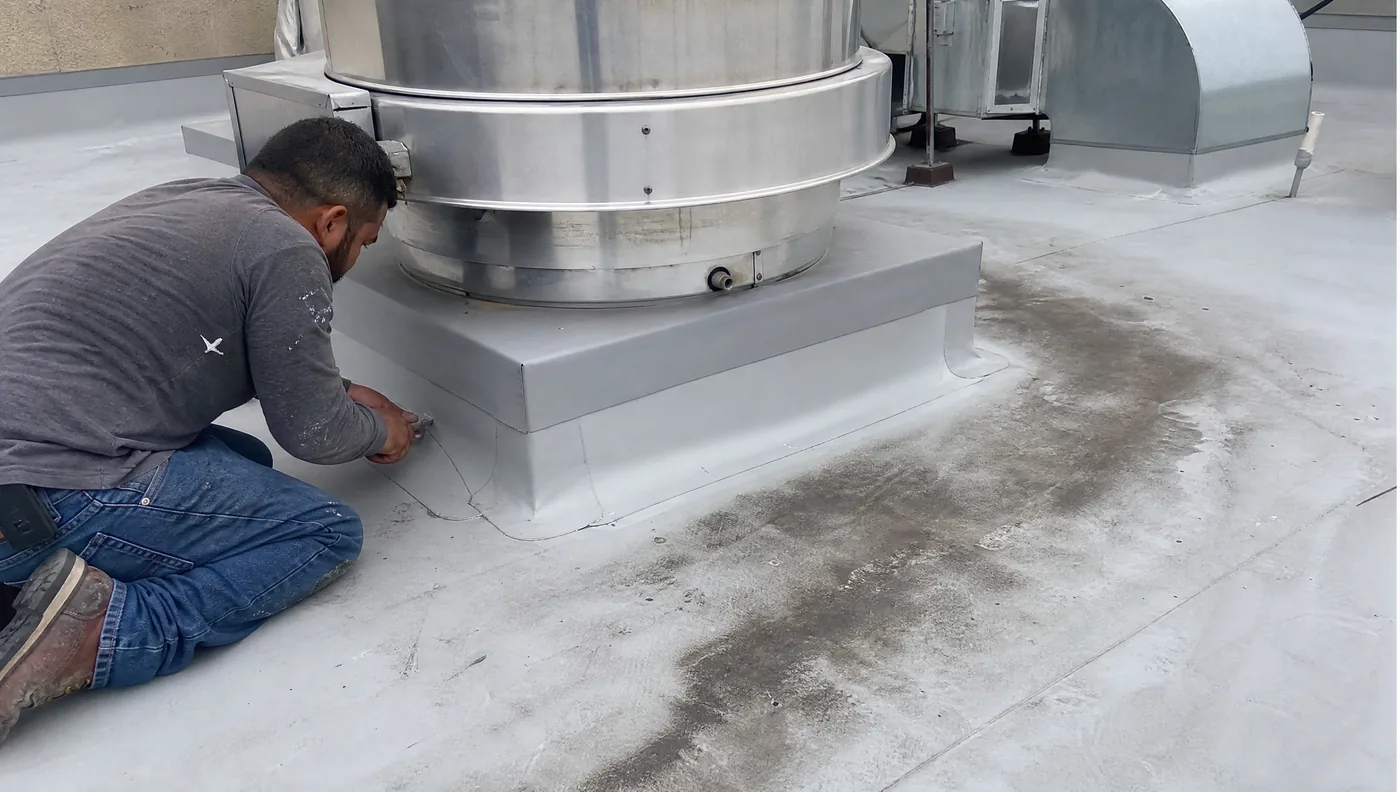
PVC and EPDM are single-ply commercial roof membranes. PVC is a hot-air welded thermoplastic like TPO but chemically different, and it is the right specification for any Houston building with grease, animal fats or chemical exhaust hitting the roof. EPDM is synthetic rubber, black, seamed with adhesive tape rather than heat, and it is the tough, forgiving, easily repaired option where reflectivity is not the priority.
Picking between them is not a matter of preference. It is a question about what lands on your roof.
PVC
PVC: the only membrane to put on a restaurant roof
Install PVC on any building where kitchen exhaust, grease, animal fats, oils or chemical vapour reach the roof surface. Not because PVC is better generally, but because TPO degrades on contact with them and PVC does not.
This matters more in Houston than people assume, because it is not only restaurants. Commissary kitchens, food processing, bakeries, hotel and hospital kitchens, and industrial buildings venting solvents or process exhaust all have the same problem: a plume of something aggressive settling on a membrane for twenty years. There is a visible signature to it, a discoloured, softened, sometimes sticky halo downwind of the exhaust fan, and once you know to look for it you see it on half the retail centres in the city.
PVC is also the more flexible membrane in cold weather and holds welds well on complex detailing, which makes it a reasonable choice on a roof with a very large number of penetrations. The trade-off is price: expect $8.00 to $13.00 a square foot installed against $6.50 to $9.50 for equivalent TPO. On a restaurant roof, pay it. The alternative is replacing a TPO roof at year eight because nobody asked what the fan was venting.
We install GAF EverGuard PVC, Sika Sarnafil, Duro-Last and Johns Manville PVC systems. Duro-Last in particular is worth knowing about on a roof with many penetrations, because the deck sheets and the flashings are prefabricated in a factory to your measurements and welded on site, which moves a lot of the fiddly detail work into controlled conditions.
EPDM
EPDM: black rubber, and where it still wins
EPDM is the toughest and most forgiving of the single-ply membranes, and the easiest to repair. It is a genuinely good specification on buildings where puncture resistance matters more than reflectivity and where the roof is not sitting in permanent full sun over conditioned space.
The honest case against it in Houston is thermal. A black membrane in climate zone 2A absorbs an enormous amount of heat, and on a conditioned building that goes straight into your cooling load. White EPDM exists and closes some of that gap at a price premium that usually makes TPO the better buy instead.
Where we do specify EPDM here:
- Unconditioned buildings. Cold stores aside, if you are not air conditioning underneath it, the reflectivity argument mostly evaporates.
- Roofs taking heavy abuse. EPDM resists punctures better than TPO of the same thickness and it can be patched by any competent roofer with a roll of tape and a primer.
- Buildings where the maintenance team wants to be able to fix small things themselves without a hot-air welder.
- Ballasted systems on large simple roofs, though we are installing far fewer of these than we used to because of the wind and load questions they raise.
Modern EPDM seams are made with factory-applied seam tape rather than the liquid adhesives of the eighties, and the difference in longevity is substantial. If somebody tells you EPDM seams fail, they are describing a roof installed thirty years ago.
Talk to a roofer
Not sure what is landing on your roof?
Tell us what the building does and what the exhaust fans are venting. That single question decides the membrane, and getting it wrong costs a roof.
Call (281) 720-3785- A roofer picks up, not a call centre
- Line-item written scope before anything is torn off
- Progress billing tied to milestones, never 85% up front
Comparison
PVC, EPDM and TPO on a Houston roof
Same building, same square footage, three specifications. The right answer depends far more on what is venting onto the roof than on which membrane a salesman prefers.
| PVC | EPDM | TPO | |
|---|---|---|---|
| Installed cost, 60 mil | $8.00 – $13.00 | $6.00 – $9.50 | $6.50 – $9.50 |
| Service life | 20 – 30 yrs | 20 – 25 yrs | 20 – 25 yrs |
| Reflectivity | high, white | low, black | high, white |
| Grease & chemical resistance | excellent | poor | poor |
| Seam method | hot-air welded | taped | hot-air welded |
| Puncture resistance | good | excellent | good |
| Owner-repairable | no | yes | no |
| Best suited to | kitchens, food plants, chemical exhaust | unconditioned, high abuse, in-house maintenance | warehouses, retail, offices, most low-slope |
Cost ranges collected in July and August 2026 from Houston commercial quotes and supply pricing, all figures for a mechanically attached system including tear-off and code-required insulation. Service life assumes a maintained roof with walkway pads on service routes.
Against TPO
So which one, against TPO?
Choose on what hits the roof, then on what walks on it, then on price.
- Grease, oils or chemical exhaust on the roof? PVC. This overrides everything else.
- Conditioned space underneath and a sunny exposed roof? TPO or PVC, both white, both reflective. Not black EPDM.
- Heavy foot traffic or high puncture risk? 80 mil of whichever thermoplastic you pick, or EPDM, and walkway pads regardless.
- Do you need in-house repairability? EPDM, or modified bitumen.
- Everything else on a normal Houston commercial building? 60 mil TPO, which is why it is on most of them.
All seven systems compared side by side with cost, lifespan and best use.
Detailing
Where these roofs get made or ruined
The membrane choice decides less than the detailing does. Three details account for most of the failures we are called to on single-ply roofs of any type.
Curb flashings. Code and every manufacturer want eight inches of flashing height above the finished roof. On a re-roof that adds insulation thickness, curbs that used to have eight inches no longer do, and the answer is to extend the curb, not to run the flashing short and hope.
Terminations. Every point where the membrane stops has to be mechanically fastened and sealed. Termination bar with sealant at the top edge, not adhesive alone, because adhesive alone at a termination is a two-year detail.
Drains. The membrane has to be clamped into the drain body with a proper clamping ring, and the field around the drain has to fall into it. A drain sitting proud of a sunken field is not a drain, it is an ornament, and it is astonishing how often we find exactly that.
Buildings we cover
PVC and EPDM membrane roofing across the Houston metro:
Commercial roofing in Bellaire, Stafford commercial roofing, commercial roofers in Pasadena, Channelview, TX, Commercial roofing in Humble, Deer Park commercial roofing, commercial roofers in Katy, Sugar Land, TX, Commercial roofing in Cypress, Spring commercial roofing, commercial roofers in La Porte, Baytown, TX, Commercial roofing in Tomball, and The Woodlands commercial roofing and every submarket we work.
Related work
Straight answers
Questions we get on this specifically
My TPO roof has gone soft and sticky near the kitchen vent. Is that fixable?
The affected area has to be cut out and replaced, and it will happen again unless the specification changes there. The usual fix is a PVC or grease-resistant membrane target patch welded in around the exhaust with a generous margin, plus a proper grease containment box on the fan so the plume stops landing on the roof at all. If the affected area is large it is worth pricing a full PVC replacement, because patching TPO repeatedly around a fan that keeps venting grease is money into a hole.
Is PVC worth double the price of EPDM?
Only if you need what it does. On a warehouse with nothing but a couple of vent pipes, no. On a building with a commercial kitchen, absolutely, because the alternative is a membrane that will fail early and take the insulation under it with it. Price the membrane against what your building actually does rather than against the other bid on the desk.
Can PVC and TPO be welded to each other?
No. They are chemically different thermoplastics and they will not bond to each other, which matters on a phased re-roof or a target patch. The tie-in between a PVC section and a TPO section has to be a mechanical detail with a proper termination on both sides, not a weld. Any contractor proposing to weld one to the other has told you something important about how much they know.
What about ballasted EPDM? There is rock all over my roof.
Ballasted EPDM was very common on large flat roofs and quite a lot of it is still running around Houston. It works, and it has two real drawbacks. The rock hides the membrane, so leaks are hard to find and the roof cannot be properly inspected without moving ballast. And the dead load is significant, which becomes a live question if anybody wants to add rooftop equipment or a second system. When we take one of these buildings over we usually recommend scanning it rather than trying to walk it, because you simply cannot see anything.
Talk to a roofer
Want a number on this roof?
Call and describe the building. If it needs a survey we will come and walk it, and there is no charge for that whether or not you use us.
Call (281) 720-3785- A roofer picks up, not a call centre
- Line-item written scope before anything is torn off
- Progress billing tied to milestones, never 85% up front