
Flat & low-slope · Houston
Flat & Low-Slope Commercial Roofing in Houston
Flat roofs are not flat, and the difference between a flat roof that lasts twenty years and one that fails at eight is almost never the membrane. It is whether the water can get off it.
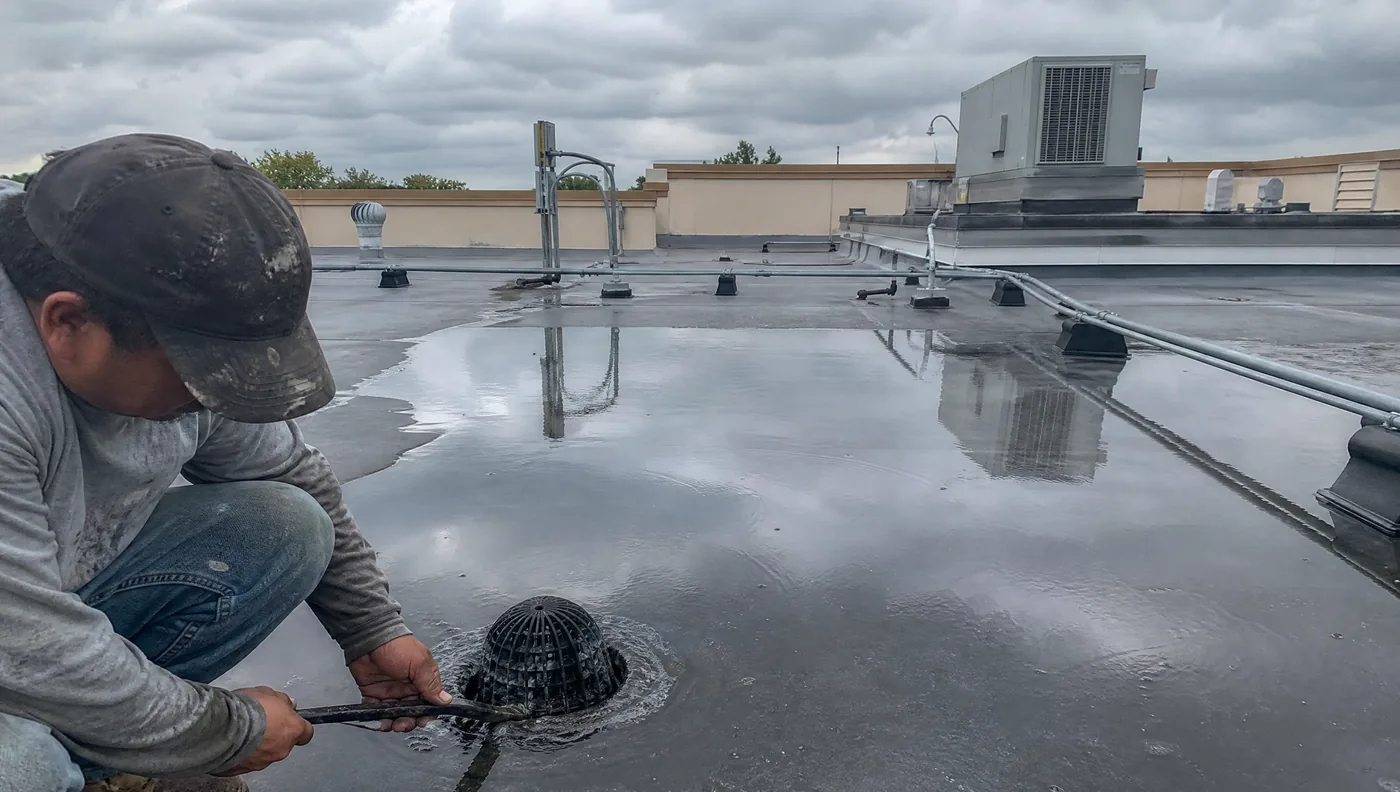
Flat and low-slope roofing covers everything under a 3:12 pitch, which is almost every commercial building in Houston. We install and repair all the low-slope systems: TPO, PVC, EPDM, modified bitumen, built-up and coatings, on warehouses, retail centres, offices, schools, plants and multi-tenant buildings.
The single most important thing about a flat roof in this city is drainage, because Houston delivers rainfall in quantities that expose every design shortcut somebody took in 1987.
The ponding problem
Ponding water, and why 48 hours is the number
Water standing on a roof more than 48 hours after rainfall stops is ponding, and it is a defect rather than a characteristic. That 48-hour threshold is the industry definition and it is what manufacturer warranties are written against.
Ponding does four things and they compound.
- Weight. Water is a little over five pounds per square foot per inch of depth. A pond deflects the deck, which deepens the pond, which adds weight. This runs away from you on a long-span structure.
- Biology. Standing water grows algae and then vegetation, and roots find seams. It sounds far-fetched until you have seen a small tree growing out of a parapet corner on a Houston retail centre, which we have, more than once.
- Accelerated ageing. Membranes and especially asphalt surfaces degrade faster under permanent water.
- Warranty. Most manufacturer warranties exclude damage caused by ponding, which means the ponding area is effectively uncovered.
The code position is that a roof should have a quarter inch per foot of fall to a drainage point. A very large number of Houston commercial buildings do not have it, because they were built before that was enforced or because the structure has deflected since.
Building slope in
Building slope into a roof that does not have any
You cannot change the structure, so you build the slope into the insulation. This is design work, not a materials selection, and it is where a competent flat roofing contractor earns the difference.
The tools:
- Tapered polyiso. Insulation boards manufactured in a wedge, usually in 1/8, 1/4 or 1/2 inch per foot slopes, laid out to a drawing so the whole field falls to the drains. It is made to order from a layout your contractor produces, which is why it has a lead time and why the layout is worth checking.
- Crickets and saddles. Tapered sections built behind curbs, walls and between drains to divert water around obstructions instead of letting it collect upslope of them. Every rooftop unit larger than about four feet across should have a cricket behind it and a remarkable number do not.
- Sumps at the drains. A tapered recess around each drain so the last two feet fall into it properly. Without a sump the drain sits proud of a settled field and simply does not drain.
- Additional drains or scuppers. Sometimes the cheapest answer is another drain rather than three hundred squares of tapered insulation, and that is a plumbing job as much as a roofing one.
Tapered insulation adds meaningfully to a bid, on the order of $1.50 to $4.00 a square foot over flat stock depending on how much slope has to be built. It is also the difference between a roof that works and one that does not, so when you see two bids and one is notably cheaper, check whether tapered is in it.
Talk to a roofer
Water still sitting up there two days after it rains?
That is a defect, not a quirk, and it is voiding the warranty on that part of the roof. Call and we will work out whether it needs tapered insulation, a cricket, a sump or just a drain clearing.
Call (281) 720-3785- A roofer picks up, not a call centre
- Line-item written scope before anything is torn off
- Progress billing tied to milestones, never 85% up front
Drainage
What tapered insulation and drainage work costs
These are the lines that separate two flat roofing bids that look identical on membrane and price. Ask every bidder which of these are included.
| Item | Typical cost | When you need it | Notes |
|---|---|---|---|
| Tapered polyiso, 1/8 in per ft | $1.50 – $2.60 / sq ft | minor correction | over and above flat stock insulation |
| Tapered polyiso, 1/4 in per ft | $2.40 – $4.00 / sq ft | code-compliant fall | the standard specification |
| Crickets behind curbs | $450 – $1,600 each | any unit over ~4 ft wide | prevents upslope ponding at equipment |
| Drain sump, tapered | $700 – $1,900 each | settled or proud drains | the last two feet of fall into the drain |
| New roof drain, cut in | $1,800 – $4,500 each | insufficient drainage points | roofing plus plumbing, needs interior access |
| Overflow scupper through parapet | $900 – $2,400 each | no secondary drainage | code requirement, frequently missing |
| Drain strainer dome | $60 – $180 each | always | missing on roughly half the roofs we survey |
| Drain clearing, per visit | $250 – $650 | twice yearly minimum | highest-return maintenance task on a flat roof |
Ranges collected from Houston commercial quotes in July and August 2026. Tapered insulation costs are the premium over flat stock, not the total insulation cost, and vary with how much slope has to be built and how complex the layout is.
Drainage
Drains, scuppers and the thing nobody maintains
Roof drains block. That is the whole of it, and it causes more preventable damage on Houston flat roofs than any material failure.
A blocked drain turns a working roof into a swimming pool during a rainfall event, and Houston rainfall events are not gentle. The load is the danger: an inch of water across a 30,000 square foot roof is about 78 tons. Deck collapses from blocked drains are rare and they do happen, and they happen in storms, which is when nobody is up there looking.
What a roof should have:
- Strainer domes on every drain, in place and unbroken. They cost almost nothing and they are missing on half the roofs we survey.
- Overflow provision. Either secondary drains or overflow scuppers through the parapet, set above the primary drain level, so that if the primaries block the water leaves the building rather than accumulating. This is a code requirement and it is genuinely often absent on older buildings.
- Drains cleared at least twice a year, and after any significant wind event that deposits debris.
Clearing drains is the single highest-return maintenance task on a flat roof and it takes an afternoon. It is the core of what our maintenance programme does.
Systems
Which system for a flat roof in Houston
For most buildings, 60 mil TPO. The reflectivity earns its keep every summer here and the cost is reasonable.
The exceptions are worth knowing and they are all about what the building does rather than what it looks like. Grease or chemical exhaust means PVC. Heavy foot traffic and in-house repairability means modified bitumen. A sound existing roof that is dry means a restoration coating rather than any new membrane at all. An unconditioned building removes most of the reflectivity argument and opens EPDM back up.
The seven systems compared with cost, lifespan and best use.
Buildings we cover
Flat and low-slope commercial roofing across the Houston metro:
Commercial roofing in Bellaire, Stafford commercial roofing, commercial roofers in Pasadena, Channelview, TX, Commercial roofing in Humble, Deer Park commercial roofing, commercial roofers in Katy, Sugar Land, TX, Commercial roofing in Cypress, Spring commercial roofing, commercial roofers in La Porte, Baytown, TX, Commercial roofing in Tomball, and The Woodlands commercial roofing and every submarket we work.
Related work
Straight answers
Flat roof questions
How much slope should a flat roof have?
A quarter inch per foot to a drainage point, which is the building code minimum for new low-slope roofs. Older buildings were frequently built dead flat and the code did not require it, so they are not illegal, they are just permanently prone to ponding until somebody builds slope in with tapered insulation.
Is standing water on my roof after a storm normal?
For a day, yes. After 48 hours it is ponding and it is a defect. Houston gets serious rainfall so it is worth checking two days after a real storm rather than during one. Mark the standing areas with chalk or take photographs from a consistent spot, and if the same four spots hold water every time, you have a drainage problem with a location rather than a mystery.
Can you fix ponding without replacing the whole roof?
Frequently yes. If the ponding is localised, tapered crickets, a rebuilt drain sump or an added drain will deal with it as a targeted repair. If the whole field is dead flat and settled, correcting it properly means tapered insulation across the roof, and at that point you are doing a re-roof anyway so it makes sense to combine them. We will tell you which of the two you have after walking it, and the honest answer is more often the first one than the trade generally admits.
What is the cheapest flat roof I can put on my building?
A restoration coating over the roof you already have, if it is dry and sound, at $2.25 to $4.75 a square foot. If the existing roof is finished, the cheapest new membrane is 45 mil mechanically attached TPO at around $6 a foot, and we generally advise against it because 60 mil costs very little more and lasts substantially longer. The genuinely cheapest roof over twenty years is almost never the cheapest roof today, which is a tedious thing for a roofer to say and it is still true.
Talk to a roofer
Want a number on this roof?
Call and describe the building. If it needs a survey we will come and walk it, and there is no charge for that whether or not you use us.
Call (281) 720-3785- A roofer picks up, not a call centre
- Line-item written scope before anything is torn off
- Progress billing tied to milestones, never 85% up front