
Modified bitumen · Houston
Modified Bitumen Roofing in Houston, TX
Everyone in this trade will tell you single-ply is the modern answer, and mostly they are right. Then you meet a facilities manager who has been patching his own mod bit roof with a bucket and a torch for fifteen years, and the argument gets more interesting.
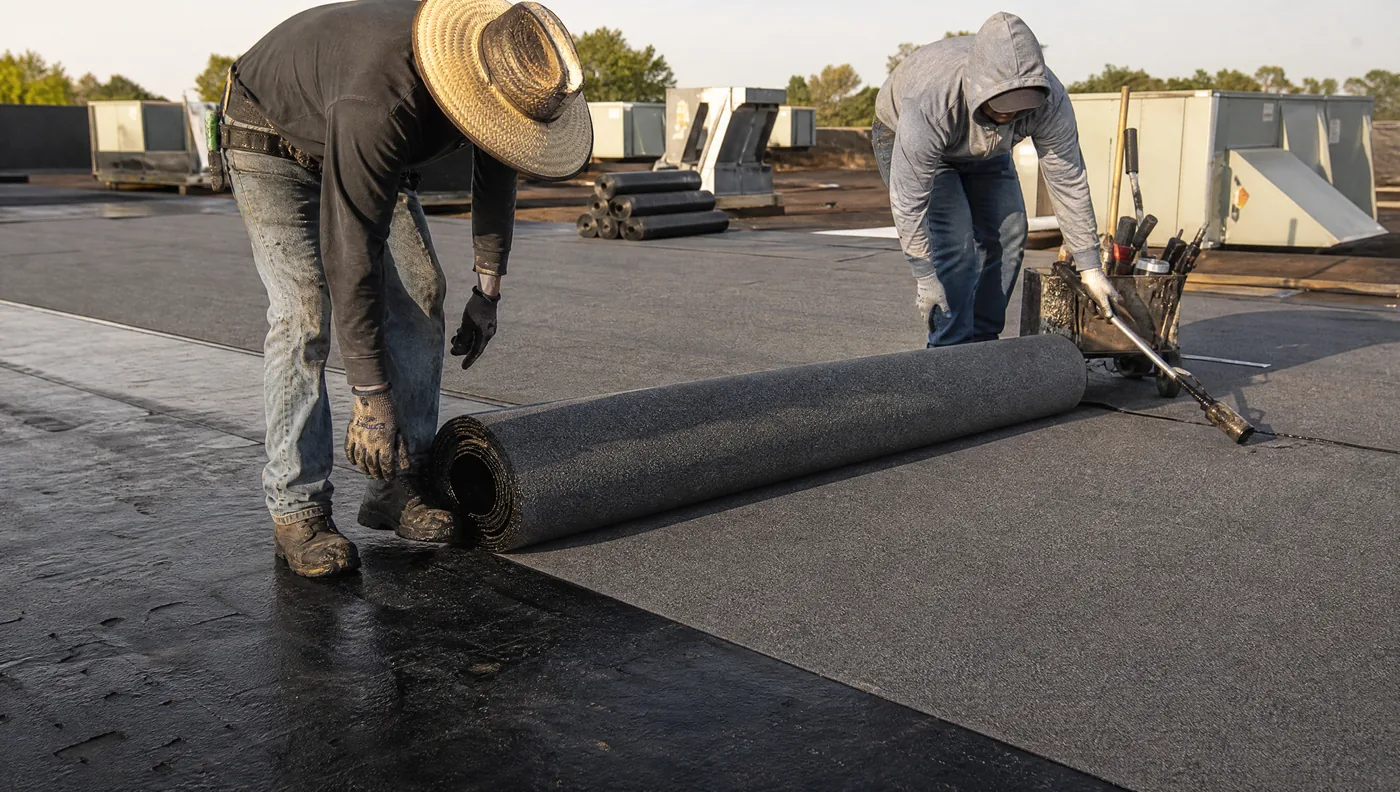
Modified bitumen is a two-ply asphalt roofing system: a base sheet and a cap sheet, with polymer modifiers added to the asphalt so it stays flexible instead of going brittle. It costs $7.00 to $11.50 per square foot installed in Houston and lasts 18 to 25 years.
Two chemistries, and the difference decides how it goes down. APP is modified with plastic and is torch-applied. SBS is modified with rubber and can be self-adhered, cold applied or hot mopped. In Houston that distinction matters more than usual, because a great many of the buildings we work on will not permit an open flame anywhere on site.
APP or SBS
APP versus SBS, and why Houston tilts toward SBS
Specify SBS on any occupied, industrial or fire-sensitive building, and APP where torching is genuinely acceptable and the budget is tight.
- APP modifiedAtactic polypropylene. Plastic modifier, higher heat tolerance, torch applied. Cheaper, faster, and an open flame on your roof.
- SBS modifiedStyrene butadiene styrene. Rubber modifier, stays flexible in a wider temperature range, better elongation over movement.
- ApplicationSBS can be self-adhered, cold adhesive applied, hot mopped in asphalt, or torched. APP is essentially torch only.
- StandardsASTM D6222 covers SBS, ASTM D6164 covers polyester-reinforced SBS, ASTM D6223 and D6509 cover APP grades.
- SurfaceGranulated cap sheet, smooth cap for coating, or a foil-surfaced cap where reflectivity matters and a coating is not wanted.
The practical reason we specify SBS on most Houston commercial work is not performance, it is insurance and site rules. Torch-applied roofing is an open flame on a roof full of combustible material, and the trade's own view of it is blunt: the first question a knowledgeable owner asks about a torch bid is how the contractor's insurer feels about it. Refineries, chemical plants, food facilities and most institutional buildings simply prohibit hot work without a permit, and often prohibit it entirely.
Self-adhered SBS goes down cold, which removes the argument completely. It is a bit more expensive per square and it takes a properly primed, genuinely clean substrate to bond, which is a discipline question rather than a materials one.
The real case for it
Why anyone still specifies a two-ply asphalt roof
Three arguments, and all three are better than the trade generally admits.
Redundancy
Modified bitumen is two independent plies fully bonded to each other. A puncture through the cap sheet does not put water in the building, because there is still a base sheet under it. A puncture through a single-ply membrane does. This is not a small difference on a roof that gets walked.
Repairability
Any roofer in Houston can patch a mod bit roof with materials from any supply house. No hot-air welder, no manufacturer certification, no proprietary anything. If your maintenance team can handle a bucket of mastic and a roll of patch, they can deal with small problems the day they appear rather than waiting for a contractor. Over twenty years that is worth real money and a lot less water in the building.
Foot traffic
A granulated cap sheet takes abuse that a 60 mil membrane does not enjoy. On roofs with a lot of rooftop equipment and technicians on them weekly, mod bit holds up genuinely well.
What a "four-ply" mod bit bid usually means
You will see two-ply systems marketed as four-ply, counting two layers of base underlayment along with the two modified plies. It is technically accurate and it is misleading, because the underlayment is there for fire rating and attachment rather than waterproofing. If a bid says four-ply, ask which layers are actually modified bitumen. Usually the answer is two, and the two bids in front of you are the same roof.
Talk to a roofer
Want the mod bit case argued properly?
We install both and we have no dog in the fight. Tell us what walks on the roof and who maintains it, and we will tell you which one your building actually wants.
Call (281) 720-3785- A roofer picks up, not a call centre
- Line-item written scope before anything is torn off
- Progress billing tied to milestones, never 85% up front
Mod bit pricing
Modified bitumen cost in Houston
Installed, including tear-off, disposal and code-required insulation. Note the self-adhered premium: it is the price of not putting an open flame on your building, and on most sites it is not optional anyway.
| System | Installed cost | Service life | Notes |
|---|---|---|---|
| APP 2-ply, torch applied | $7.00 – $9.50 | 18 – 22 yrs | cheapest mod bit, hot work permit required |
| SBS 2-ply, self-adhered | $8.00 – $11.00 | 20 – 25 yrs | no flame, our default on occupied buildings |
| SBS 2-ply, cold adhesive | $8.50 – $11.50 | 20 – 25 yrs | good bond on awkward substrates, odour on occupied sites |
| SBS 2-ply, hot mopped | $7.50 – $10.00 | 20 – 25 yrs | kettle on site, odour and traffic impact |
| Mod bit recover over existing | $5.50 – $8.00 | 15 – 20 yrs | one recover only, dry substrate required |
| Cap sheet only, over sound base | $4.50 – $6.50 | 12 – 18 yrs | only where the base ply is genuinely sound |
| Mod bit patch repair | $300 – $850 | – | per detail, materials available at any supply house |
Ranges collected from Houston commercial quotes and contractor discussion in July and August 2026. For context on how these numbers land in the real world, two competing bids on the same low-slope job recently came in at $800 per square for TPO against $975 per square for a two-ply modified system, which is the same ordering you see in this table.
Where it goes wrong
Where mod bit roofs fail
Differently from single-ply, and mostly more slowly, which is part of the appeal.
- Seam and lap separation where the torch or adhesive did not achieve full bond. On a torched roof this shows as fishmouthing along the laps within a couple of years.
- Granule loss exposing the asphalt to UV, which then oxidises, hardens and cracks. Granule loss into the gutters is the early warning and it is visible from the ground.
- Blistering where moisture got trapped between plies during installation. Common on roofs installed in Houston humidity without proper substrate drying.
- Ridging and cracking over insulation joints as the assembly moves. Less common with SBS, which is exactly what the rubber modifier is for.
- Shrinkage at penetrations pulling flashing away from the base of pipes and posts.
The useful thing about all five is that they are visible and slow. A mod bit roof generally tells you it is failing for a year or two before it actually lets water in, which is more courtesy than a cold-welded TPO seam extends you.
Over the top
Putting TPO over an existing modified bitumen roof
Common, entirely legitimate, and it needs a separation layer. This comes up on a lot of Houston buildings that took a mod bit roof in the nineties and are now looking at single-ply.
You cannot lay a TPO membrane straight onto asphalt. The plasticisers migrate and the membrane degrades from the back, which is a slow and unfixable failure. The correct assembly puts a separator between them: new polyiso, a cover board such as DensDeck or Securock, or at minimum a slip sheet specified by the membrane manufacturer.
Given that a re-roof adding insulation is likely required to reach R-25 continuous anyway under the code Houston adopted in January 1, 2024, the new polyiso usually solves the separation question as a side effect. Which is convenient, and it is also why "recover in TPO" and "add insulation to code" are frequently the same conversation.
Do check how many systems are already on the deck. The code permits one recover. More on recover versus tear-off here.
Buildings we cover
Modified bitumen installation and repair across the Houston metro:
Commercial roofing in Bellaire, Stafford commercial roofing, commercial roofers in Pasadena, Channelview, TX, Commercial roofing in Humble, Deer Park commercial roofing, commercial roofers in Katy, Sugar Land, TX, Commercial roofing in Cypress, Spring commercial roofing, commercial roofers in La Porte, Baytown, TX, Commercial roofing in Tomball, and The Woodlands commercial roofing and every submarket we work.
Related work
Straight answers
Questions we get on this specifically
Is torch-down roofing safe on an occupied building?
It is done, it is legal with the right hot work procedures, and we avoid it on occupied buildings anyway. An open propane flame on a roof full of asphalt, insulation and decades of accumulated debris carries a real fire risk, and roof fires from torching are a well-documented cause of loss in this industry. If a contractor proposes torch work on your building, ask to see the hot work permit procedure, the fire watch arrangement and, genuinely, ask how their insurer treats torch application. The answer to that last question is informative.
Self-adhered SBS gives you the same roof without the conversation.
My roof is mod bit and it is 22 years old. Coat it or replace it?
Scan it first, then decide. A modified bitumen roof at 22 years with dry insulation underneath and an intact base ply is a very good candidate for a silicone restoration coating, which will give you another ten to fifteen years for roughly a third of the replacement cost. If the insulation is wet across a meaningful share of the field, or the cap has lost most of its granules and is cracking through to the base, coat it and you have wasted the money. The coating decision in full.
What is alligatoring and does it mean my roof is finished?
Alligatoring is the cracked, scaled pattern that appears on an exposed asphalt surface as it oxidises and shrinks, and it looks exactly like the name suggests. On its own it means the surface has aged, not that the roof has failed. If the cracks are shallow and confined to the surfacing, a coating will deal with it. If they run through the plies, water is already getting in. A core cut answers it in ten minutes and there is no way to know from a photograph.
Can I put a mod bit roof over my existing gravel built-up roof?
Only after the gravel comes off, and that is more work than it sounds. Loose aggregate has to be removed or spudded and the surface made smooth enough to bond to, which on a four-ply gravel roof is a genuinely heavy job. Frequently by the time you have priced that, a full tear-off is a marginal extra and you get a code-compliant assembly and a proper warranty out of it. We will price both so you can see the gap.
Talk to a roofer
Want a number on this roof?
Call and describe the building. If it needs a survey we will come and walk it, and there is no charge for that whether or not you use us.
Call (281) 720-3785- A roofer picks up, not a call centre
- Line-item written scope before anything is torn off
- Progress billing tied to milestones, never 85% up front