
Emergency response · Houston
Emergency Commercial Roof Repair in Houston
Water is coming through the deck and there is inventory or equipment underneath it. This is not a quotation exercise. Call and we will get somebody moving.
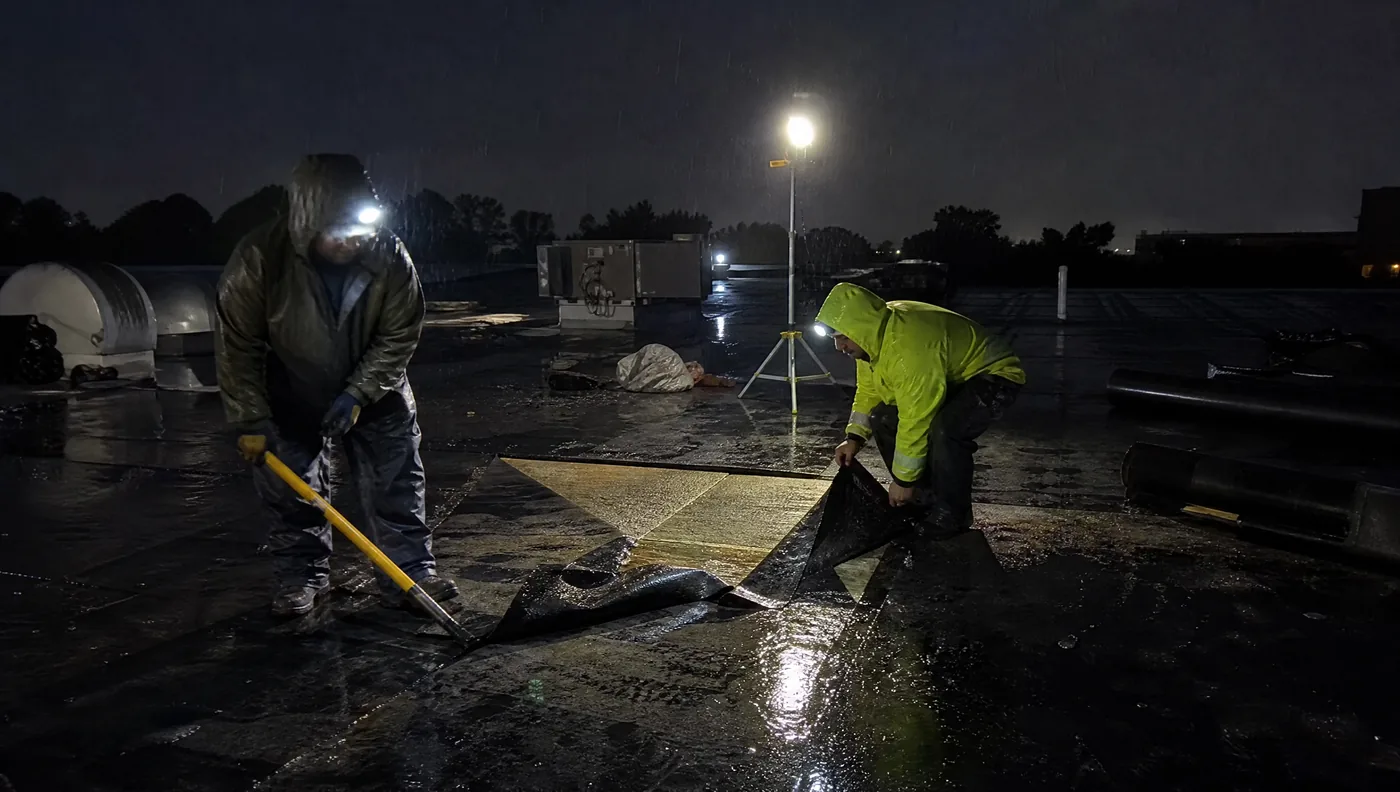
Emergency commercial roof repair means stopping water entering your building tonight, not scheduling an estimate. We answer the phone outside business hours, we carry membrane, self-adhered patch, mastic and shrink-wrap on the trucks, and we dry buildings in across greater Houston through storm season.
The permanent repair gets priced afterwards, in daylight, when everybody can think. Those are two different jobs and treating them as one is how people end up paying emergency rates for work that could have waited until Tuesday.
Before we get there
What to do in the twenty minutes before we arrive
Four things, in this order, and none of them involve going on the roof.
- Kill power to the affected area if water is anywhere near electrical. Light fittings, panels, busway, data racks. This is the only genuinely urgent one.
- Move or cover what you can. Inventory, equipment, paper records. Poly sheeting over a rack takes two minutes and saves a claim.
- Photograph everything, with the timestamp on. The water, the stains, the damaged goods, the buckets. Your insurer will ask and nobody ever has enough photographs from the first hour.
- Relieve a bulging ceiling from a safe distance if it is safe to do so. A ceiling tile holding twenty gallons will come down eventually and you would rather it came down into a bin than onto somebody. Puncture it from the side with a pole, standing clear.
Do not send your maintenance man onto a wet commercial roof in the dark. A wet TPO membrane is genuinely slippery, skylights and smoke hatches are effectively invisible at night, and falls through fragile rooflights kill people in this industry every year. It is covered under OSHA 1926 Subpart M for a reason. Whatever is up there will still be up there when somebody with a harness and a light arrives.
What we do on arrival
What we actually do when we get there
The first pass is triage, not repair. We find where the water is entering, we stabilise it, and we document the condition as we found it.
Stabilising might be a self-adhered patch welded down over a split seam, a section of membrane mechanically fastened over a torn area, shrink-wrap across a section of failed field, a temporary drain path cut to move standing water away from the breach, or a properly ballasted tarp where the damage is too extensive to close. What it is not is a permanent repair, and we will say so on the ticket.
We photograph everything before we touch it. That set of photographs is worth more than people realise: it is the only record of the pre-repair condition, and if this turns into an insurance claim it is the difference between an adjuster taking your word for it and an adjuster looking at dated evidence. Nobody thinks to take those at 10pm in the rain. We do it as standard.
Before we leave you get a plain-language description of what failed, what we did about it, and what the permanent fix looks like. The permanent fix gets quoted the next working day.
Talk to a roofer
Active leak? Call now, not in the morning.
Water in a building compounds every hour it runs. Tell us the address, what is underneath the leak, and whether power is affected.
Call (281) 720-3785- A roofer answers after hours, not a call centre
- Dry-in first, quotation afterwards
- Photographic record taken before we touch anything
Response
Emergency response times across the Houston metro
Realistic drive times from the yard under normal conditions. During a named storm nobody can promise these and anybody who does is guessing, so we triage by severity: active water over live electrical or over occupied space goes first.
| Submarket | Normal response | Post-storm | Notes |
|---|---|---|---|
| Houston inner loop, Bellaire | 60 – 90 min | same day | closest coverage, usually the first calls we clear |
| Stafford, Sugar Land, Katy | 90 min – 2 hrs | same day | Southwest Freeway and Beltway access |
| Pasadena, Deer Park, Channelview | 90 min – 2 hrs | 24 – 48 hrs | plant sites need gate clearance, tell us the contractor gate |
| Spring, Humble, Cypress | 2 hrs | 24 – 48 hrs | north and northwest corridors |
| La Porte, Baytown | 2 – 2.5 hrs | 48 hrs | east of Highway 146, windstorm zone documentation applies |
| Tomball, The Woodlands | 2 – 2.5 hrs | 48 hrs | outer edge of the service radius |
Response windows are from the call being answered, not from a voicemail being returned. Business-hours calls are answered by a person; after hours you get a roofer's mobile, not an answering service.
Storm season
Hurricane season, and the week either side of a named storm
June through November, and the two busiest weeks of our year are always the ones immediately after a system comes through. Houston took two serious wind events eight weeks apart in 2024: the May 16, 2024 derecho with straight-line winds that blew curtain-wall glass out of downtown high rises, and then Hurricane Beryl on July 8, 2024, which put a 84 mph gust through Houston Hobby and did more than six billion dollars of damage across the region.
Two things are true about the aftermath of a storm like that and both work against you. First, every roofer in the city is booked, which means response times stretch from hours to weeks. Second, the city fills up with out-of-state crews who are excellent at signing contracts and variable at everything after that.
The pre-storm call is worth more than the post-storm one
When a system enters the Gulf we run pre-storm checks for maintenance clients: drains and scuppers cleared, loose edge metal secured, anything on the roof that can become a projectile removed or tied down, and a dated photographic record of the roof's condition before the storm. That last one is the single most useful thing you can have when you file a claim, because the argument after every hurricane is always about what was already damaged.
More on documenting storm and hail damage on a commercial roof.
What it costs and why
What emergency work costs, and what we do not do
An emergency dry-in on a commercial building typically runs $800 to $3,500 depending on the size of the breach, the access and the hour. That is a stabilisation charge, and it is separate from the permanent repair.
What we will not do is use the emergency to sell you the roof. It is the oldest move in this trade: turn up at midnight, tell a panicking owner the whole roof is finished, and put a replacement contract in front of him while the water is still coming in. We quote the permanent work in daylight after a proper survey, and if the honest answer is that you need two curb re-flashings and not a new roof, that is what the quote will say.
We also do not ask for payment on the roof at night. Emergency work is invoiced afterwards like everything else.
Buildings we cover
Emergency commercial roof response across greater Houston, including the plants and distribution buildings east of town:
Commercial roofing in Bellaire, Stafford commercial roofing, commercial roofers in Pasadena, Channelview, TX, Commercial roofing in Humble, Deer Park commercial roofing, commercial roofers in Katy, Sugar Land, TX, Commercial roofing in Cypress, Spring commercial roofing, commercial roofers in La Porte, Baytown, TX, Commercial roofing in Tomball, and The Woodlands commercial roofing and every submarket we work.
Related work
Straight answers
Emergency questions, answered plainly
Do you actually answer at 2am?
Yes, on a mobile, and it is a roofer rather than a call handler. Whether we can get a crew moving at 2am depends on what is happening: a genuine active breach over occupied or high-value space gets somebody out, and a slow drip into a bucket in an empty warehouse gets a first-thing-in-the-morning slot and honest advice about it on the phone.
Will you work on the roof in the rain?
For a dry-in, yes, within reason. Self-adhered and mechanically attached temporary repairs can be made in wet conditions. What cannot be done in the rain is anything permanent: hot-air welding needs a clean dry surface, adhesives have temperature and moisture minimums, and insulation laid into standing water is a problem you will be paying for again in three years. If a contractor tells you he can install your permanent roof in the rain, that is worth pausing on.
The failure mode is real and well known in the trade: a crew gets stopped by a thunderstorm mid-job, covers up, and the wet insulation ends up underneath the finished roof. The building then leaks only on warm sunny days, when the trapped moisture drives as vapour, and it takes years to diagnose.
Can you tarp it and I will deal with it after the holidays?
We can, and sometimes that is the right commercial decision. Be clear-eyed about what a tarp is: a ballasted tarp on a commercial roof is good for weeks, not months, and it will move in the first serious wind. If you are deferring into next quarter, a mechanically attached temporary membrane patch costs a bit more and actually survives the wait.
My tenant is threatening rent abatement. Does that change anything?
It changes the urgency and it changes what you should be documenting. Keep a dated log of every report, every response and every remediation, and get the roof condition photographed independently. Most commercial leases give the tenant remedies once a defect goes unremedied for a defined period, so the record of prompt response is what protects you, more than the speed of the permanent repair. We are not lawyers and this is not legal advice, but the paperwork we hand you is built with that argument in mind.
Talk to a roofer
Not an emergency, but heading that way?
If a roof has been on your list for two seasons, the cheapest time to deal with it is now, before hurricane season decides for you.
Call (281) 720-3785- A roofer picks up, not a call centre
- Line-item written scope before anything is torn off
- Progress billing tied to milestones, never 85% up front