
Metal roofing & sheet metal · Houston
Commercial Metal Roofing in Houston, TX
Almost every metal roof leak we get called to is a fastener, a closure or something another trade cut in later. The panels themselves usually have decades left, which is why replacement is so often the wrong first answer.
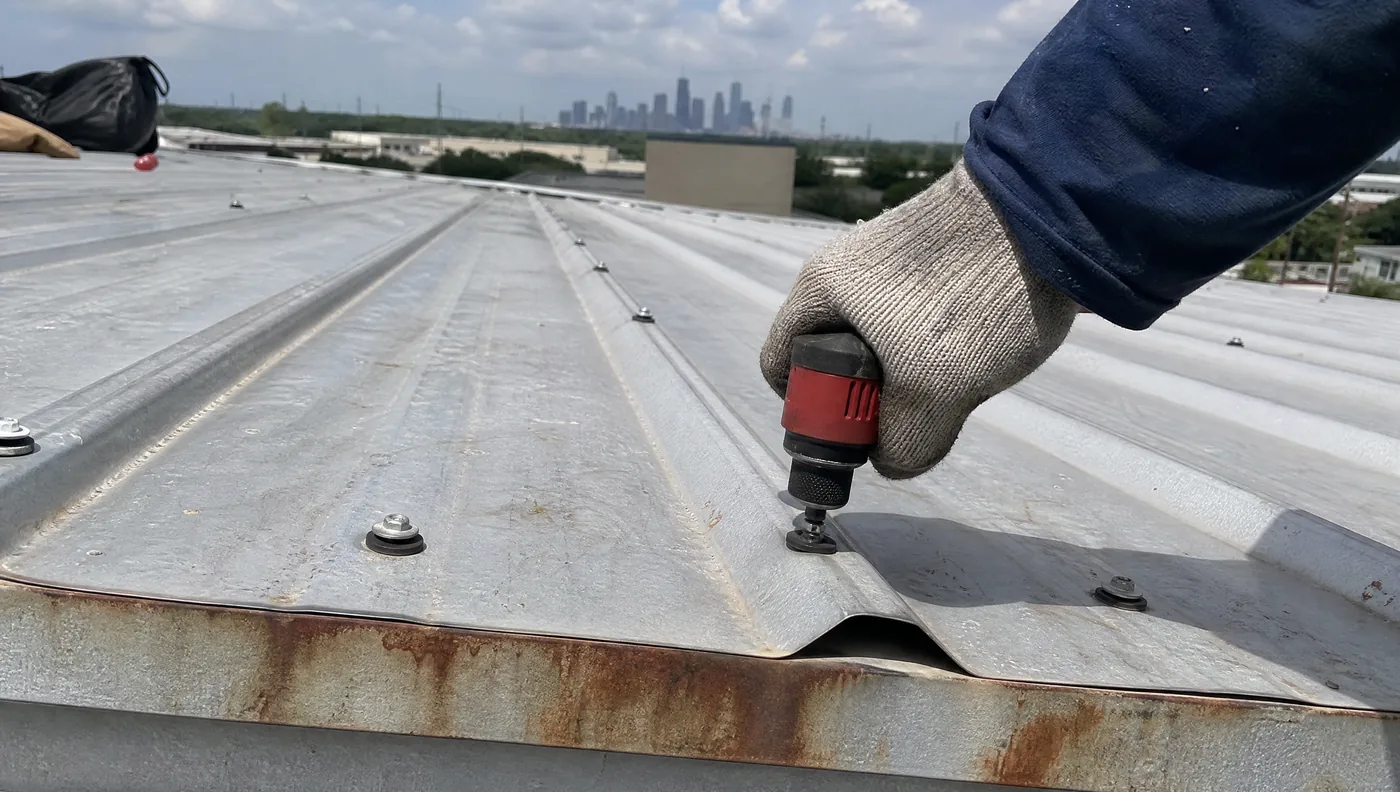
Commercial metal roofing in Houston covers two quite different things: structural metal roof panels, mostly R-panel and standing seam, and the sheet metal that finishes every other kind of roof. Metal roof replacement runs $11.00 to $19.00 a square foot installed. A restoration coating over a sound panel roof runs $3.50 to $6.50 and buys you fifteen to twenty years.
That gap is the single most useful thing on this page, because most metal roofs we are asked to replace do not need replacing.
Panel types
R-panel, standing seam, and the gauge that matters
Two systems on Houston commercial buildings and they behave completely differently.
- R-panel / PBRExposed-fastener corrugated panel, screwed straight through the sheet into purlins. Cheap, fast, and it leaks at the fasteners eventually. On most Houston warehouses.
- Standing seamConcealed clips, seams mechanically or snap locked above the water line. No penetrations through the panel. Twice the price and roughly twice the life.
- Gauge24 gauge is heavier and stiffer, 26 gauge is thinner and cheaper. Specify 24 on anything you intend to keep, and on any roof with foot traffic.
- FinishKynar 500 / PVDF holds colour and chalk resistance far better than a polyester finish, and it is the difference between a roof that still looks like a roof at year fifteen and one that does not.
- SlopeMetal wants slope. Below about 3:12 on exposed fastener, and below 1/4:12 on standing seam, you are outside what the system was designed for regardless of what anybody promises.
The critical difference is thermal movement. A metal roof expands and contracts a lot across a Houston summer day. An exposed-fastener R-panel roof is pinned at every screw, so all that movement works against the fastener and the washer, which is precisely why exposed-fastener roofs leak at the screws and standing seam roofs do not. A standing seam panel floats on concealed clips and moves freely.
If somebody is quoting you an exposed-fastener roof on a long-hold building, ask about the fastener replacement schedule, because there will be one.
Why it leaks
Where metal roofs leak, in order
Not through the metal. Through the things holding the metal on and the holes people have made in it.
- Fasteners. The neoprene washer under the screw head hardens, cracks and stops sealing, typically at 10 to 15 years in this climate. Then every screw on the roof is a small hole. There are thousands of them. This is by far the most common metal roof problem in Houston and it presents as diffuse, hard-to-locate drips.
- Panel end laps. Where one sheet overlaps the next up the slope. Sealant tape in the lap has a life, and on a low-slope metal roof capillary action pulls water up through a failed lap remarkably well.
- Ridge and eave closures. The foam closures that fill the corrugation profile degrade and fall out, and then wind-driven rain goes straight in. Houston gets a lot of horizontal rain.
- Penetrations cut in later. Every vent, conduit, condenser stand and satellite dish somebody put through the roof without a proper curb and boot.
- Rusted panels at the eave and at ponding points, where water sits and the coating has gone.
Notice that four of the five are repairable without replacing anything. Fastener replacement with oversized screws and new washers, re-sealing laps, replacing closures and properly detailing penetrations will resolve most metal roof leaks for a fraction of a replacement.
Talk to a roofer
Been told your metal roof needs replacing?
Get a second opinion before you commit six figures. We will tell you honestly whether the panels have life in them, and if they do, restoration is a third of the price.
Call (281) 720-3785- A roofer picks up, not a call centre
- Line-item written scope before anything is torn off
- Progress billing tied to milestones, never 85% up front
Metal pricing
Metal roofing and restoration costs in Houston
The restoration row against the replacement rows is the entire argument of this page. Look at them together before anyone convinces you that a leaking metal roof is a finished metal roof.
| Work | Installed cost | Service life added | Notes |
|---|---|---|---|
| Standing seam, 24 ga, Kynar | $13.00 – $19.00 | 40 – 60 yrs | concealed fasteners, longest life available |
| R-panel / PBR, 26 ga | $8.50 – $13.00 | 20 – 30 yrs | exposed fasteners, budget specification |
| R-panel / PBR, 24 ga | $11.00 – $15.00 | 25 – 35 yrs | worth the upgrade on anything you are keeping |
| Metal restoration coating system | $3.50 – $6.50 | 15 – 20 yrs | includes full fastener replacement and lap sealing |
| Fastener replacement only | $1.10 – $2.40 | 5 – 10 yrs | oversized screws and new washers throughout |
| Single-ply retrofit over metal | $8.00 – $12.50 | 20 – 25 yrs | sub-purlin system, insulation infill, membrane over |
| Gutter and downspout replacement | $18 – $42 / linear ft | 20 – 30 yrs | 24 ga or heavier, sized to actual roof area |
| Coping and edge metal, ES-1 rated | $26 – $58 / linear ft | 25 – 40 yrs | the cheapest wind resistance on the building |
Ranges collected from Houston commercial quotes and supply pricing in July and August 2026. Restoration pricing assumes panels are structurally sound with no widespread perforation; panel replacement is priced separately and quickly changes the arithmetic if a large share of the roof has holed through.
Restoration
Metal roof restoration, which is what most of these buildings actually need
A metal roof restoration coating over a structurally sound panel roof costs $3.50 to $6.50 a square foot and extends the roof by fifteen to twenty years. A replacement costs $11.00 to $19.00. On a 40,000 square foot warehouse that is a difference of several hundred thousand dollars, and on a lot of buildings the restoration is not the compromise option, it is the better engineering answer.
The system, in order:
- Wash the roof down properly and let it dry. Half of all coating failures are preparation failures.
- Replace every fastener with an oversized screw and a new washer. Every single one. This is the part that actually stops the leaks.
- Treat rust, prime bare metal, replace any panel that has holed through.
- Seal every lap and detail with reinforcing fabric and mastic.
- Apply silicone or acrylic coating over the whole roof to the specified mil thickness, usually in two passes.
The conditions are honest ones. The panels have to be structurally sound with no widespread perforation, the purlins have to be sound, and the roof cannot have significant standing water. If a third of the panels have rusted through at the eave, you are replacing panels first and coating afterwards, and at some point that arithmetic tips.
Restoration coatings also frequently qualify for their own manufacturer warranty and, because the work is maintenance rather than replacement, the accounting treatment is sometimes friendlier. That is a question for your accountant rather than your roofer, and it is worth asking.
Sheet metal
Sheet metal, which every roof needs regardless of type
Edge metal, coping caps, counterflashing, gutters, downspouts, scuppers, collector heads, curbs, pitch pans and expansion joint covers. We fabricate and install all of it, and it is the part of a roof that most decides whether the rest of it survives.
Edge metal in particular is not decoration. The ANSI/SPRI ES-1 standard covers wind resistance of roof edge systems, and it exists because a great many commercial roof failures in high wind begin at the edge and unzip inward from there. A properly designed and fastened edge is one of the cheapest wind-resistance improvements available on a building, and it is one of the first things value engineered out of a bid.
On buildings east of Highway 146, where TDI windstorm certification applies, edge detailing is not a matter of preference at all. More on the windstorm zone here.
Buildings we cover
Metal roofing, restoration and sheet metal across the Houston metro:
Commercial roofing in Bellaire, Stafford commercial roofing, commercial roofers in Pasadena, Channelview, TX, Commercial roofing in Humble, Deer Park commercial roofing, commercial roofers in Katy, Sugar Land, TX, Commercial roofing in Cypress, Spring commercial roofing, commercial roofers in La Porte, Baytown, TX, Commercial roofing in Tomball, and The Woodlands commercial roofing and every submarket we work.
Related work
Straight answers
Questions we get on this specifically
My metal roof leaks everywhere but I cannot find a hole. Why?
Because it is the fasteners, and there are thousands of them. When the neoprene washers under the screw heads harden and crack, every screw becomes a pinhole, and the water tracks along the purlins before it drops. The symptom is exactly what you describe: diffuse drips that move around and never trace back to one point. The fix is replacing every fastener with an oversized screw and a new washer, which is tedious and effective and much cheaper than a roof.
Can you put a membrane roof over a metal roof?
Yes, it is called a retrofit and it is common on low-slope R-panel warehouses. A sub-purlin or hat channel system goes over the ribs, insulation fills between, and a single-ply membrane goes over the top. You get a code-compliant insulation upgrade and a warrantable membrane roof without removing the metal. It costs $8.00 to $12.50 a square foot and it adds dead load, so the structure needs checking first.
Is rust on my metal roof serious?
Surface rust on the finish is cosmetic and treatable. Rust that has perforated the panel is not. The places to look are the eave, where water sits at the drip edge, any ponding point on a low-slope run, the cut edges at panel ends, and anywhere two dissimilar metals are touching, because galvanic corrosion between, say, a copper vent and a galvanised panel will eat the panel remarkably fast. Take a screwdriver and press. If it goes through, that panel is finished.
Do metal roofs make the building hotter?
An uninsulated bare metal roof radiates heat into the space below enthusiastically, yes. A light-coloured Kynar finish or a reflective restoration coating changes that substantially, and the retrofit systems add real insulation into the assembly. If your warehouse is unbearable in August, a reflective coating on the metal roof is one of the cheaper interventions available and it is measurable on the electricity bill in a cooling-dominated climate like this one.
Talk to a roofer
Want a number on this roof?
Call and describe the building. If it needs a survey we will come and walk it, and there is no charge for that whether or not you use us.
Call (281) 720-3785- A roofer picks up, not a call centre
- Line-item written scope before anything is torn off
- Progress billing tied to milestones, never 85% up front