
Inspection & survey · Houston
Commercial Roof Inspection in Houston, TX
Three contractors will give you three different opinions about your roof and every one of them will be a sales position. A moisture survey gives you a fact, and the fact costs less than a day of anybody's crew.
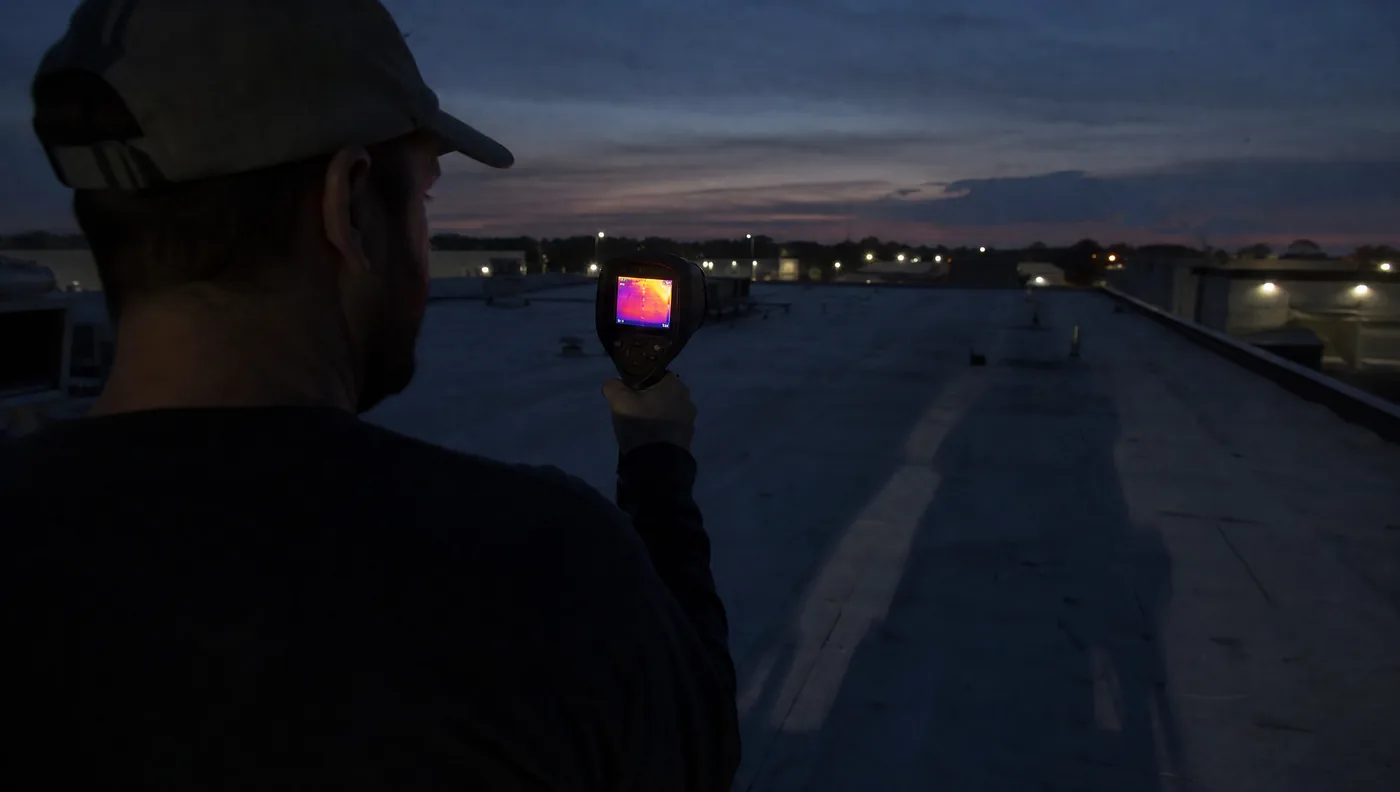
A commercial roof inspection in Houston runs from no charge for a visual survey with a written finding, to $500 to $1,000 for an infrared moisture survey on a typical building. The infrared survey is the one that answers the question that actually decides the money: how much of your roof is wet.
Everything else, repair or replace, coat or tear off, phase it or do it all, follows from that number. Which is why we take it before we quote anything and why we would rather you had it even if you use somebody else.
What is included
What a proper commercial roof inspection covers
A walk-and-look is not an inspection, it is a glance. What we produce is a written condition report with photographs, and it covers eight things in order.
- Assembly identification. What is on the deck, how many systems, what insulation, what deck. Established by core cut, not by guessing.
- Field condition. Membrane state, surfacing loss, blistering, ridging, shrinkage, chalking, brittleness. Whether the sheet still folds without cracking is a genuinely informative test.
- Every seam and lap, probed by hand along the run.
- Every penetration and curb. Photographed individually. This is usually the longest section of the report and it is where the leaks are.
- Drainage. Drains, strainers, sumps, scuppers, overflow provision, and where water stands. We come back after rain if we can.
- Perimeter and edge. Coping, drip edge, counterflashing, parapet walls and through-wall flashing.
- Rooftop equipment. Condition, curb flashing, whether anything has been added since the roof went on, and whether it was flashed by somebody who knew what they were doing.
- Housekeeping. Debris, vegetation, abandoned equipment, cut cables and anything else that will end up as a projectile or a puncture.
You get a written report with photographs, a plan marking the defects, a priority ranking and a budget figure against each item. It is yours regardless of what you do next.
Infrared
The infrared survey, and why it happens at night
An infrared survey maps the wet insulation in a roof assembly. It works because wet material has higher thermal mass than dry material: through the day the whole roof absorbs solar heat, and after sundown the dry areas cool quickly while the wet areas hold heat and glow against them on a thermal camera.
Which is why it has to be done in a specific window: starting an hour or two after sunset, on a day that had sun, with no rain in the preceding day or two and not much wind. Houston gives you plenty of suitable evenings and it does mean scheduling around the weather rather than the diary.
Budget $500 to $1,000 on a typical commercial building. On very large warehouse roofs it is priced per square foot instead, in the region of two to ten cents, with a base charge around $1,500 to cover mobilisation. Aerial infrared by drone covers large areas quickly; walked infrared is slower and better on complex roofs with a lot of equipment.
What you get is a thermal plan of the roof with the wet areas outlined and quantified in square feet, verified by core cuts at a sample of the anomalies, because a thermal camera shows a temperature difference rather than water and confirmation matters. That number, wet square feet as a percentage of the roof, is the single most useful figure about your roof, and almost nobody has it.
Talk to a roofer
Find out what you actually have up there
Before you accept a replacement quote, get the roof scanned. It is the cheapest money in the whole project and it regularly saves buildings from being re-roofed unnecessarily.
Call (281) 720-3785- A roofer picks up, not a call centre
- Line-item written scope before anything is torn off
- Progress billing tied to milestones, never 85% up front
Inspection pricing
What roof inspections and surveys cost in Houston
Published because it is impossible to find these numbers anywhere and because they are small enough that people should stop hesitating over them.
| Service | Cost | Turnaround | What you get |
|---|---|---|---|
| Visual survey and written finding | no charge | 2 – 3 days | photographs, defect list, budget figures |
| Infrared moisture survey, typical building | $500 – $1,000 | scheduled after dark | thermal plan, wet area quantified in sq ft |
| Infrared survey, large warehouse | $0.02 – $0.10 / sq ft | scheduled after dark | typically with a base charge around $1,500 |
| Core cuts | included with survey | same visit | assembly confirmed, patched with matching materials |
| Due diligence report for acquisition | $1,200 – $3,500 | 5 – 7 days | full report, remaining life estimate, capital forecast |
| Post-storm damage assessment | no charge | 2 – 4 days | test squares, cores, dated evidence package |
| Annual condition report, maintenance clients | included | twice yearly | photographic history that builds the case for later claims |
Infrared pricing collected from commercial thermography discussion and Houston quotes in July and August 2026. Survey scheduling depends on weather: infrared needs a sunny day followed by a dry, still evening, which is a scheduling constraint rather than a delay tactic.
Core cuts
Core cuts, and why we take them on every serious survey
A core cut is a two-inch plug taken through the whole roof assembly down to the deck. It takes ten minutes, it gets patched properly, and it is the only way to know what you actually have.
What a core tells you that nothing else will: how many roof systems are on the deck, which decides whether a recover is even legal; the insulation type and thickness, which decides what the energy code will require on a tear-off; whether the insulation is saturated, and how far down; the deck material and its condition; and on a storm claim, whether the membrane's reinforcement has been fractured by hail.
People resist cores because it means cutting a hole in a roof they are worried about. It is a two-inch hole, patched with matching materials in the same visit, and the information is worth orders of magnitude more than the risk. Every serious roofing decision made without a core is made on a guess.
We take three to six cores on a typical survey, more on a large or complicated roof, and we photograph each one against a tape measure.
When to inspect
How often, and when it is worth paying for
Twice a year as a baseline, plus after events. Spring before hurricane season and autumn after it, which is the rhythm our maintenance programme runs on.
The specific moments when an inspection earns its money several times over:
- Before you buy a building. A roof is one of the largest single capital items on a commercial property and a survey during due diligence is trivially cheap against the purchase price. We do a lot of this work and it moves the price regularly.
- Before you accept any replacement quote. If three bidders have priced a tear-off and nobody has scanned it, you do not know whether you need one.
- After any hail or serious wind event, whether or not it is leaking, because on a membrane roof it will not be leaking yet.
- At warranty expiry. The last chance to get anything covered.
- Before a lease renewal or a sale, where roof condition is going to be argued about anyway and evidence beats assertion.
- When your insurer starts asking about roof age. Documentation materially helps that conversation.
Buildings we cover
Roof inspections and infrared surveys across the Houston metro:
Commercial roofing in Bellaire, Stafford commercial roofing, commercial roofers in Pasadena, Channelview, TX, Commercial roofing in Humble, Deer Park commercial roofing, commercial roofers in Katy, Sugar Land, TX, Commercial roofing in Cypress, Spring commercial roofing, commercial roofers in La Porte, Baytown, TX, Commercial roofing in Tomball, and The Woodlands commercial roofing and every submarket we work.
Related work
Straight answers
Questions we get on this specifically
Is the free inspection actually free?
Yes, for the visual survey and written finding, and there is no obligation attached to it. The infrared survey is charged because it is a separate specialist exercise with equipment and an after-dark call-out attached, and it is what we recommend before any significant decision. If we do the infrared and you then have us do the work, we credit the survey cost against the job.
Can a drone do this?
For the aerial infrared over a large simple roof, yes, and it covers ground fast. For everything else, no. A drone cannot probe a seam, lift a flashing, take a core or press a screwdriver into a rusted panel, and those are the things that tell you what is actually happening. We use aerial imagery where it is genuinely the better tool and we still walk the roof.
Will the core cuts leak?
No. Each core is patched in the same visit with matching materials, properly welded or bonded to the surrounding system, and photographed. On a warrantied roof we use the manufacturer's specified repair detail so the coverage is unaffected. In fifteen years we have not had a patched core cause a leak, and if one ever does it is on us.
How wet is too wet?
As a working rule: under 10% of the field wet is a straightforward cut-out and repair or coat. Between 10 and 25% is a judgement call that depends on how long you are holding the building. Over 25% and the arithmetic has already tipped toward replacement, because the cut-out work approaches the cost of a new roof and you would be warranting a compromised assembly. These are the thresholds we apply to our own quoting and we will show you the plan the number came from.
Talk to a roofer
Want a number on this roof?
Call and describe the building. If it needs a survey we will come and walk it, and there is no charge for that whether or not you use us.
Call (281) 720-3785- A roofer picks up, not a call centre
- Line-item written scope before anything is torn off
- Progress billing tied to milestones, never 85% up front