
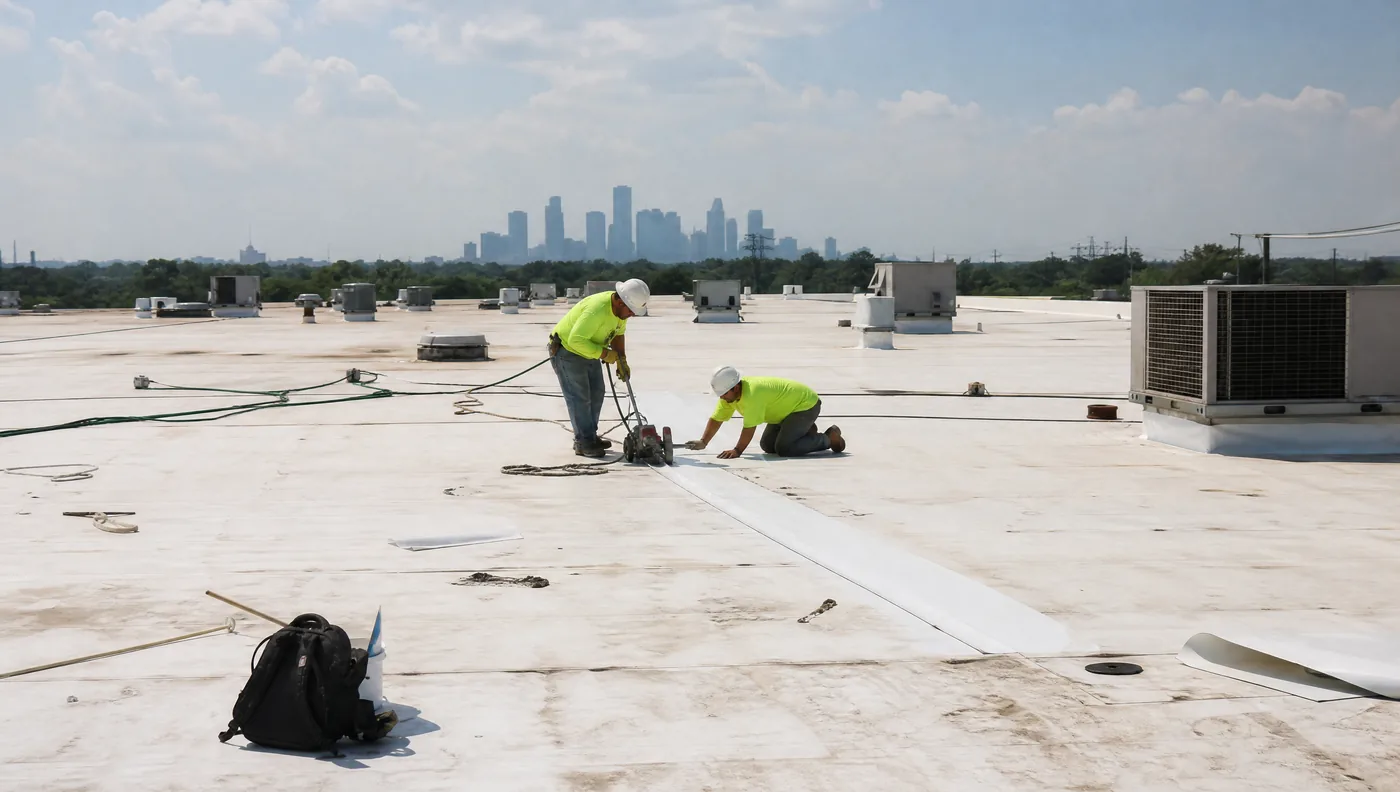
Houston, Texas · commercial & industrial
Commercial Roofing Houston
Low-slope and metal roofing for warehouses, retail centres, offices, plants and multi-tenant buildings across Harris, Fort Bend, Montgomery and Chambers County. We publish our square-foot pricing, we pull the City of Houston permit, and we do not hand you a bid you cannot read.
- Commercial only, no residential crews
- Written scope before tear-off
- Milestone billing, never 85% up front
Manufacturer-certified installers for GAF, Carlisle SynTec, Johns Manville, Versico and Duro-Last systems. Working greater Houston since 2009.
What owners say
★★★★★
Third bid we got and the only one that showed us where the water was actually getting in. Scan found wet insulation over about 900 square feet we did not know about. Fixed that, coated the rest.
Marcus D.Stafford, warehouse roof restoration
★★★★★
They were four days late starting because the polyiso came in short from the supply house, which annoyed me because I had tenants to tell. But Andre called me the morning he knew, not the morning of, and they knocked the delay off the retainage without me asking. Roof has been dry through two seasons now. I would use them again on the strength of that phone call alone.
Priya N.multi-tenant retail, Katy
★★★★★
Came in at $8.40 a foot on 22,000 feet of 60 mil TPO with all new ISO, which was in the middle of the three numbers we had. What sold it was the schedule. They worked the building in four sections so we never had a section of the plant open to weather overnight, and they were off the roof before our second shift came in.
Dwayne R.light manufacturing, Channelview
Before you call anyone
What a neglected commercial roof in Houston actually costs you
These are the six things that come up over and over on the buildings we get called to, and none of them start as a roofing problem. They start as a stain on a ceiling tile that somebody moves a bucket under.
- Wet insulation you are paying to cool Soaked polyiso loses most of its R-value and never dries out under a membrane. You are air-conditioning a sponge every August.
- Tenant complaints that turn into rent abatement One leak over a leased suite is a maintenance ticket. Three months of leaks over the same suite is a lease negotiation.
- Deck rot that turns a bid into a change order Steel deck corrodes from underneath where water sits. Nobody prices what they cannot see, so it lands as an extra halfway through the job.
- A warranty already voided by somebody else The HVAC contractor who cut in a new curb without flashing it properly did not tell you he just ended your manufacturer coverage.
- Insurance treating your roof age as the whole story Texas carriers now underwrite commercial property on roof age first. An undocumented roof gets the worst assumption.
- Ponding that fails the roof where it stands Standing water 48 hours after rain is a code problem, a warranty problem and a membrane problem all at once, and Houston gets the rain to prove it.
Why it matters
Three reasons to put a Houston commercial roofing contractor on your building
Commercial Roofing Houston installs and repairs low-slope roof systems on commercial and industrial buildings across the Houston metro. That is the entire business. We do not run a residential division, we do not chase shingle work after a hailstorm, and the crew that shows up at your warehouse has spent the last decade welding seams and detailing curbs rather than nailing three-tab.
Your roof is the cheapest part of the building and it protects all the rest
A membrane replacement on a 30,000 square foot warehouse runs somewhere in the low six figures. The racking, the inventory, the electrical distribution and the tenant improvements underneath it are worth many multiples of that, and every one of them is ruined by water in a way the roof itself is not. This is why deferring a roof is the most expensive saving in facilities management.
Cooling load in this climate is a roofing decision
Houston sits in IECC climate zone 2A, which means the building is cooling-dominated almost year round. A reflective white membrane over correctly specified polyiso is worth real money on a summer electricity bill in a way it simply is not in Ohio. It is also why the energy code has something to say the moment you tear a roof off, which we get into below because none of our competitors will.
The work is mostly invisible, which is exactly why documentation matters
You will never stand on your own roof. Neither will your insurer, your lender or your buyer. What all three of them will look at is the paperwork: the moisture survey, the permit, the manufacturer warranty registration, the photographs of every penetration. We produce that file as part of the job because the day it matters, the roof is already under water.
Our services include commercial roof repair, emergency leak response, full roof replacement and re-roofing, TPO and single-ply membrane, EPDM and PVC, modified bitumen in both APP and SBS, built-up gravel roofs, metal roofing and sheet metal fabrication, flat and low-slope work of every kind, silicone and acrylic roof coatings and restoration, storm and hail damage repair, infrared moisture surveys and roof inspections, preventative maintenance programmes, and industrial roofing on plants and distribution buildings.
We work Houston proper and the submarkets around it: Bellaire, Stafford, Pasadena, Channelview, Humble, Deer Park, Katy, Sugar Land, Cypress, Spring, La Porte, Baytown, Tomball, The Woodlands, Jersey Village, Galena Park, South Houston, Webster, Klein and Aldine. If your building is not in one of those, call anyway. If it is inside about forty-five minutes of the yard we will come and look at it.
Talk to a roofer
Get a roof survey and a written scope, at no charge
We walk it, core it where we need to, photograph everything and put a line-item scope in your hand. Take it to your other bidders and hold them to the same sheet.
Call (281) 720-3785- A roofer picks up, not a call centre
- Line-item written scope before anything is torn off
- Progress billing tied to milestones, never 85% up front
What we do
Commercial roofing services across Houston
Fourteen things we actually do, in the order building owners usually need them. Every one of these has its own page with pricing on it.
Commercial Roof Repair
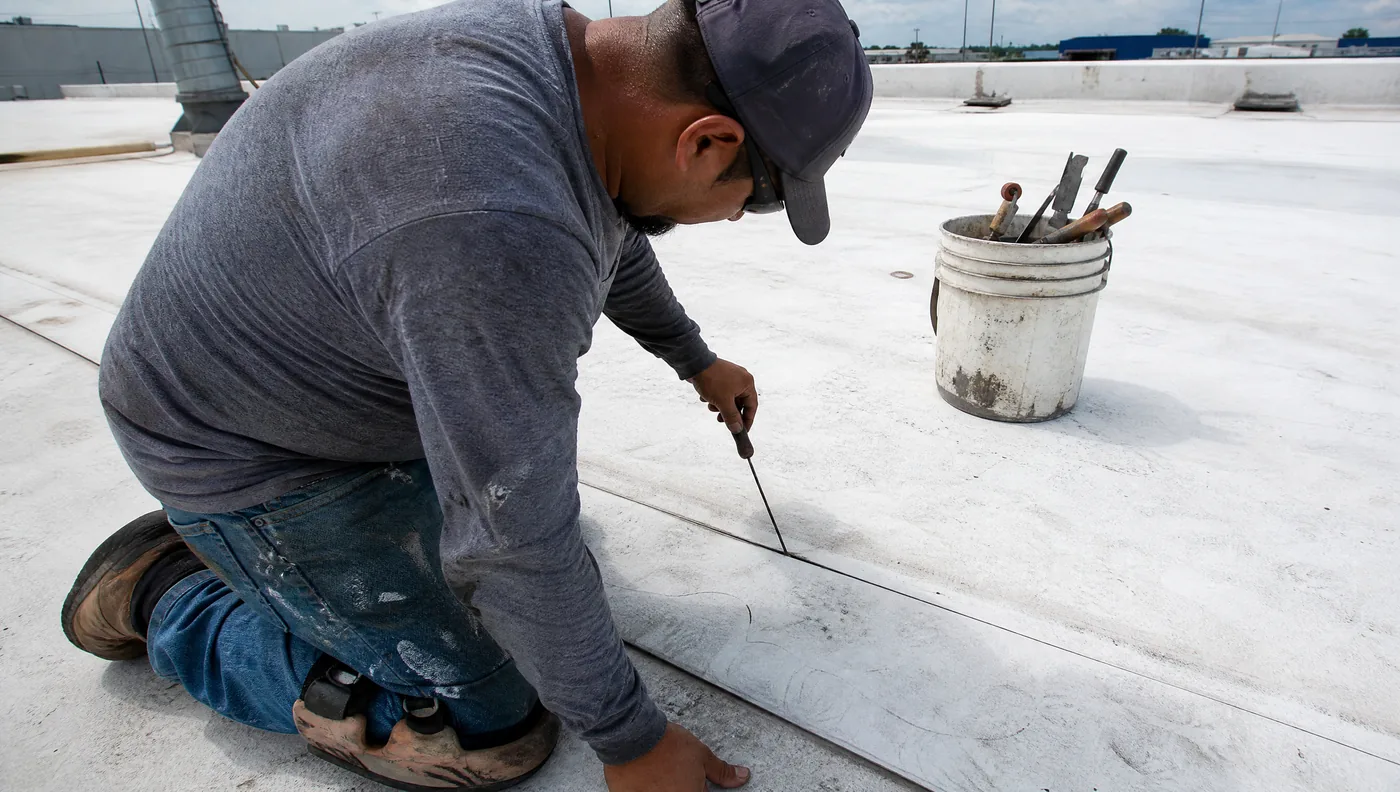
Brown ring on a ceiling tile? The leak is almost never above it. Commercial roof repair starts with finding the actual entry point, which on a low-slope roof is usually a seam, a curb flashing or a fastener that has backed out and tented the membrane.
We repair TPO, PVC, EPDM, modified bitumen, built-up and metal, and we tell you honestly when a repair is throwing money at a roof that needs replacing.
Emergency Roof Repair
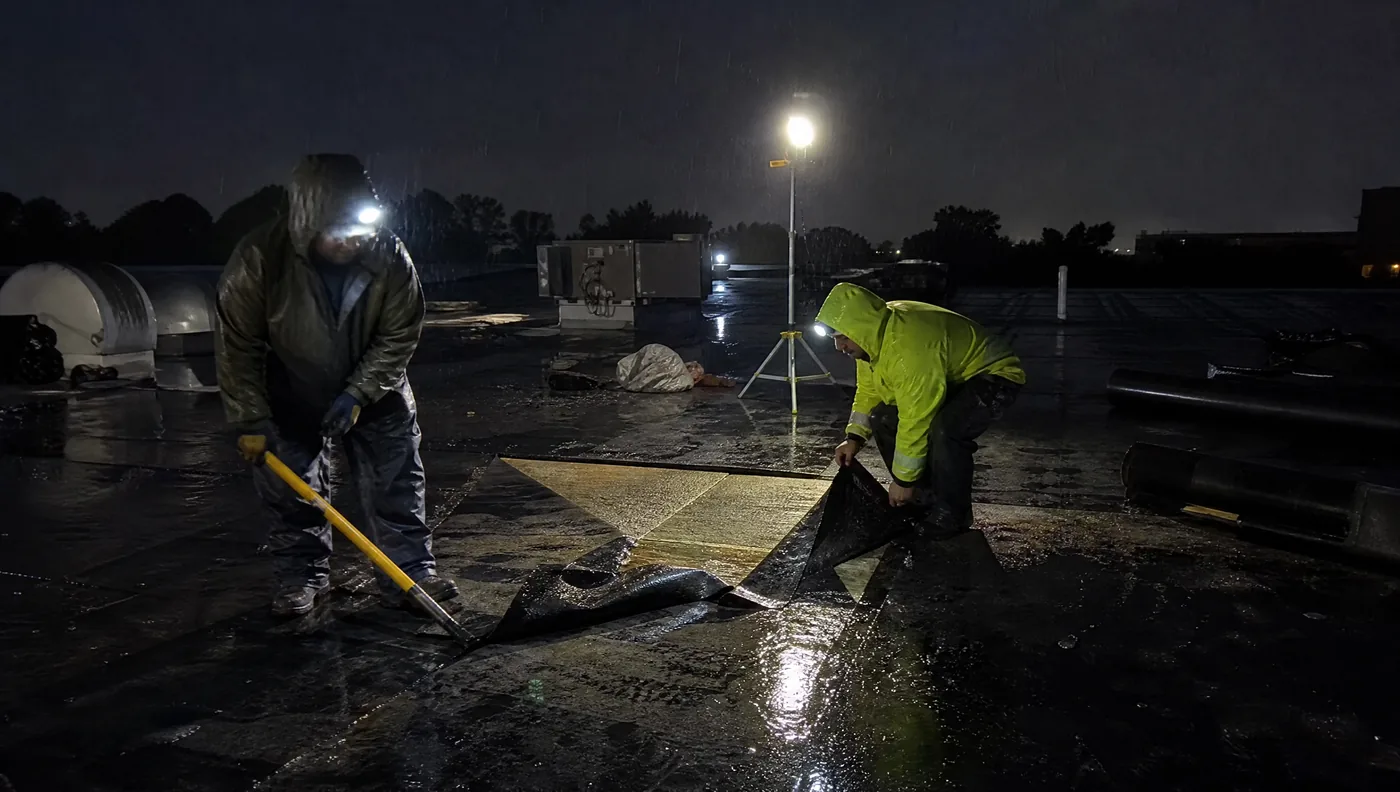
Water coming through the deck at four in the afternoon on a Friday is not a quotation exercise. It is a dry-in.
We carry membrane, mastic, self-adhered patch and shrink-wrap on the truck, and we stabilise the building first and price the permanent fix afterwards. Every emergency call gets photographed as it is found, because that photo set is what your carrier wants and what nobody thinks to take.
Roof Replacement & Re-Roofing
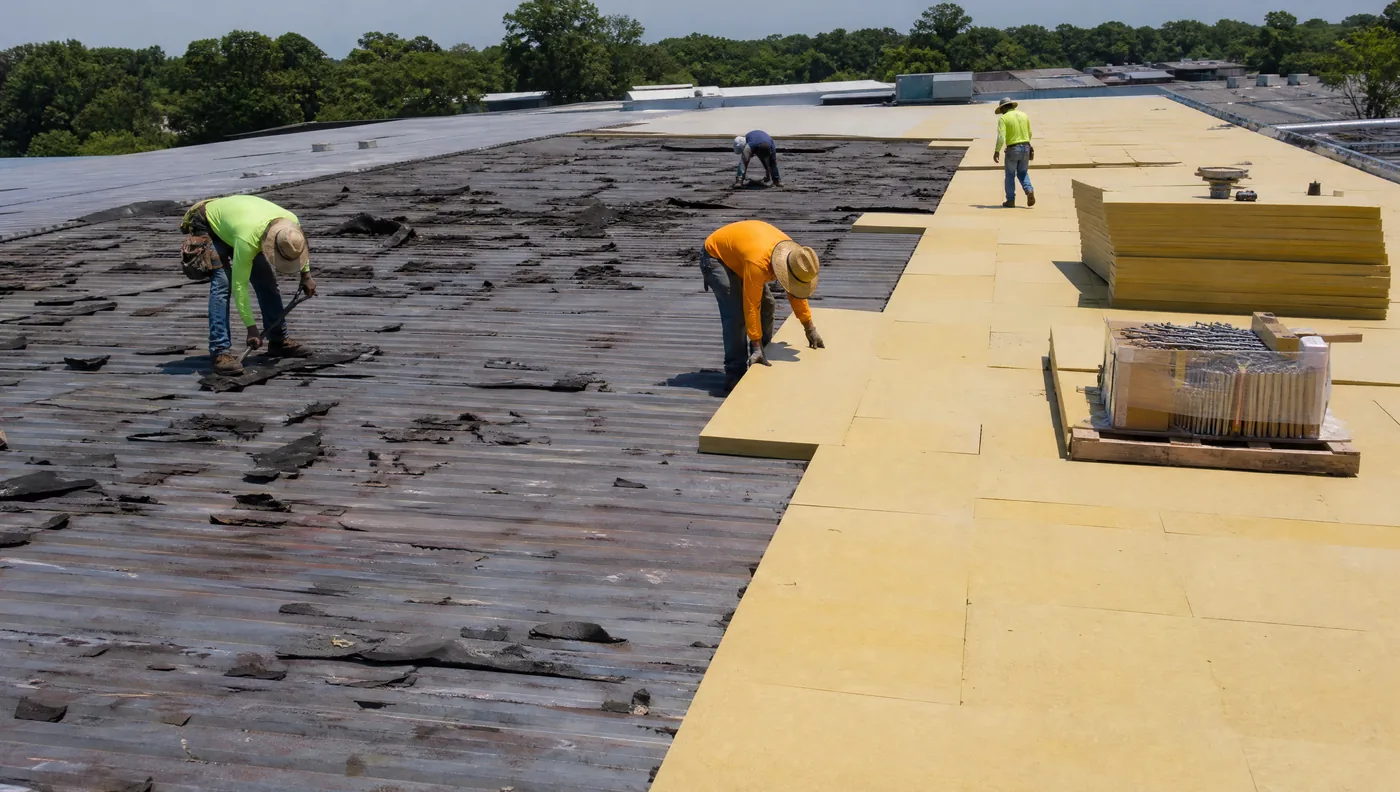
A full replacement means tear-off to deck, deck repair, new vapour control where the building needs it, new polyiso to current code, cover board and a new membrane.
The part nobody warns you about: once you tear off, the 2021 energy code Houston adopted in January 1, 2024 requires the assembly to come back at R-25 continuous above deck. On a building running old inch-and-a-half ISO that is real money and it moves your edge metal, your drain sumps and your door thresholds with it.
TPO Roofing
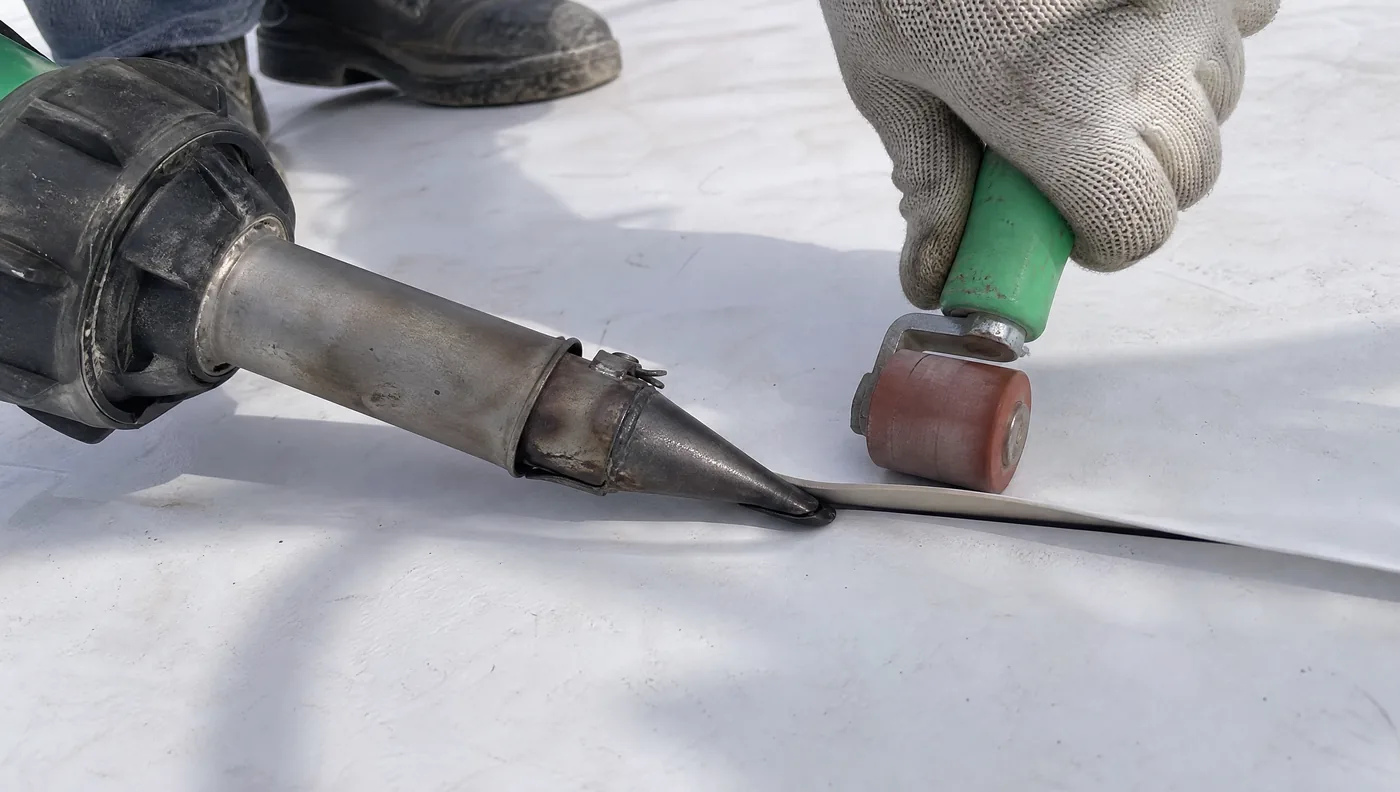
TPO is the default commercial membrane in Houston and it deserves to be. White, reflective, heat-welded seams, and in a cooling-dominated climate the reflectivity is worth something every single summer.
Specification matters more than brand. We install 60 mil as standard and 80 mil where there is rooftop equipment and foot traffic, because 45 mil on a roof the HVAC techs walk twice a month is a false economy that shows up as punctures in year six.
EPDM & PVC Membrane
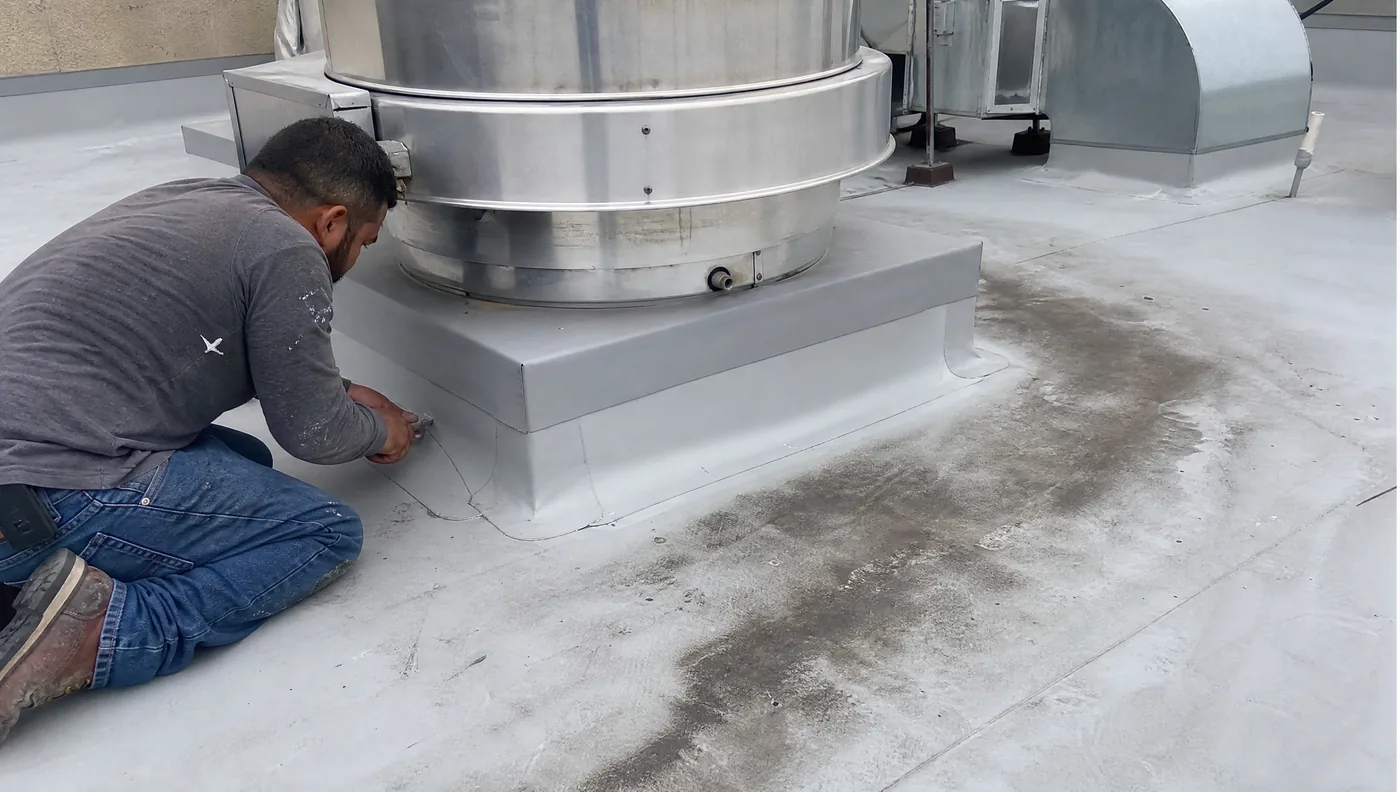
PVC is what goes on a building with grease in the exhaust. Restaurants, commissary kitchens, food plants and anywhere the roof sees chemical or animal fat exposure, because PVC resists it and TPO does not.
EPDM is black rubber, tough, forgiving and cheap to repair, and it makes sense on buildings where reflectivity is not the priority and puncture resistance is.
Modified Bitumen
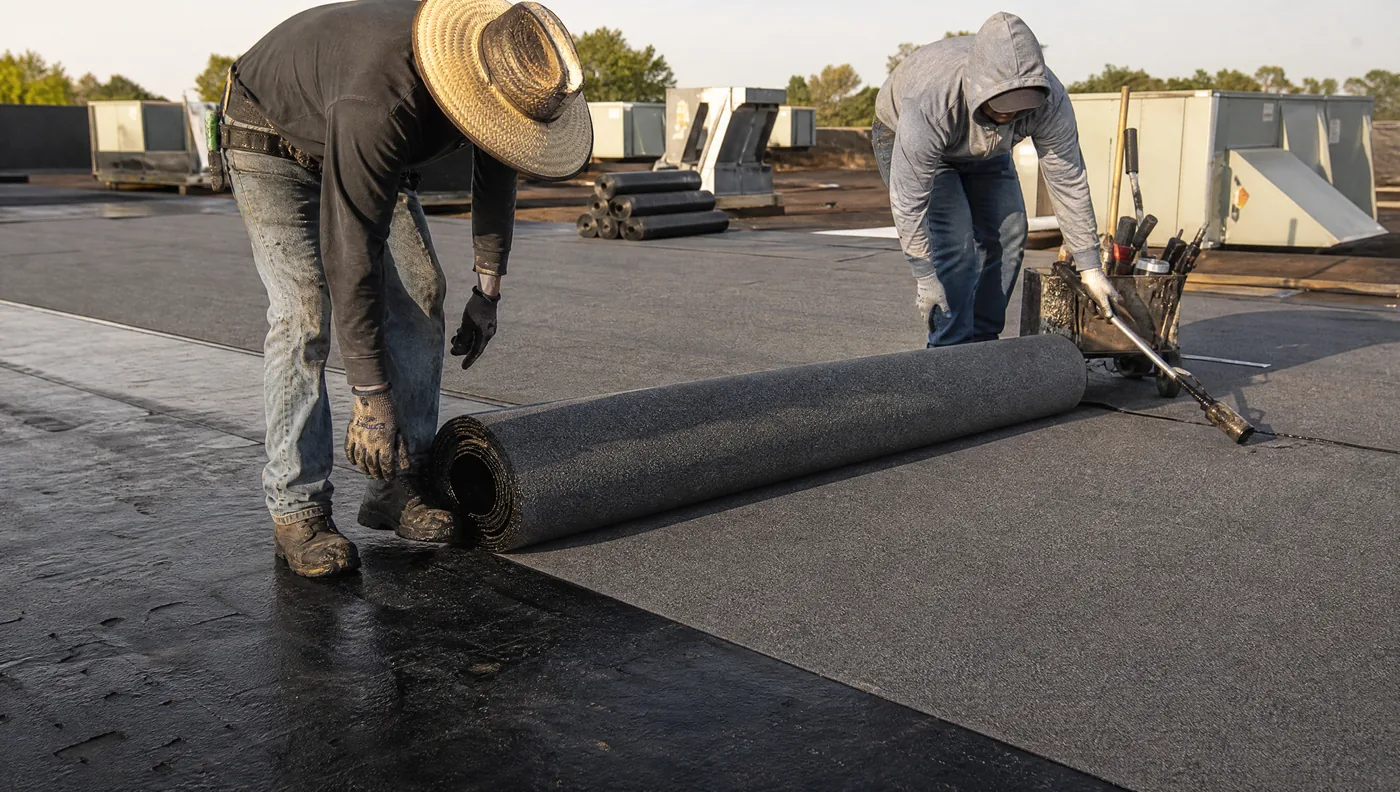
Two-ply asphalt systems, base sheet and cap sheet, in APP (torch) or SBS (self-adhered, cold-applied or hot mopped). Modified bitumen is old technology in the way a diesel engine is old technology.
Where it wins: heavy foot traffic, redundancy, and repairability. A mod bit roof can be patched by any roofer with a torch or a bucket. A TPO seam failure needs a welder and somebody who knows how to probe the weld afterwards.
Built-Up Roofing (BUR)
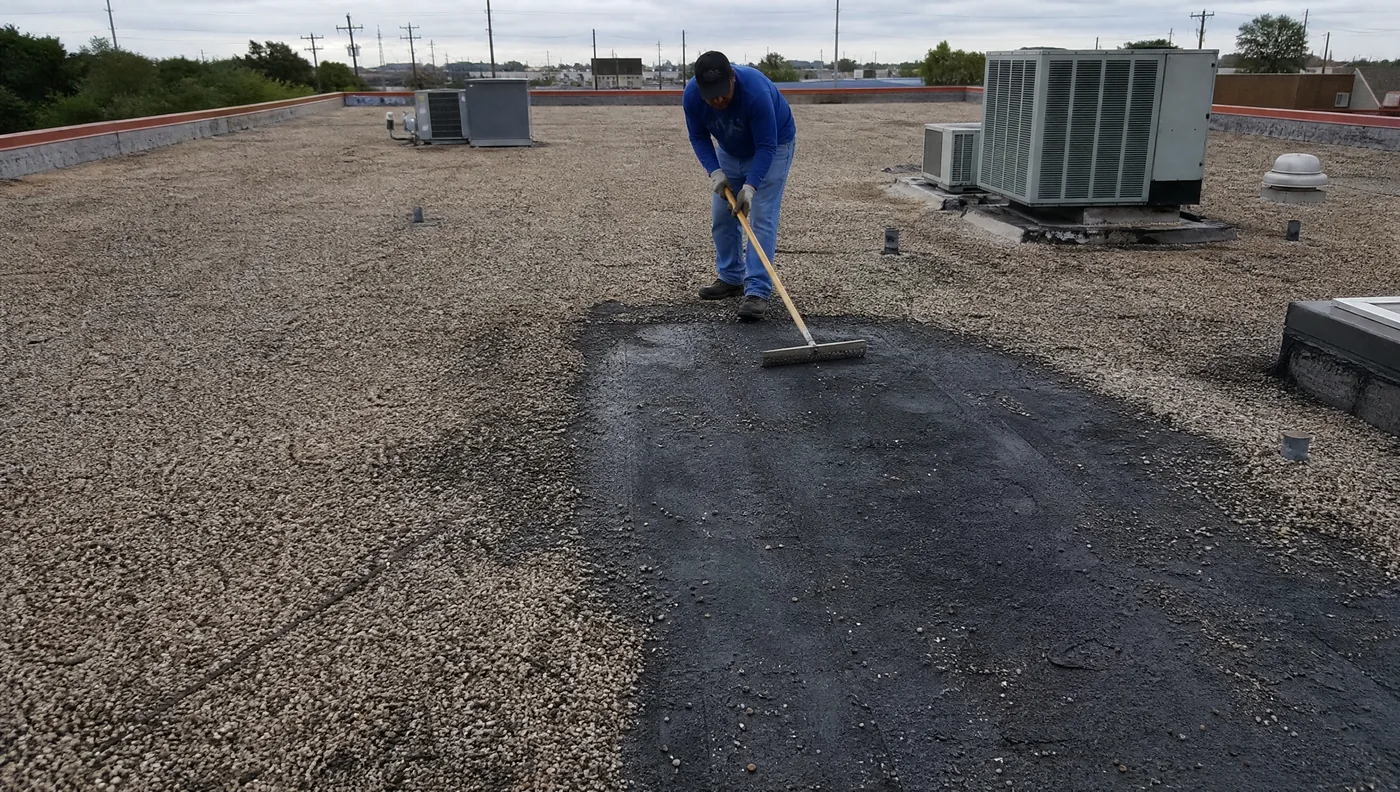
The gravel roofs. Alternating plies of asphalt and felt, three or four ply, surfaced with aggregate or a cap sheet. There are a great many of these still running across Houston on buildings put up between 1965 and 1995 and plenty of them have life left in them.
We repair BUR, we recover it, and we tear it off when the felts have gone brittle and it is alligatoring across the field. Tearing off a four-ply gravel roof is a genuinely heavy job and the disposal cost is a real line on the bid, so we show it.
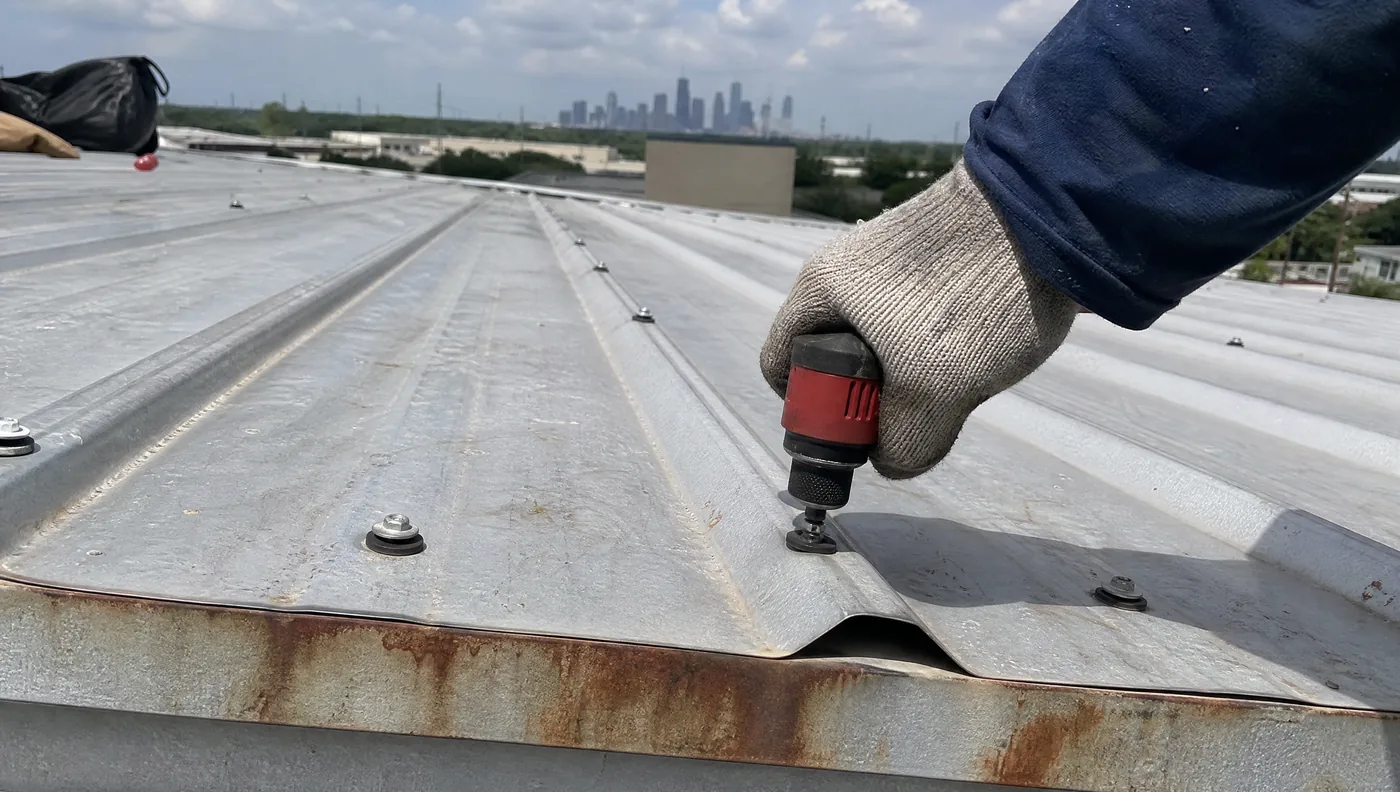
Metal Roofing & Sheet Metal
R-panel, standing seam, and the sheet metal that ties any roof together: copings, edge metal, counterflashing, gutters, scuppers, curbs and pitch pans.
Most metal roof leaks in this market are not the panels. They are the fasteners, the closures at the ridge and eave, and the penetrations somebody cut in later. A metal roof restoration coating over a sound structural panel is frequently a better answer than replacement, and it is a fraction of the price.
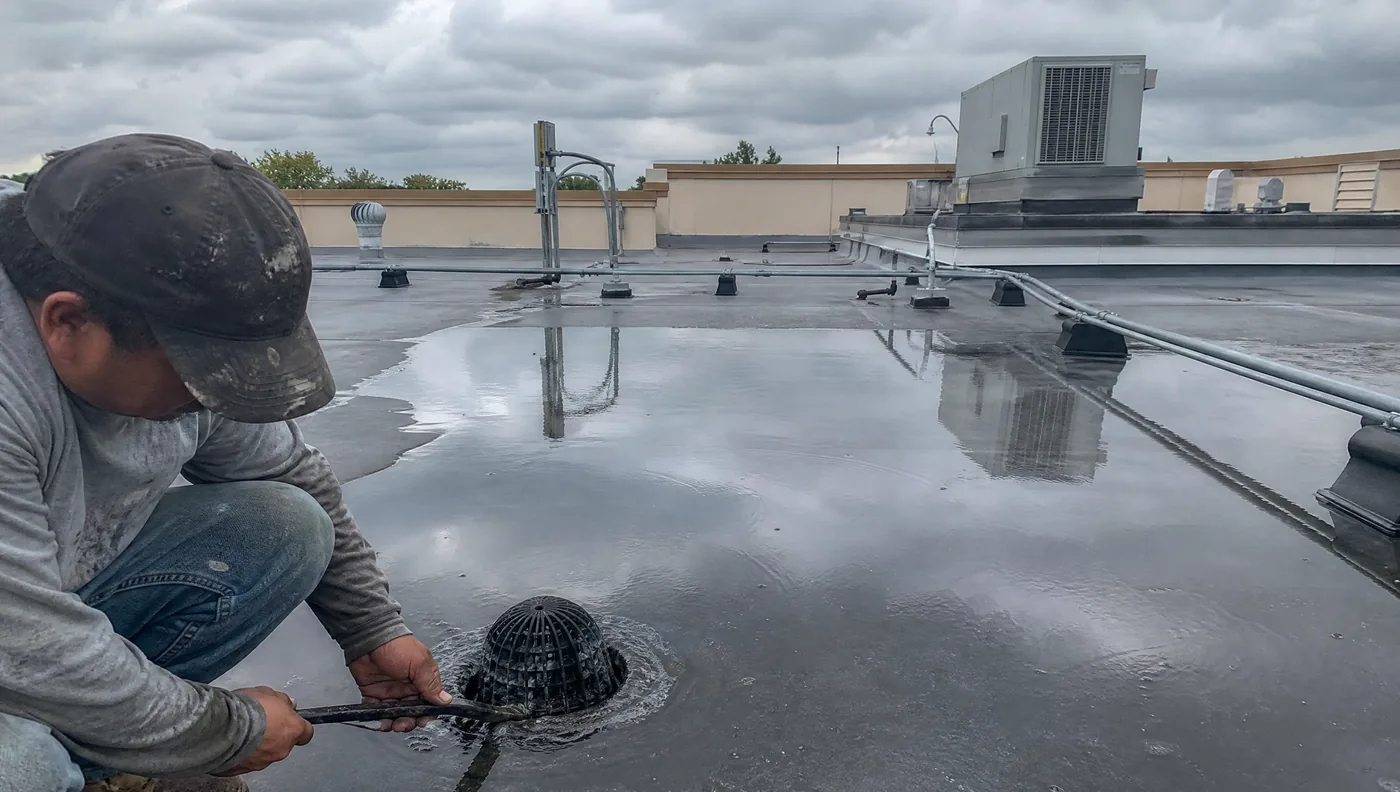
Flat & Low-Slope Roofing
Flat roofs are not flat and that is the entire problem. Code wants a quarter inch per foot of fall and a great many Houston buildings do not have it, which is how you end up with birdbaths that sit for days and grow their own ecosystem.
Where the structure will not give us slope we build it in with tapered polyiso, crickets behind curbs and sumps at the drains. That is a design exercise, not a materials choice, and it is the difference between a roof that lasts twenty years and one that fails at eight.
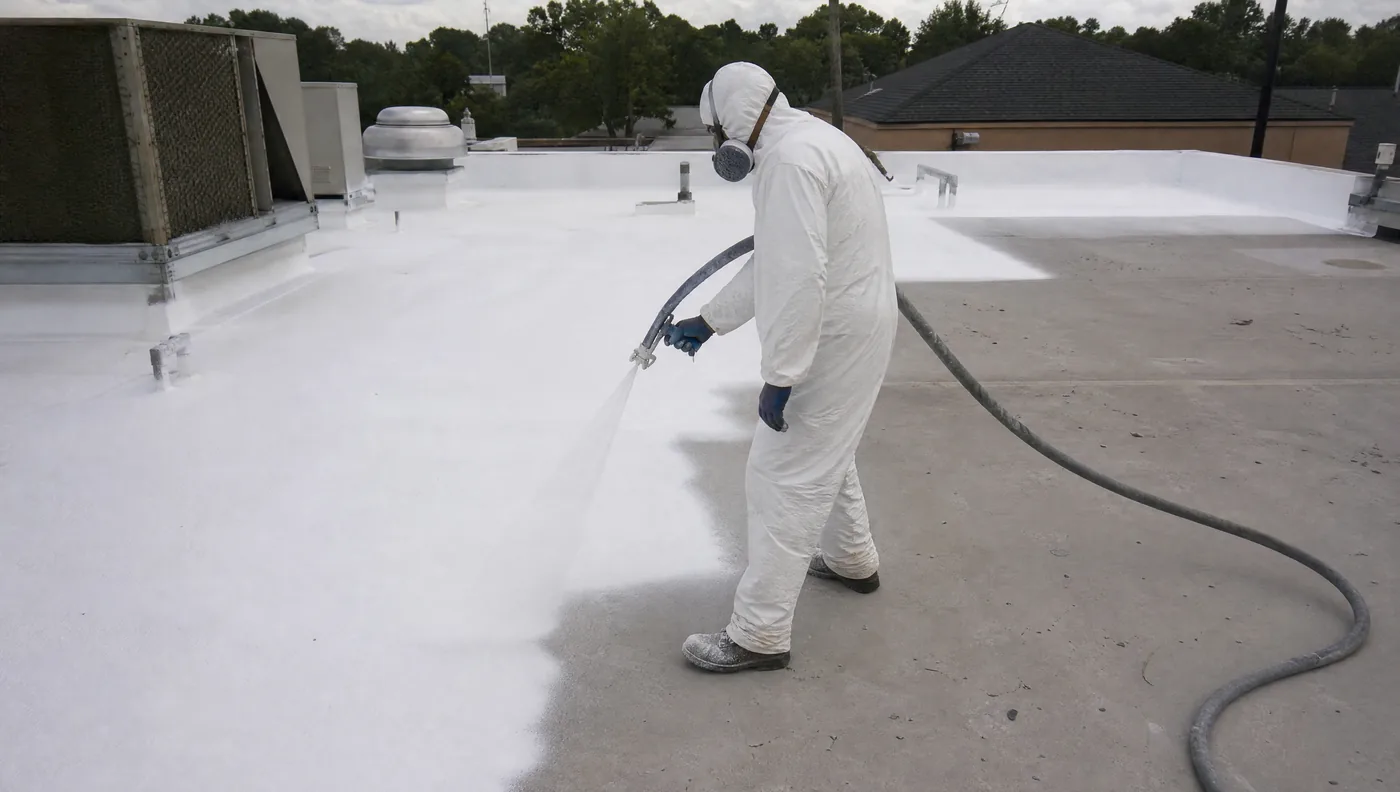
Roof Coatings & Restoration
A silicone or acrylic restoration coating over a sound roof buys you ten to fifteen years for roughly a third of the cost of a tear-off, with no disposal and no disruption to the tenants underneath.
The condition is genuine: the substrate has to be dry. Coating over wet insulation seals the water in and buys you nothing but a warmer, heavier, still-leaking roof. This is why we scan first and why we will tell you no.
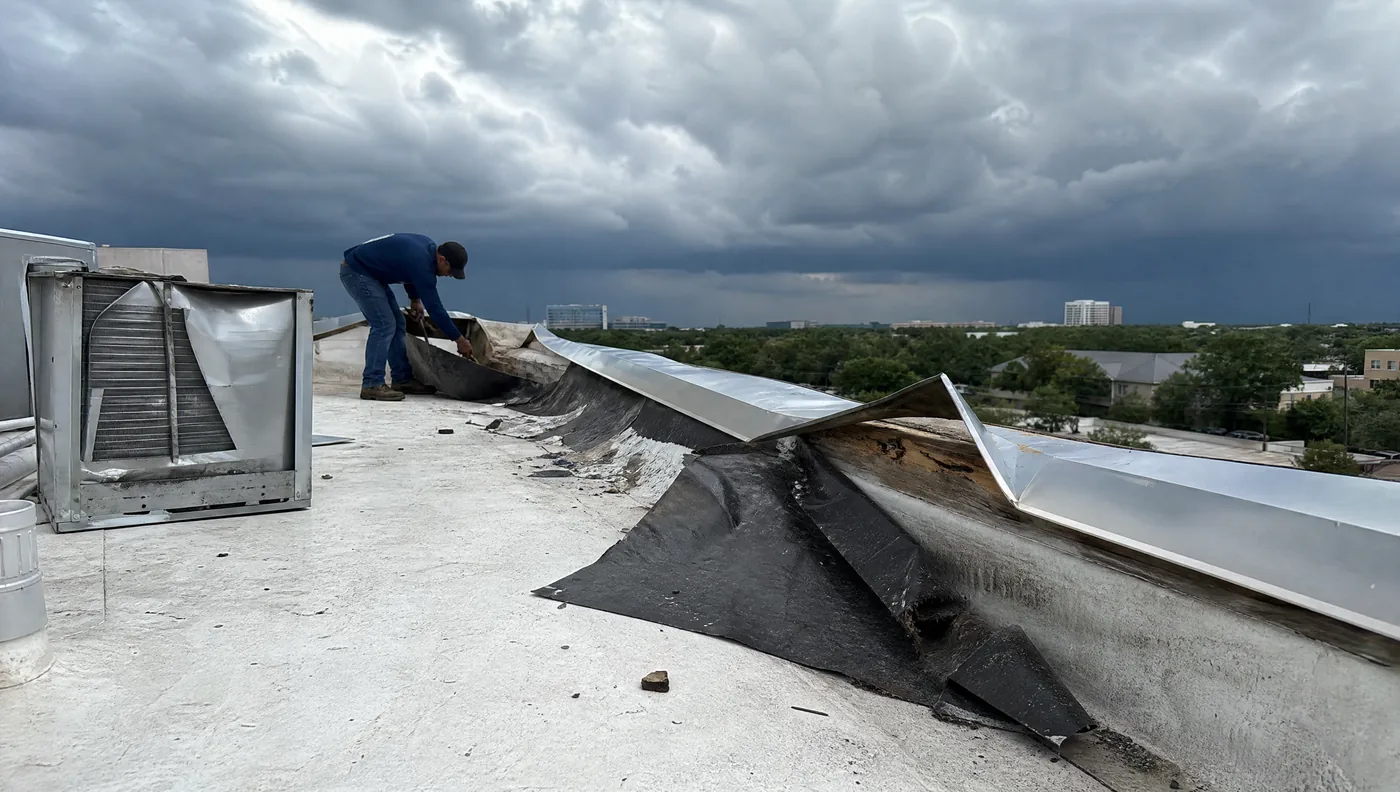
Storm, Hail & Wind Damage
Houston took two serious wind events eight weeks apart in 2024: the May 16, 2024 derecho through downtown, then Hurricane Beryl on July 8, 2024 with a 84 mph gust recorded at Houston Hobby.
Hail damage on a single-ply membrane does not look like hail damage on a shingle. It is bruising, not holes, and it shows up as fractured reinforcement scrim that fails eighteen months later. Documenting it correctly at the time is what determines whether a claim gets paid.
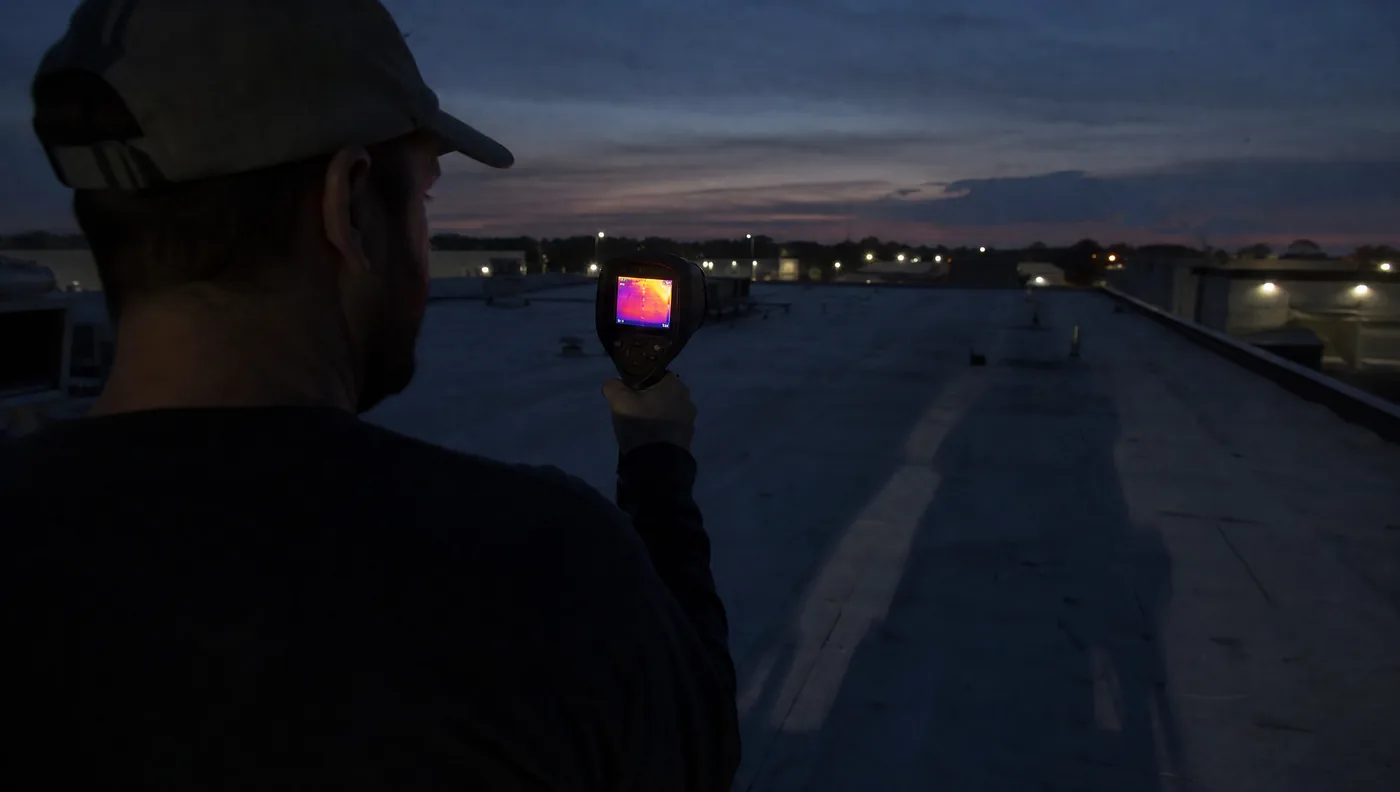
Inspection & Moisture Survey
An infrared survey is flown or walked after sundown, when wet insulation gives back the heat it absorbed all day and lights up against the dry field. It is the only way to know how much of the roof is actually wet.
Budget $500 to $1,000 on a typical commercial building. It is the cheapest money you will spend on the roof, because it is the difference between a targeted repair and replacing forty thousand feet you did not need to replace.
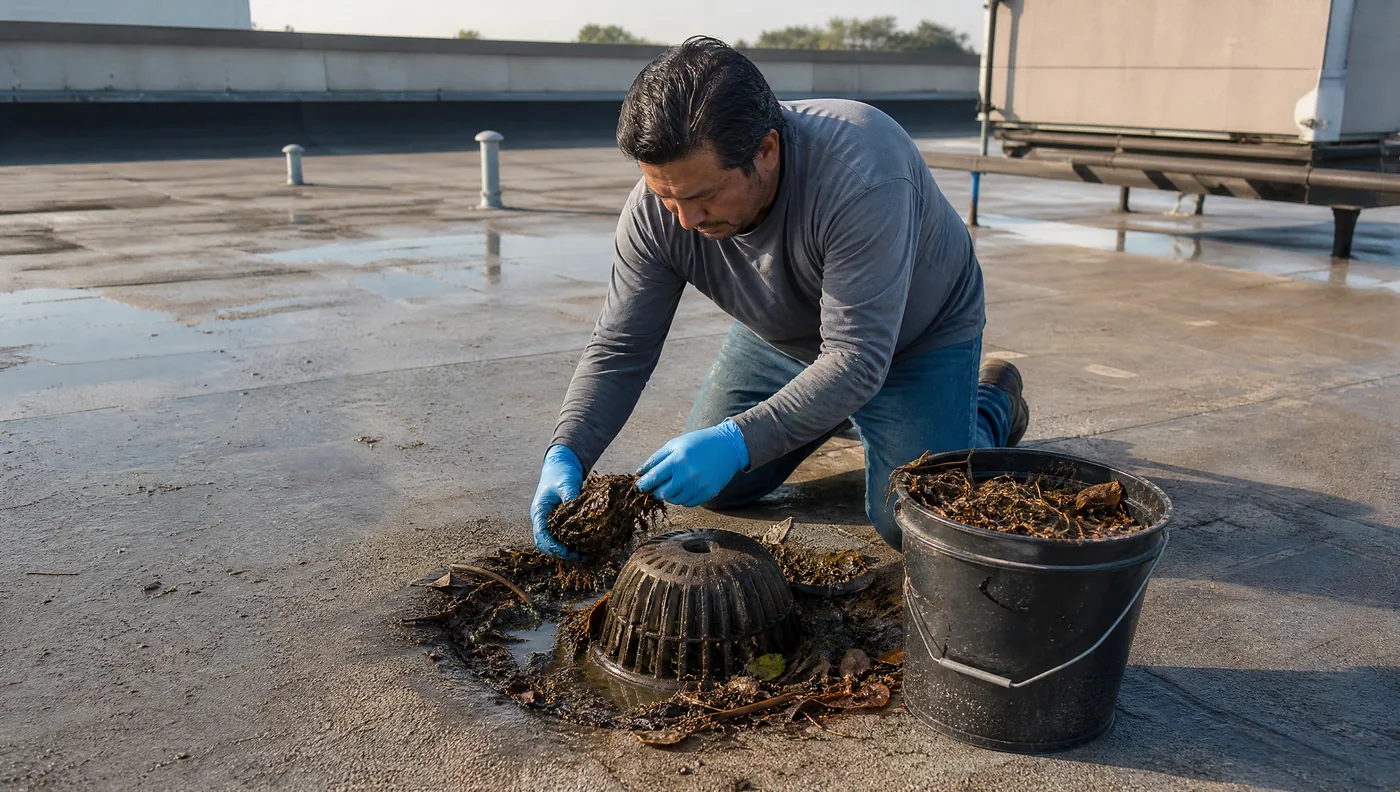
Preventative Maintenance
Twice a year, spring and autumn, either side of hurricane season. Drains and scuppers cleared, seams probed, curb flashings checked, pitch pans topped, debris off, photographs and a written condition report each visit.
The report is half the value. It is a documented maintenance history, which is what your manufacturer warranty requires you to have and what your insurer increasingly wants to see.
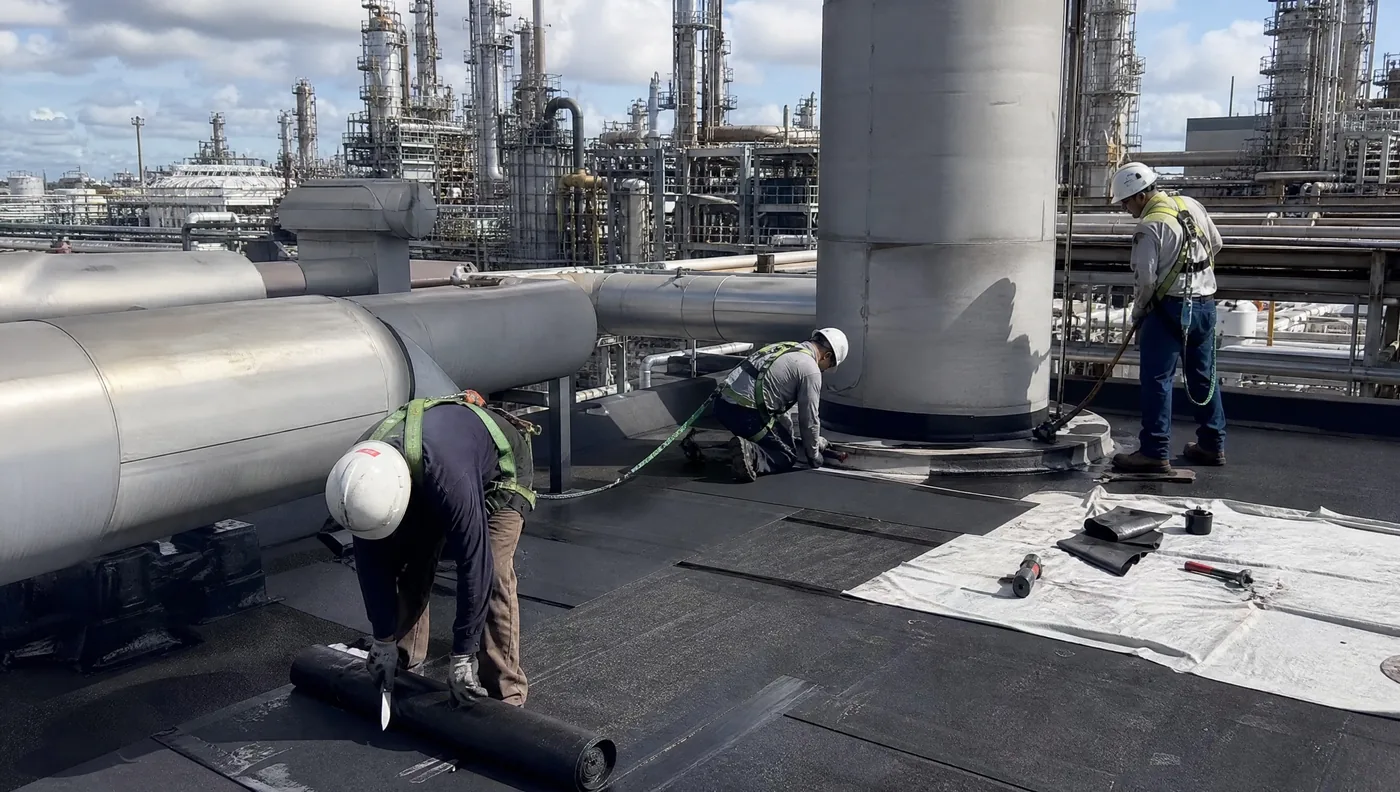
Industrial Roofing
Plants, refineries, tank farms, distribution centres and the office and lab buildings attached to them. Different work: site-specific safety orientation, hot work permits, escorts, contractor management portals, and often a hard rule against open flame anywhere on the property.
Which is why we detail industrial re-roofs in self-adhered and mechanically attached systems rather than torch. It is slower to install and it is the only thing that gets approved on a live process facility.
Numbers worth knowing
Published pricing
What does commercial roofing cost per square foot in Houston?
Commercial roofing in Houston costs between $6.00 and $12.00 per square foot installed for a full replacement, depending on the system. That is the honest range and here is how it breaks down by system rather than as one useless average.
| System | Tear-off & replace | Typical service life | Best suited to |
|---|---|---|---|
| TPO, 60 mil | $6.50 – $10.00 | 20 – 25 yrs | warehouses, retail, most low-slope buildings |
| TPO, 80 mil | $7.50 – $12.00 | 25 – 30 yrs | roofs with heavy equipment and foot traffic |
| PVC, 60 mil | $8.00 – $13.00 | 20 – 30 yrs | restaurants, kitchens, chemical exposure |
| EPDM, 60 mil | $6.00 – $9.50 | 20 – 25 yrs | puncture-prone roofs where reflectivity is not critical |
| Modified bitumen, 2 ply | $7.00 – $11.50 | 18 – 25 yrs | heavy traffic, redundancy, easy field repair |
| Built-up, 4 ply gravel | $8.50 – $13.50 | 20 – 30 yrs | traditional specifications, heavy assemblies |
| Standing seam metal | $11.00 – $19.00 | 40 – 60 yrs | long-hold assets, steeper slopes |
| Silicone restoration coating | $2.25 – $4.75 | 10 – 15 yrs | sound, substantially dry existing roofs |
Ranges collected from Houston-area commercial quotes, supply pricing and contractor discussion in July and August 2026, and cross-checked against published Houston cost guides. They include tear-off, disposal, code-required insulation and a manufacturer warranty. They are ranges, not a quote: the only number that means anything is the one that comes after somebody walks your roof.
What moves a job to the top of its range: deck condition discovered at tear-off, the number of penetrations and curbs, whether the building can take a crane or has to be hoisted, access and staging, night or weekend work to keep a tenant trading, and the insulation you have to add to satisfy the energy code. What moves it to the bottom: a big simple rectangle with few penetrations, good existing deck, daytime access and a single mobilisation.
The full Houston commercial roofing cost breakdown has the repair pricing, the change-order unit rates and a calculator that works off your own square footage.
How it works
What actually happens after you call
Nobody hesitates because they do not know roofs exist. They hesitate because they do not know what they are agreeing to when they let a contractor onto the building. So here it is in order.
-
The call and the survey
Tell us the address, roughly the square footage, what the roof is now and what it is doing. We come out within two business days, or the same day if it is actively leaking. We walk it, we core it where we need to know what is underneath, and we photograph everything.
No charge for this and no obligation attached to it.
-
The written scope, itemised
You get a scope of work that lists the system, the membrane thickness, the insulation R-value, the attachment method, the edge metal, the number of drains and the warranty being registered. Unit rates for deck replacement are stated up front, so rotten deck is a known number rather than a surprise.
Nothing in it says "as needed" or "if required". If we cannot see it, we say so and we price the contingency.
-
Permit, schedule and the work
We pull the City of Houston commercial roofing permit and allow the 10 business days of plan review in the schedule rather than pretending it does not exist. We stage the roof in sections so no part of your building is ever open to weather overnight.
Billing is by milestone against work in place. We do not ask for the majority of the contract before the first roll goes down, and you should be wary of anyone who does.
Before and after
A 34,000 square foot distribution building off Beltway 8
Ballasted EPDM from the early nineties with a decade of patch history on it. The owner had three bids for a full tear-off and asked us for a fourth. The scan changed the answer.
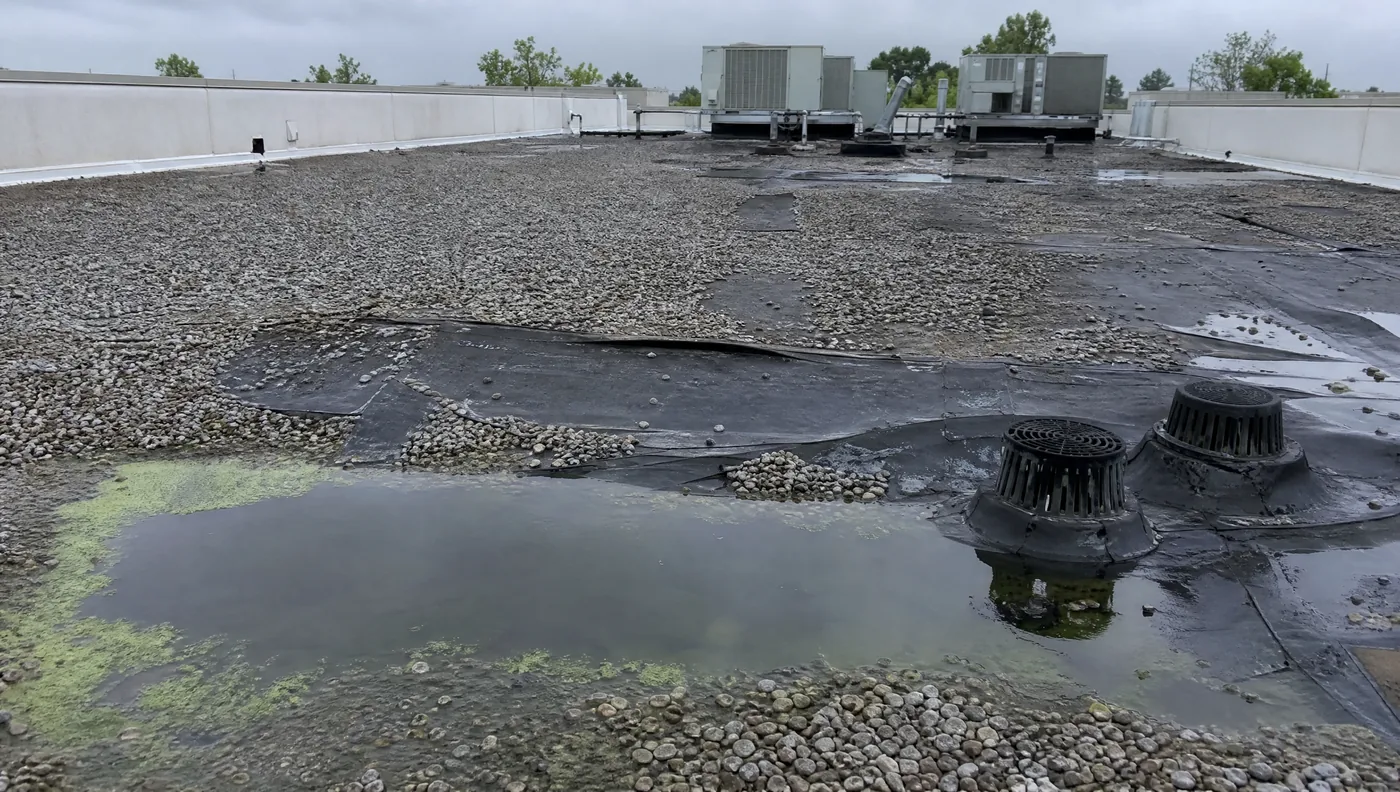
Twelve leaks, four buckets, and nobody knew how much of it was wet
Ballast rock hiding the membrane, seams releasing at the laps, two drains sumped below a field that had settled around them, and a decade of asphalt mastic smeared over everything by whoever came last.
- Ponding held water more than 72 hours after rain at four separate low points
- Infrared survey found saturated insulation over roughly 6,100 square feet, about 18% of the roof, all of it clustered around the two failed drains
- The other 82% of the insulation was dry and the deck under it was sound
- Three bidders had priced a full tear-off without scanning anything
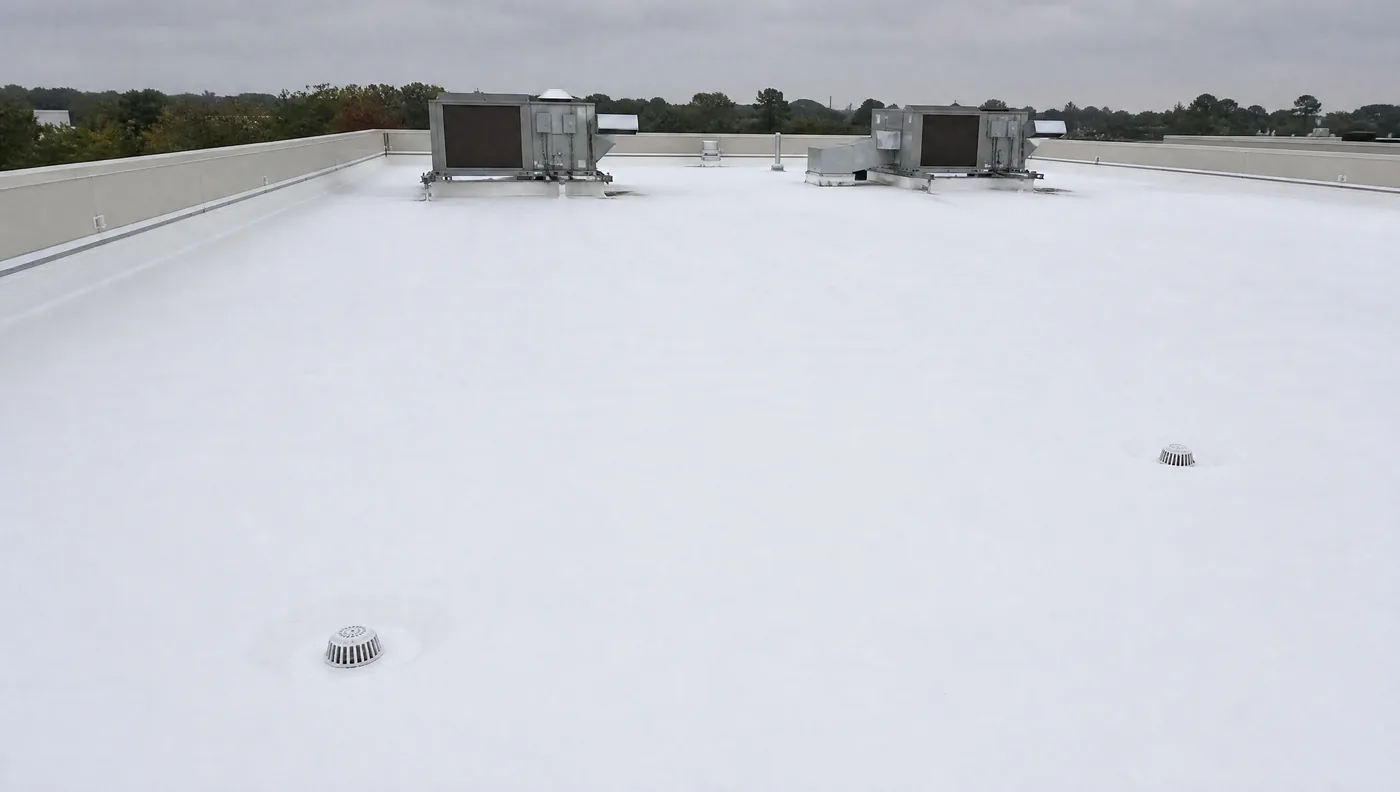
Wet section replaced, drains re-sumped, the rest restored
We cut out and replaced only the saturated 6,100 feet, rebuilt both drain sumps with tapered polyiso and new clamping rings, added crickets behind the two largest curbs, then cleaned and coated the entire field in silicone.
- Came in at a little under half the lowest tear-off bid
- Nine working days instead of six weeks, no disposal skips, no disruption to the dock schedule
- Ponding gone at three of the four low points, fourth reduced to a damp ring
- Fifteen-year manufacturer restoration warranty registered, with the moisture scan filed as the pre-existing condition record
We will show you the thermal images from this job on request. It is the clearest possible argument for scanning before you buy a roof.
Talk to a roofer
Two bids at the same price are not the same roof
Ask both for the membrane thickness, the insulation R-value, the deck unit rates and the draw schedule. Then call us and we will tell you what the answers mean.
Call (281) 720-3785- Published $/sq ft on every service page
- Deck replacement unit rates stated up front
- We pull the City of Houston permit and allow for the review
Worth understanding
The four things Houston building owners get wrong about commercial roofs
Do I need a permit to re-roof a commercial building in Houston?
Yes. The City of Houston requires a commercial roofing permit, HPWCODE1157, for a new roof or an overlay on any commercial structure. Plan review is required, inspection is required, the admin fee is $33.56 on top of the fee schedule amount, processing runs about 10 business days, and the permit is valid for 6 months. A full re-roof uses worksheet CE-1076 and an overlay uses CE-1104, which are different documents because the code treats the two jobs differently.
Almost no roofing website in this market mentions any of that, and the reason is uncomfortable: a lot of commercial re-roofing in Houston gets done without a permit. It is your building and your certificate of occupancy that carries the risk, not the roofer's. We pull it, we schedule around the plan review, and we hand you the closed permit at the end. The full permit and code guide is here.
Why does tearing the old roof off make the new one more expensive?
Because a tear-off triggers the current energy code and an overlay does not. Houston adopted the 2021 International Codes, including the 2021 IECC under Ordinance No. 2023-907, effective January 1, 2024. When you replace a roof assembly with insulation above the deck, that assembly has to come back at the current requirement for climate zone 2A, which is R-25 continuous, roughly about 4.4 inches of polyiso in two staggered layers.
If your building has been running on an inch and a half of old ISO since 1998, that is two and a half extra inches of insulation you did not have. It is not just the material. It raises the roof surface, which means taller edge metal, deeper drain sumps, higher curb extensions and sometimes a door threshold that has to be dealt with. Any bid that does not mention insulation thickness is either recovering rather than replacing, or has not thought about it, and you want to know which.
Is my building east of Highway 146, and why would that matter?
If it is, your roof work needs a TDI windstorm certificate. The Texas Department of Insurance designated catastrophe area covers fourteen coastal counties plus the part of Harris County east of Highway 146, which inside city limits means La Porte, Morgan’s Point, Pasadena, Seabrook and Shoreacres. Structures built or altered on or after January 1, 1988 in that zone need a WPI-8 certificate of compliance to stay eligible for TWIA windstorm coverage.
West of that line, in Houston proper, Katy, Cypress or Sugar Land, none of this applies and anyone telling you it does is selling something. Which side of the line your building sits on is a genuinely consequential fact about it, and it is on each of our city pages because it changes per submarket. From April 1, 2026, WPI-1 applications have to be certified under the 2024 IRC or 2024 IBC.
When is a roof coating a genuinely good idea, and when is it a waste of money?
A coating works when the existing roof is structurally sound and substantially dry, and it is a waste of money when it is not. There is no judgement in that sentence, it is a moisture question with a factual answer, and an infrared survey at $500 to $1,000 answers it.
Coating over wet insulation traps the water permanently. The roof gets heavier, the R-value stays gone, and you have spent real money to make the eventual tear-off worse. People are right to be sceptical of coating salesmen, and the correct response to that scepticism is not a better sales pitch, it is a scan. If more than roughly a quarter of the field comes back wet, we will tell you to replace it.
Straight answers
Questions Houston building owners actually ask
How quickly can you get to an active leak?
Same day for an active leak during business hours, and we answer the phone at night and at weekends during storm season. A dry-in is a different job from a repair: the first goal is to stop water entering the building, and we will do that with membrane and mastic at nine at night if that is what it takes. We keep a truck loaded for exactly this because the distribution buildings we cover out toward Channelview do not stop shipping because it is raining.
Do you work on occupied buildings without shutting the tenants down?
Yes, and on a multi-tenant retail centre it is the default. We stage the roof in sections, dry each section in before the crew leaves, and schedule the noisy work around trading hours. On a Sugar Land retail centre last year we worked the roof in six sections over three weeks so no unit was ever exposed and no tenant lost a trading day. Tell us who is underneath and when they open, and we will build the sequence around it.
What is your payment schedule?
Milestone billing against work in place, with a deposit for materials only.
We say this plainly because it is the single loudest complaint in every commercial roofing discussion we have ever read. Bids that want 85% of the contract before the first roll of membrane goes down are asking you to finance their business, and if they run into trouble on another job it is your money that is gone. Ask every bidder for their draw schedule in writing and compare those alongside the prices, because two identical numbers with different payment terms are not the same offer.
How do I compare two roofing bids that are the same price?
Compare the specification, not the total. Six things decide it: membrane thickness in mils, insulation R-value and thickness, attachment method, the deck-replacement unit rate, what the warranty actually covers and for how long, and the draw schedule. Two bids at $9 a foot where one is 45 mil over existing insulation and the other is 60 mil over new R-25 polyiso are not remotely the same roof. We publish our unit rates for exactly this reason. Deck replacement alone typically runs around $100 a sheet for plywood and $35 a linear foot for structural members, and a bid that leaves that blank has left your budget open-ended.
Does hail actually damage a flat membrane roof? It looks fine.
Yes, and it usually does look fine, which is the problem. Hail on a single-ply membrane fractures the reinforcing scrim underneath the surface without breaking through it. The roof passes a walk-and-look inspection and then fails in eighteen months at the fracture points. This is why post-storm documentation matters so much: we core-sample and photograph, so if a Deer Park plant roof took a bad cell in the spring there is a dated record when it starts leaking the following year.
Are you licensed?
Texas does not license roofing contractors, so no roofer in this state can honestly answer yes to that question, and a number on a website means nothing. What you can check is real: our certificate of liability and workers' compensation, sent directly from our carrier rather than as a PDF we email you, our manufacturer certifications with GAF, Carlisle and Johns Manville, which are the credentials that let us register a full-system warranty at all, and any WPI-8 certificates we have pulled, which are public and searchable at TDI.
Will you tell me if my roof does not need replacing?
Regularly, and it is most of what an infrared survey is for. Roughly a third of the buildings we get called out to on a replacement enquiry turn out to need a targeted repair and a maintenance programme instead. We would rather have a maintenance contract on your Humble distribution building for the next twelve years than sell you one roof you did not need and never hear from you again.
Where we work
Commercial roofing across the Houston metro
We run out of a yard and a materials trailer, not a showroom, so we publish the submarkets we cover instead of a street address. Nobody buys a 40,000 square foot roof by walking into a lobby. Our submarkets run from the inner loop out to the Ship Channel, the Energy Corridor, the 249 and 290 corridors and the I-45 north spine.
Talk to a roofer
Commercial roofing in Houston, from a company that only does commercial roofing
Call and describe the building. Two minutes on the phone tells us whether you need a crew today, a survey next week, or just some advice.
Call (281) 720-3785- A roofer picks up, not a call centre
- Line-item written scope before anything is torn off
- Progress billing tied to milestones, never 85% up front