
Storm, hail & wind · Houston
Commercial Roof Storm & Hail Damage in Houston, TX
Hail damage on a commercial membrane roof does not look like damage. There is no hole and nothing is leaking, and eighteen months later the roof fails at every point the hail hit. This is the single most misunderstood thing in commercial roofing.
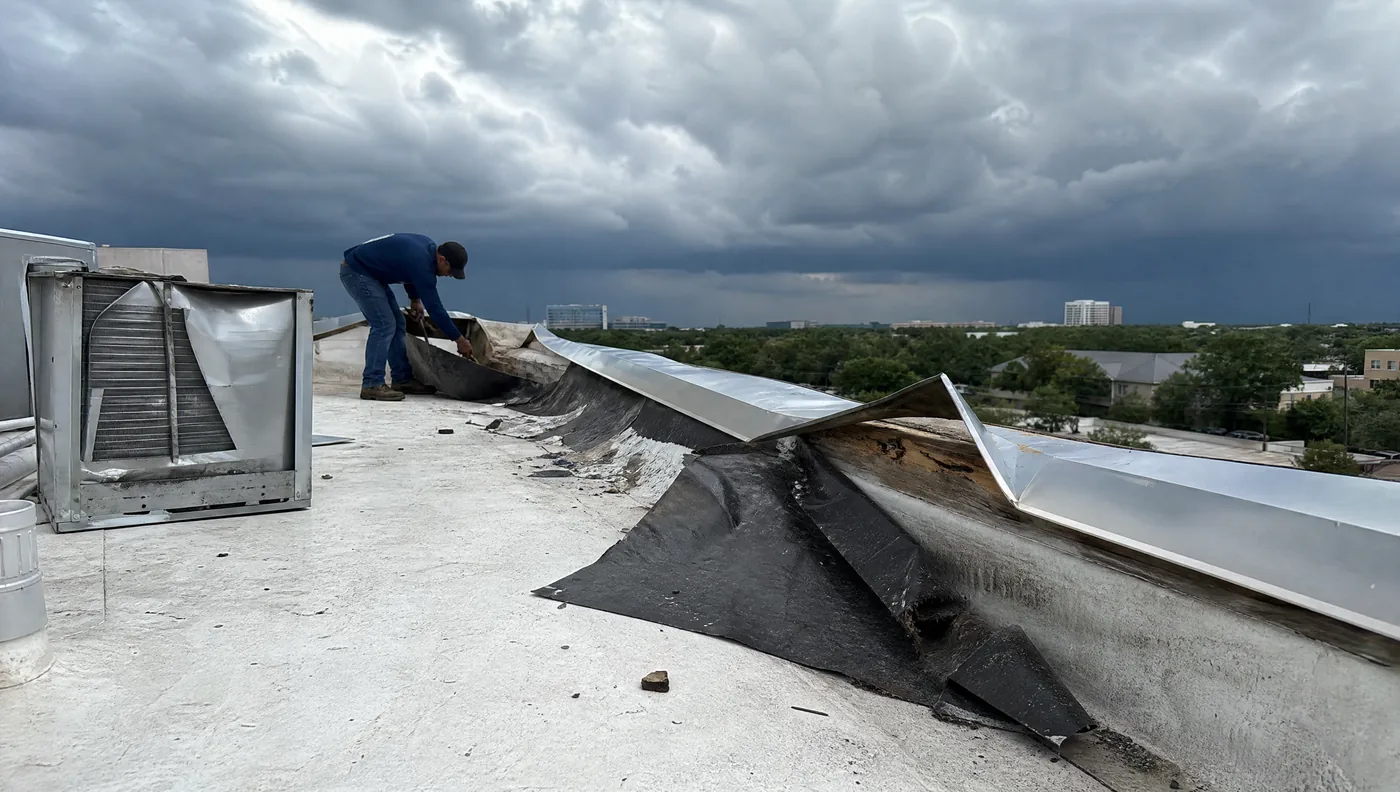
Storm damage on a low-slope commercial roof takes three forms: hail bruising that fractures the membrane's reinforcement without breaking the surface, wind uplift that starts at the perimeter and works inward, and impact damage from debris. Only the third is obvious from the ground.
Houston took two serious wind events eight weeks apart in 2024. The May 16, 2024 derecho put straight-line winds through the centre of the city hard enough to blow curtain-wall glass out of downtown high rises, and Hurricane Beryl arrived on July 8, 2024 with a 84 mph gust recorded at Houston Hobby and more than six billion dollars of damage across the region.
Hail on a membrane
Why hail damage on a flat roof is invisible
On a shingle roof, hail knocks granules off and leaves a visible bruise. On a single-ply membrane, hail transmits an impact through the surface into the reinforcing scrim underneath and fractures it, leaving the surface intact.
The roof then passes every visual inspection anybody performs. It does not leak. The adjuster walks it and finds nothing. Twelve to twenty-four months later the fractured points open up under thermal cycling and the roof begins leaking at dozens of locations at once, and by then the claim window has closed and the storm is ancient history.
How it is actually found:
- Core cuts through impact points. Take a plug, look at the scrim from the underside, and the fracture is unmistakable. This is the definitive test and it is why we core rather than walk.
- Test squares. A statistically representative marked area, typically ten foot by ten foot, examined in detail, with the hit count recorded. This is what adjusters expect to see and it is how the extent gets extrapolated across the roof.
- Insulation impressions. On a mechanically attached membrane, hail of any size dents the insulation board underneath, and lifting a section shows the pattern clearly.
- Collateral evidence. Dented condenser fins, dented gutters and downspouts, spatter marks on the pipe boots and rooftop equipment. This is what establishes that a hail event actually reached your roof, and it is frequently the thing that gets a claim taken seriously.
On a built-up or modified bitumen roof hail behaves differently again: it fractures the surfacing and displaces the granules or aggregate, which accelerates UV degradation without breaking through. Same principle, same invisibility, same delayed failure.
Wind damage
Wind damage, and why it always starts at the edge
Wind does not push a roof off. It lifts it, and the lift is several times greater at the corners and along the perimeter than it is in the middle of the field.
That is why fastening patterns are denser at the corners and perimeter, and why the edge metal specification matters so much. The ANSI/SPRI ES-1 standard for roof edge systems exists because edge failure is one of the most common initiating events in commercial roof wind loss: wind gets under a coping cap or a drip edge, peels it back, and then has an open edge of membrane to work on. From there it unzips.
What to look for after a wind event:
- Coping caps, drip edge or gravel stop lifted, buckled or missing entirely.
- Membrane billowing or fluttering in the field, which means the attachment beneath it has released even though nothing is visibly torn.
- Seams opened at the perimeter.
- Insulation fasteners pulled through, visible as tenting or as loose plates.
- Rooftop units shifted on their curbs, which breaks the flashing seal even where the unit looks fine.
- Debris impact punctures, most commonly from other people's roof material.
The wind exclusion in your warranty
Most single-ply manufacturer warranties exclude damage from wind above a stated speed, commonly between 55 and 72 mph depending on system and attachment. Beryl's 84 mph gust at Houston Hobby is comfortably above that. In practice this means a manufacturer can decline a claim by attributing a failure to wind, including failures that were really workmanship. Know your warranty's stated wind speed before you need it, and specify an enhanced-wind system on exposed buildings.
Talk to a roofer
Storm came through and the roof looks fine?
On a membrane roof that means very little. We will core it, mark test squares and give you a dated evidence package, whether or not you end up claiming.
Call (281) 720-3785- Core samples and marked test squares, not a walk-and-look
- Dated photographic package you keep either way
- We never touch your deductible, and Texas law is why
Damage assessment
What to look for after a Houston storm, by roof type
Different systems fail differently and the visible symptom is different on each. This is what we are checking for when we walk a roof after an event.
| Roof system | Hail signature | Wind signature | How it is confirmed |
|---|---|---|---|
| TPO / PVC single-ply | no surface damage, fractured scrim beneath | seam separation at perimeter, billowing field | core cut through impact points |
| EPDM | circular bruising, occasional puncture | lifted at terminations and edges | core cut, seam probe |
| Modified bitumen | granule displacement, surface fracture | lap separation, cap sheet lifting | test square, granule loss in gutters |
| Built-up gravel | aggregate displacement, felt bruising | gravel scour, blow-off at edges | spudded test square |
| Metal panel | visible denting, coating fracture | panel lift at eave and ridge, closures gone | visual, fastener check |
| Any system | dented condensers, gutters, pipe boots | displaced rooftop units, missing coping | collateral damage survey plus NWS event record |
Assessment method reflects standard commercial claim practice: a marked test square with a recorded hit count, plus core cuts, plus collateral damage on rooftop equipment to establish that the event reached the building. A visual walk alone on a single-ply roof will find nothing, which is why so much hail damage on commercial roofs goes unclaimed.
Documentation
Documenting it so the claim survives contact with an adjuster
The difference between a paid claim and a denied one is almost always the quality and the timing of the documentation, not the severity of the damage.
- Report it promptly. Policies carry notice requirements and delay is the easiest reason to deny.
- Establish the weather event. Date, hail size and wind speed at your specific address, from NWS records rather than from memory. This is the anchor for everything else.
- Photograph everything, dated. Overall roof, each elevation, each test square, each core, the collateral damage on equipment and gutters, and any interior damage.
- Core sample. The only proof of scrim fracture that survives an argument.
- Get the pre-storm condition on record. This is where maintenance clients are at an enormous advantage. If we have been photographing your roof twice a year, there is a dated record of what it looked like before, and the "pre-existing damage" argument evaporates.
- Be present for the adjuster's inspection. Walk it with them. An adjuster looking at a membrane roof without cores will find nothing, and they are not being difficult, there is genuinely nothing visible.
We produce this package as standard on any storm call. We are roofers rather than public adjusters and we do not negotiate your claim for you, and we will supply the technical evidence that a claim is built on.
On storm-chasing contractors
After every major Houston storm the city fills with out-of-state crews. Some are competent. The pattern to watch for is a contractor who wants to sign a contingency agreement before anybody has assessed anything, who offers to handle the whole claim for you, or who suggests any arrangement involving your deductible. Under Texas law it is an offence for a contractor to pay, waive, absorb or rebate an insurance deductible, and a contractor offering to do it is telling you exactly how they run a business.
Roof age and insurance
Roof age is now the first thing your insurer looks at
Texas commercial property insurers have moved to treating roof age as a primary underwriting factor rather than one input among many. That shows up as higher premiums, separate and much larger wind and hail deductibles, actual-cash-value settlement instead of replacement cost on older roofs, and in some cases declining to quote at all.
Two practical consequences.
First, a documented roof is worth more than an undocumented one of the same age. If you can produce a maintenance history, a moisture survey and a record of repairs, you are arguing from evidence. If you cannot, the underwriter assumes the worst case, and the worst case for a twenty-year-old roof in a hail market is expensive.
Second, the economics of restoration change. A coating or restoration system that resets the roof's effective condition, with documentation, can be worth more in insurance terms than its cost, quite apart from the leaks it prevents. More on restoration here.
Ask your broker specifically what your wind and hail deductible is as a percentage of insured value, because on a commercial policy it is frequently a percentage rather than a flat sum, and on a large building that number surprises people badly at exactly the wrong moment.
Buildings we cover
Storm and hail damage assessment across the Houston metro:
Commercial roofing in Bellaire, Stafford commercial roofing, commercial roofers in Pasadena, Channelview, TX, Commercial roofing in Humble, Deer Park commercial roofing, commercial roofers in Katy, Sugar Land, TX, Commercial roofing in Cypress, Spring commercial roofing, commercial roofers in La Porte, Baytown, TX, Commercial roofing in Tomball, and The Woodlands commercial roofing and every submarket we work.
Related work
Straight answers
Questions we get on this specifically
How long do I have to file a hail claim?
Check your policy, and do not rely on the general answer. Texas policies carry notice requirements and statutory limitation periods apply, but the practical constraint is different and tighter: the longer you wait, the harder it is to establish that a specific storm caused the damage rather than age or a later event. On a commercial membrane roof, where the failure surfaces a year or more after the storm, that argument is the whole fight. Get it assessed and documented soon after the event even if you do not file, because the dated evidence is what preserves your position.
My adjuster says there is no damage. Is he wrong?
He may be looking correctly and seeing nothing, because on a single-ply roof there genuinely is nothing to see from the surface. The answer is not to argue, it is to core. A plug showing fractured reinforcement is physical evidence and it changes the conversation completely. Ask for a re-inspection with cores taken, and be there for it.
Should I sign with the roofer who knocked on the door after the storm?
Not on the day, and not before anybody has assessed the roof. Read what you are signing very carefully: contingency agreements sometimes bind you to that contractor for whatever the insurer eventually pays, regardless of whether you like the price or the workmanship. A contractor who is genuinely local will still be here next year when the warranty matters, and can show you commercial buildings in Houston you can go and look at. Ask for three addresses and go and look.
Does hail damage affect my roof warranty?
Almost always excluded from the manufacturer warranty as an act of nature, which is what your insurance is for, and this is where the two interact badly. Undocumented hail damage that later causes a failure can also give a manufacturer grounds to decline a warranty claim on the basis that the failure was storm-caused rather than a material defect. Documenting a storm event even when nothing is leaking protects both positions at once, which is the strongest single argument for getting the roof looked at after every serious event.
Talk to a roofer
Want a number on this roof?
Call and describe the building. If it needs a survey we will come and walk it, and there is no charge for that whether or not you use us.
Call (281) 720-3785- A roofer picks up, not a call centre
- Line-item written scope before anything is torn off
- Progress billing tied to milestones, never 85% up front