
Preventative maintenance · Houston
Commercial Roof Maintenance in Houston, TX
Every manufacturer warranty on your roof requires documented maintenance. Almost nobody does it, and almost nobody finds out until they try to claim.
A commercial roof maintenance programme in Houston costs roughly 6 to 14 cents per square foot per year and includes two scheduled visits, drains and scuppers cleared, seams and details inspected and probed, minor repairs made on the spot, and a photographed written condition report each time.
On a 30,000 square foot warehouse that is somewhere between $1,800 and $4,200 a year against a roof worth two to three hundred thousand to replace. The case is not subtle, and the reason it still gets skipped is that nothing visible happens when it works.
What a visit includes
What actually happens on a maintenance visit
Two visits a year, spring and autumn, either side of hurricane season. Each visit is a half day to a day depending on the size of the roof.
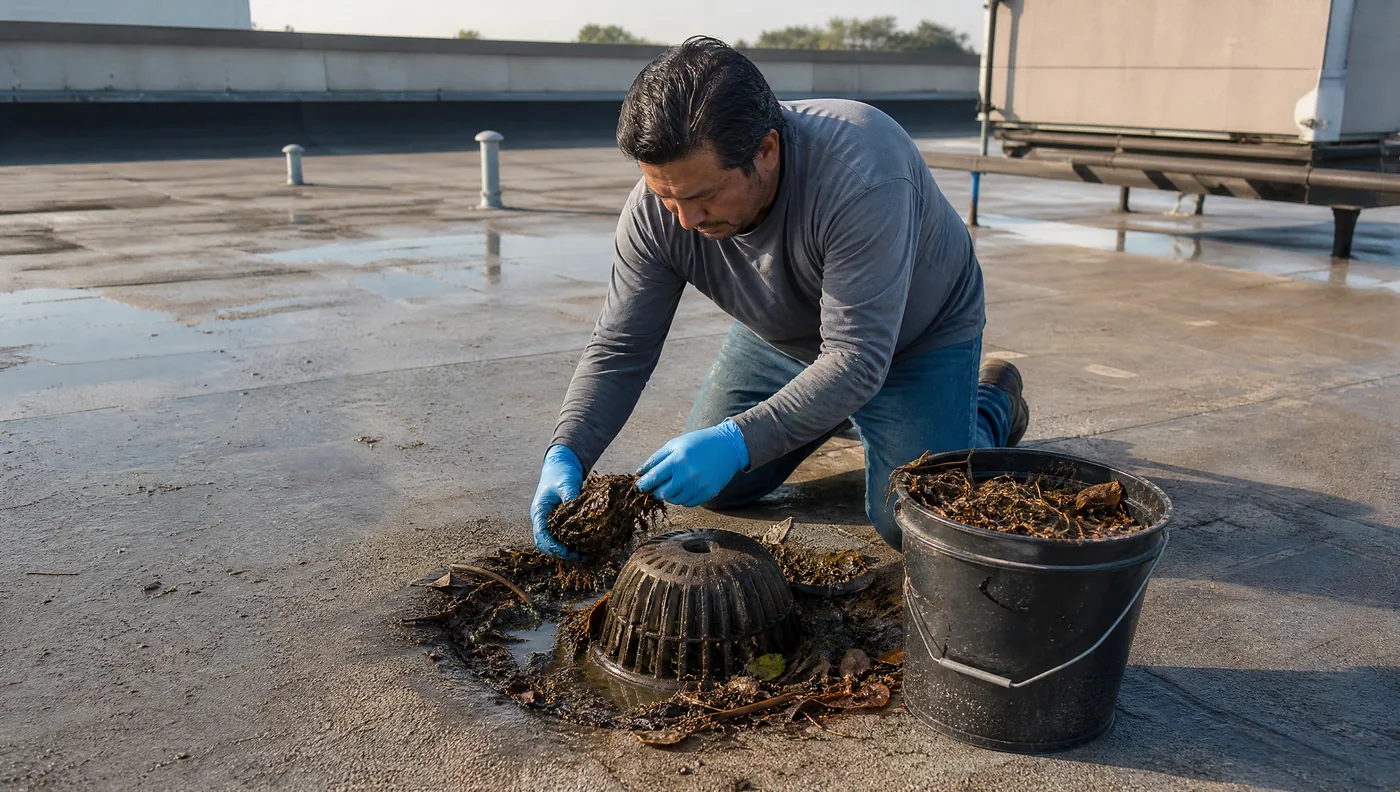
- Drains, strainers, scuppers and gutters cleared. The highest-value task on the list by a distance and the one most often not done at all.
- Debris removed. Everything from leaves and packaging to abandoned conduit, offcuts and whatever the last contractor left up there.
- Vegetation removed at the roots, before roots find a seam. Vegetation on a Houston flat roof grows faster than people believe.
- Seams and laps probed in a systematic pattern, with anything found marked, photographed and either repaired on the visit or quoted.
- Every penetration, curb and pitch pan checked. Pitch pans topped up, which is a five-minute job that prevents a very common leak.
- Perimeter, coping and counterflashing checked for wind damage and loose fixings.
- Minor repairs made on the spot. Small punctures, loose terminations, sealant renewal. Included up to an agreed allowance rather than quoted separately, which is what stops small things becoming projects.
- Photographed written report. Same format every time so the comparison across visits is meaningful.
The report is half the value of the programme, and the reason is in the next section.
The warranty problem
The warranty condition nobody reads
Manufacturer roof warranties require the roof to be maintained and, in most cases, require you to be able to produce evidence of it. They also require that any new penetration is flashed by an approved contractor.
Both of those get breached routinely, and they get discovered at the worst possible moment, which is when you have a failure and you are trying to claim on a twenty-year warranty in year eleven.
The penetration one is worth spelling out because it is so common. A tenant fit-out goes in, the mechanical contractor puts three new curbs through the roof, nobody tells the roofer, and the flashing is done by somebody whose trade is sheet metal for ductwork rather than roofing. Every one of those is now both a likely leak and a documented reason for the manufacturer to decline the whole warranty. This is a widely discussed problem in commercial facilities management and one frequently cited industry case put the cost of a single uncoordinated rooftop installation at $85,000 in lost coverage.
The one-line fix
Put a clause in every rooftop contractor's scope of work requiring your roofing contractor to make or approve any roof penetration, at the tenant's or contractor's cost. It costs you nothing, it takes one sentence, and it closes the single largest hole in commercial roof warranty compliance. Our maintenance clients get told this on day one and it is the most useful thing on the list.
Talk to a roofer
Put the roof on a schedule instead of a crisis
Two visits a year, drains cleared, defects caught small, and a photographic record that keeps your warranty enforceable and your insurer reasonable.
Call (281) 720-3785- Twice-yearly visits with a written photographic report
- Minor repairs included up to an agreed allowance
- Priority scheduling when everybody calls at once
Programme pricing
What a roof maintenance programme costs in Houston
Annual cost, two visits included, minor repairs up to the stated allowance included. Priced per square foot of roof area, which is how it should be quoted and frequently is not.
| Roof area | Annual cost | Per sq ft / yr | Minor repair allowance included |
|---|---|---|---|
| Under 10,000 sq ft | $950 – $1,600 | $0.10 – $0.16 | $500 |
| 10,000 – 25,000 sq ft | $1,400 – $2,900 | $0.09 – $0.14 | $750 |
| 25,000 – 50,000 sq ft | $2,200 – $5,000 | $0.07 – $0.11 | $1,200 |
| 50,000 – 100,000 sq ft | $3,800 – $8,500 | $0.06 – $0.09 | $2,000 |
| Over 100,000 sq ft | by survey | $0.05 – $0.08 | by agreement |
| Multi-building portfolio | by survey | 10 – 20% below single-site | pooled across the portfolio |
| Additional visit, ad hoc | $450 – $1,100 | – | – |
| Pre-storm check, maintenance clients | included | – | drains, loose material, dated photo record |
Ranges from our own 2026 programme pricing across greater Houston. Larger roofs cost less per square foot because mobilisation is a fixed cost spread over more area, which is also why portfolio agreements price better than single buildings.
Seasonal
Hurricane season, and the calendar we work to
The Atlantic hurricane season runs from 1 June to 30 November and Houston's exposure is real. The maintenance calendar is built around it.
- March to May, pre-season visit. Drains cleared, loose edge metal and coping secured, anything that can become a projectile removed or fixed down, pre-season photographic record taken. This last item is the one that pays.
- When a system enters the Gulf. We run pre-storm checks for maintenance clients: drains, loose material, and a dated photo set. Priority scheduling afterwards goes to maintenance clients first, which is not a sales line, it is simply how the call list gets ordered when everybody phones on the same morning.
- Post-event inspection. After any named storm or serious hail, whether or not anything is leaking.
- October to November, post-season visit. Full inspection, storm damage assessment, and the winter repair list agreed while there is still budget in the year.
The pre-storm photographic record deserves emphasis. Every post-hurricane claim argument in this city is about what was already damaged before the storm. If you have a dated set of photographs from six weeks earlier, that argument is over before it starts.
What it is worth
What the programme is actually worth
The industry rule of thumb is that a maintained commercial roof lasts substantially longer than an unmaintained one, and our own experience is that the gap is about a quarter to a third of the service life. On a twenty-year roof that is five to seven extra years for a few cents a foot a year.
But the strongest argument is not longevity, it is the four things a maintenance history buys you that money cannot buy retrospectively:
- Your manufacturer warranty stays enforceable.
- You have dated pre-storm evidence when you need to claim.
- Your insurer is looking at a documented roof rather than assuming the worst about an undocumented one.
- You get eighteen months of warning before a capital expense instead of a phone call on a Friday afternoon.
That last one is what facilities managers actually value. Nobody minds spending money on a roof. They mind spending it in a quarter they had not planned for.
Buildings we cover
Roof maintenance programmes across the Houston metro:
Commercial roofing in Bellaire, Stafford commercial roofing, commercial roofers in Pasadena, Channelview, TX, Commercial roofing in Humble, Deer Park commercial roofing, commercial roofers in Katy, Sugar Land, TX, Commercial roofing in Cypress, Spring commercial roofing, commercial roofers in La Porte, Baytown, TX, Commercial roofing in Tomball, and The Woodlands commercial roofing and every submarket we work.
Related work
Straight answers
Questions we get on this specifically
Can my own maintenance team do this?
Some of it, and the parts they can do are worth doing. Clearing drains, removing debris and reporting what they see are all reasonable in-house tasks if they have proper fall protection and know what not to step on. What we would not ask an in-house team to do is probe seams, repair membrane or work on anything under warranty, because a well-meaning repair with the wrong material voids coverage. A sensible split is your team on housekeeping monthly, us on the technical visits twice a year.
What if you find something major on a maintenance visit?
You get told the same day with photographs, a recommendation and a budget figure, and nothing gets done beyond the included allowance without your authorisation. We are not going to find a $40,000 problem and start work on it because we were on the roof anyway. Most visits find two or three small things that get fixed inside the allowance and never become anything.
Do you maintain roofs you did not install?
Yes, most of them. We survey it first so we know what we are taking on and so there is a documented starting condition, and if there are existing defects we will list them and price them separately rather than quietly inheriting them. We will also tell you honestly if a roof is too far gone for maintenance to be a sensible spend, which happens and is better said at the start.
Is this worth it on a building I am selling in two years?
Arguably more so, because roof condition is going to come up in due diligence and you would rather be handing over a maintenance file than arguing about a survey the buyer commissioned. A documented, maintained roof is a materially easier item in a sale than an undocumented one of exactly the same age, and two years of maintenance costs considerably less than the price chip a buyer's roof consultant will ask for.
Talk to a roofer
Want a number on this roof?
Call and describe the building. If it needs a survey we will come and walk it, and there is no charge for that whether or not you use us.
Call (281) 720-3785- A roofer picks up, not a call centre
- Line-item written scope before anything is torn off
- Progress billing tied to milestones, never 85% up front